The Cultural Heritage Administration's act of establishing the 'Comprehensive Plan for the Preservation and Management of Pungnap Toseong' and designating the area around Pungnap Toseong in Songpa-gu, Seoul, as a preservation and management zone through a public notice was dismissed in a jurisdictional dispute filed by Songpa District Office, which claimed that this infringed on local autonomy.
The reason was that the Administrator of the Cultural Heritage Administration is not a national institution established by the Constitution and therefore lacks the capacity to be a party in a jurisdictional dispute.
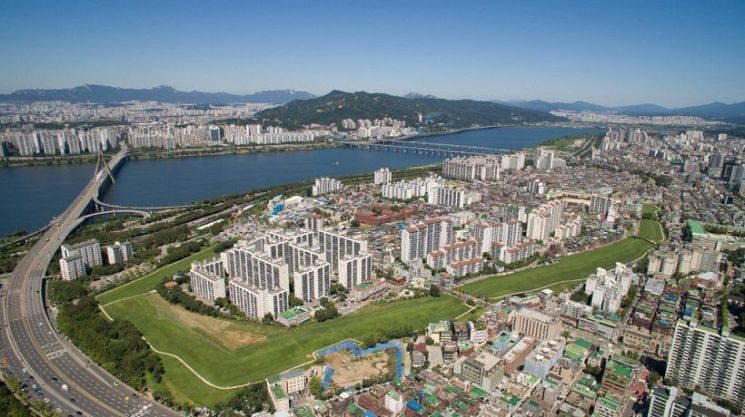 Panoramic view of the Pungnap Toseong archaeological site. Photo by Songpa District Office [Image source=Yonhap News]
On the 21st, the Constitutional Court unanimously dismissed the jurisdictional dispute petition filed by Songpa District Office against the Administrator of the Cultural Heritage Administration with the participation of all eight justices in the deliberation.
A dismissal means that the case is concluded without substantive judgment because the petition does not meet the requirements to file a constitutional trial.
The Constitutional Court first cited a previous decision regarding the capacity to be a party in a jurisdictional dispute, stating, "Article 111, Paragraph 1, Subparagraph 4 of the Constitution stipulates as one of the matters under the jurisdiction of the Constitutional Court 'jurisdictional disputes between national institutions, between national institutions and local governments, and between local governments,' but it does not provide any regulations on the types or scope of national institutions that can be parties to jurisdictional disputes, nor does it delegate this to be determined by law."
It continued, "Therefore, whether a national institution can be a party to a jurisdictional dispute under Article 111, Paragraph 1, Subparagraph 4 of the Constitution should be judged comprehensively by considering whether the institution is established by the Constitution, whether it is granted independent authority by the Constitution and laws, and whether there are appropriate institutions or methods to resolve disputes over authority. A national institution established solely by law, whose existence and scope of authority are determined by legislative acts of the National Assembly, cannot be regarded as a 'national institution established by the Constitution and granted independent authority by the Constitution and laws.'"
Furthermore, the Court stated, "The Cultural Heritage Administration and its Administrator are institutions and heads under the Minister of Culture, Sports and Tourism, one of the administrative departments, established pursuant to Articles 36(3) and 36(4) of the Government Organization Act, with their establishment based solely on law, and as a result, their existence and scope of authority are determined by legislative acts of the National Assembly. Therefore, the Cultural Heritage Administration, the respondent in this case, cannot be considered a 'national institution established by the Constitution and granted independent authority by the Constitution and laws.'"
Pungnap Toseong was designated as Historic Site No. 11, a nationally designated cultural property, in 1963. In 1997, after Baekje-era artifacts were excavated inside the fortress walls of Pungnap Toseong, views emerged through several excavations that Pungnap Toseong was the capital city Wirye-seong of Baekje. Consequently, Songpa District Office established a basic plan for the preservation, management, and utilization of Pungnap Toseong in 2002.
Despite efforts to harmonize the preservation of Pungnap Toseong and the guarantee of residents' living areas through amendments to the basic plan in 2009 and 2015, sufficient results were not achieved. Therefore, on June 9, 2020, the National Assembly enacted the 'Special Act on the Preservation and Management of Pungnap Toseong,' which came into effect in June 2021.
According to the Special Act, the Administrator of the Cultural Heritage Administration must establish a comprehensive plan for the preservation and management of Pungnap Toseong every five years, consulting in advance with heads of related central administrative agencies, provincial governors, and mayors, county heads, and district heads. The comprehensive plan must include the basic direction for preservation and management of Pungnap Toseong, designation, change, or cancellation of preservation and management zones, guarantee of residents' property rights and promotion of resident support projects, securing financial resources for preservation and management projects, and other necessary matters for the preservation and management of Pungnap Toseong.
Songpa District Office requested a meeting with the Administrator of the Cultural Heritage Administration on October 14 last year to exchange opinions on the comprehensive plan for the preservation and management of Pungnap Toseong, but the meeting did not take place. Subsequently, on October 24 and November 30 last year, Songpa District Office submitted opinion letters to the Administrator explaining that the prolonged delay in the Pungnap Toseong maintenance project caused deterioration and slumification of the residential environment, serious property damage to residents, distrust in cultural heritage policies, and requested the lifting of building regulations in areas other than the core zone when establishing the comprehensive plan.
In the opinion letters, Songpa District Office argued that the buildings in Pungnap-dong, built in the 1980s, rapidly aged, worsening the residential environment and increasing residents' suffering and accident risks, thus necessitating the lifting of building regulations. They also claimed that residents of Pungnap-dong have faced significant restrictions on exercising property rights due to cultural heritage regulations lasting over 20 years.
They further proposed designating the presumed fortress wall area as a preservation and management zone but lifting the designation for the residential area inside the fortress, allowing construction within 2 meters underground in Zone 3, and lifting regulations such as trial excavation and excavation investigations for construction in Zone 5.
However, on January 27 this year, the Cultural Heritage Administration established the 'Comprehensive Plan for the Preservation and Management of Pungnap Toseong' pursuant to the Special Act, and on February 1, through a public notice by the Cultural Heritage Administration, designated the area of Pungnap-dong, Songpa-gu, Seoul, as a preservation and management zone.
As Songpa District Office's opinions were not reflected in the establishment of the comprehensive plan and the area was designated as a preservation and management zone, Songpa District Office filed a jurisdictional dispute petition claiming that the acts of the Administrator of the Cultural Heritage Administration infringed on Songpa District Office's local autonomy and sought confirmation and cancellation of the infringement of authority for each act.
A Constitutional Court official stated, "This case reaffirmed the precedent interpretation that the scope of national institutions that can be parties to jurisdictional disputes does not include national institutions established solely by law, whose existence and scope of authority are determined by legislative acts of the National Assembly."
© The Asia Business Daily(www.asiae.co.kr). All rights reserved.

![Clutching a Stolen Dior Bag, Saying "I Hate Being Poor but Real"... The Grotesque Con of a "Human Knockoff" [Slate]](https://cwcontent.asiae.co.kr/asiaresize/183/2026021902243444107_1771435474.jpg)














