Threats Including Hitting Elevator Door When Meeting
Court: "10 Million Won Fine Following Official Disciplinary Procedures"
As "random crimes" cause social unrest, concerns are also rising that if the issue of noise between floors is left unaddressed, it could lead to serious crimes.
Amid this, a government official who, unable to endure noise from the upstairs neighbors, went to their door and kicked the front door in a threatening manner was sentenced to a fine.
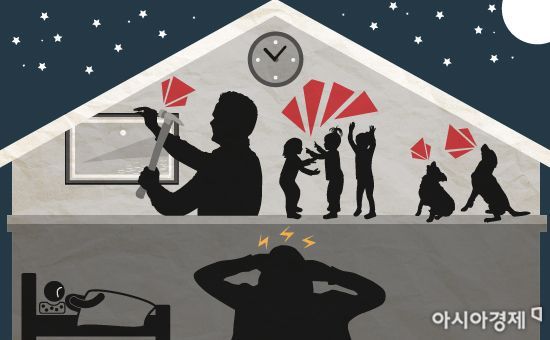 Mr. A was indicted on charges of causing distress to Ms. B (53, female), who lives upstairs in an apartment in Sejong City, by kicking the front door with his foot and repeatedly knocking on it with his fist around 10 p.m. on March 20 due to noise complaints between floors. The next day, when he encountered Ms. B in the elevator, he struck the elevator door with his fist, exhibiting aggressive behavior. Photo by Asia Economy
According to the legal community on the 20th, Judge Cha Ho-seong of the Daejeon District Court Criminal Division 9 sentenced A (54) to a fine of 100,000 won for violating the Minor Offenses Act. A was charged with kicking the front door of B's (53, female) apartment upstairs in Sejong City around 10 p.m. on March 20 due to noise between floors, repeatedly knocking with his fists, and when he encountered B in the elevator the next day, he punched the elevator door, causing B to feel anxious. On April 1 around 7 p.m., he again went to B's apartment and kicked the front door and knocked several times with his fists.
A's side claimed, "This occurred during a passive protest against the noise caused by the victim, and there was a 'justifiable reason,'" but the first-instance court rejected this, stating, "Even if certain noise is transmitted inside the apartment building, it cannot be definitively concluded that it originated from the apartment directly above, and there is no objective evidence to confirm that it is socially unacceptable to the extent claimed."
The court stated, "The victim likely felt considerable anxiety due to the defendant's actions, and the defendant still shows an attitude of shifting responsibility to the victim," adding, "However, considering that disciplinary procedures have been initiated against the defendant, who is a public official, and that the victim does not wish for punishment," explaining the sentencing rationale.
The Minor Offenses Act stipulates that without justifiable reason, blocking the road, provoking disputes, or using harsh words or actions to intimidate others causing anxiety can be punished by a fine or penalty not exceeding 100,000 won or detention.
86% of Residents Say “If Noise Between Floors Decreases, They Are Willing to Pay More”
Recently, the chronic problem of noise between floors in apartment complexes has emerged as a social issue.
Conflicts are increasing, such as sharpening knives or repeatedly kicking the front door of neighbors due to loud "thumping" noises from upstairs.
 Minister of Land, Infrastructure and Transport Won Hee-ryong announced the "Measures to Resolve Noise Between Floors in Apartment Buildings" on the 11th at the Government Seoul Office in Jongno-gu, Seoul.
 Photo by Jo Yong-jun jun21@
Among them, a survey found that 9 out of 10 residents of apartments and other multi-family housing are willing to pay extra when purchasing if the apartment reduces noise between floors.
As noise between floors becomes a social problem, the government recently took a strong stance by refusing construction approval if standards are not met. The construction industry is concerned that construction costs to prevent noise between floors will inevitably rise, but from the perspective of actual consumers, there is a strong willingness to "pay more to reduce noise damage."
According to the Korea Land and Housing Corporation (LH) on the 19th, the LH Land and Housing Research Institute recently published a report titled "Cost Analysis of Measures to Reduce Impact Noise in Multi-family Housing."
According to the "Survey on Awareness of Noise Between Floors Among Residents of Multi-family Housing" included in the report, an online survey of 1,000 residents (sampled by a survey agency) showed that 88.1% responded that noise between floors exists. The discomfort level was rated 5.6 out of 10. In terms of general awareness, sensitivity to noise between floors has increased across society compared to 10 years ago (3.2 on a 5-point scale) to the current level (4.2).
Furthermore, respondents were positive about choosing "noise-reducing apartments," stating that the current noise between floors must be reduced by an average of 58.3% to be recognized as a noise-reducing apartment. For a fundamental solution to the noise problem, they identified "using noise-blocking materials during apartment construction" (39.5%) and "changing apartment spatial design" (34.5%) as the most important measures.
Regarding willingness to pay extra when purchasing noise-reducing apartments, only 13.7% said they were unwilling to pay additional amounts. On the other hand, more than half (53.8%) said they could pay more than 1 million won.
Specifically, 19.5% were willing to pay between 500,000 won and less than 1 million won, the highest proportion. This was followed by 17.5% willing to pay between 5 million and less than 10 million won, 16.1% between 1 million and less than 3 million won, 13% each for between 3 million and less than 5 million won and less than 500,000 won, 3.8% over 10 million won, and 3.4% willing to pay regardless of amount, totaling 86% of respondents willing to pay extra.
© The Asia Business Daily(www.asiae.co.kr). All rights reserved.


















