Continuing Candid Remarks Through YouTube Channel
Analyzing Low Birthrate from an Evolutionary Biology Perspective
In a situation where serious low birth rates and aging population have led to discussions about the "disappearance of the nation," evolutionary biologist Choi Jae-chun, a distinguished professor at Ewha Womans University’s Department of EcoScience, expressed the opinion that "an era has come where we must explore how to live humanely with a small number of citizens."
On the 14th, Professor Choi uploaded a video titled "Nation Disappearance? I’m Struggling, Is That Important?" on his YouTube channel, stating, "I hope the day (when birth rates recover) never comes."
 Regarding the declining birth rate and the gradually increasing elderly population, Professor Choi Jae-cheon said, "If we work hard, there might come a day when the birth rate recovers to 1.8, and if we work even harder, to 2.1 (the birth rate level that prevents population decline). But I hope that day never comes."
 [Photo by YouTube channel Choi Jae-cheon's Amazon]
Professor Choi has already made candid remarks regarding birth rates. In 2021, he released a video titled "People Who Have Children in Korea Are Strange," explaining, "From the perspective of an evolutionary biologist, the current low birth rate phenomenon in Korea is a very natural evolutionary adaptation," and analyzed, "Animals that reproduce when there is no food or shelter around find it difficult to survive through evolution."
Specifically, Professor Choi compared the theory of Professor Wyn Edwards, who argued that "animals that can regulate reproduction at the group level survive," with modern theories. He said, "From an individual’s perspective, the question of whether I can really raise a child in the environment I am in is a very serious concern," and strongly pointed out, "Those who still have children despite this concern, in my view, are people who do not calculate."
He continued, "At the same time, those people are patriots. Those who boldly decide to have children and raise them, enjoying that happiness despite knowing it will be difficult, are ultimately patriots," and said, "In Korean society, having and raising children is never a wise decision no matter how you calculate it."
Furthermore, Professor Choi emphasized, "Once the situation improves, people will have children. It is very difficult to prevent reproduction, and very easy to let it happen," adding, "There must be a vision where if children are born in this country, they grow up very well, and as parents, we can look at those well-growing children and form happy families for things to change."
Moreover, Professor Choi stressed, "Korean people are a nation that adapts remarkably well from an evolutionary perspective," and said, "Animals that cannot raise their offspring cannot create a favorable environment. You must have children when the situation improves."
"We Must Explore Ways to Live Well with a Small Population"
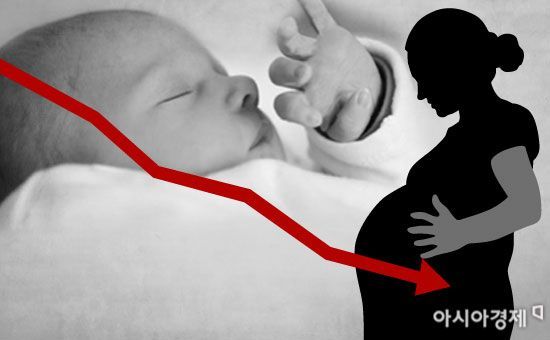 Statistics Korea projects that South Korea's total population will decrease sharply by about 15.5 million over the next 50 years, remaining in the 36 million range. In South Korea, the elderly population is expected to enter the 20% range of the total population by 2025, marking the arrival of a super-aged society, and by 2050, the elderly population is projected to account for 40% of the total population.
 [Photo by Asia Economy]
Statistics Korea projects that South Korea’s total population will sharply decrease by about 15.5 million over the next 50 years, remaining in the 36 million range. By 2025, the elderly population will enter the 20% range, marking the arrival of a super-aged society.
Regarding the declining birth rate and the gradually increasing elderly population, Professor Choi said, "If we work hard, maybe one day we can recover a birth rate of 1.8, and if we work even harder, 2.1 (the level at which the population does not decrease). But I hope that day never comes."
He explained the reason, saying, "Globally, we have artificially increased the Earth’s capacity to support the population through technology. How long can this be maintained?" and argued, "All environmental problems ultimately stem from population issues. Because there are too many people, we actually need to reduce the population. The fact that wealthy countries are trying to increase birth rates is a global disaster."
Finally, Professor Choi said, "Economists keep worrying that life will become difficult due to labor shortages, but rather, isn’t it time to explore how to live humanely with a small number of citizens?" and added, "If a global consensus can be reached, a gradual population decline will make Earth a much better planet to live on. Perhaps South Korea is playing a pioneering role in this."
© The Asia Business Daily(www.asiae.co.kr). All rights reserved.

















