Minutes of the Monetary Policy Committee Meeting on the 30th of Last Month
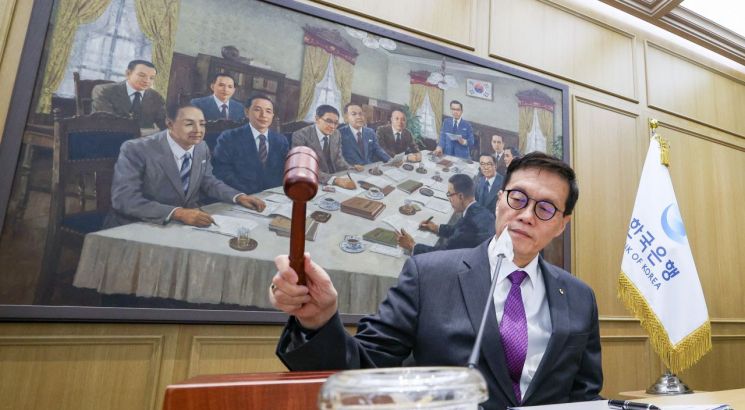 Bank of Korea Governor Lee Chang-yong is striking the gavel at the Monetary Policy Direction Decision Meeting of the Monetary Policy Committee held at the Bank of Korea in Jung-gu, Seoul, on the 30th of last month.
 [Photo by Yonhap News]
As the Monetary Policy Committee of the Bank of Korea kept the base interest rate steady at 3.5% per annum as of the 30th of last month, the majority of committee members explained that due to the significant uncertainty surrounding inflation, it is necessary to maintain a tight monetary policy stance while considering additional tightening if needed.
However, some members emphasized that considering domestic and international economic and financial conditions, the current interest rate level is sufficiently tight, and that the direction of monetary policy should be decided by observing inflation, growth, and financial market conditions for the time being.
The minutes of the Monetary Policy Committee meeting held on the 30th of last month, released by the Bank of Korea on the 19th, contained concerns from committee members regarding inflation, household debt, and financial market conditions. Members explained that although the inflation rate is slowing down, it is necessary to maintain the current stance due to significant uncertainties surrounding household loans and the global economic situation.
One member stated, "As the core inflation slowdown trend continues, consumer price inflation is expected to gradually decrease in the future. However, it is necessary to monitor household loan trends more closely, and uncertainties regarding the global economic situation and monetary policy remain. Therefore, it is appropriate to maintain the base interest rate at the current 3.50% in this meeting."
Another member said, "Domestic inflation has shown an upward trend exceeding the August forecast path due to increased supply-side upward pressures, and the stabilization at the target level seems delayed. On the other hand, international oil prices have been declining recently amid renewed concerns about global demand slowdown, and domestic consumption recovery is weak, so demand-side pressures are expected to be limited."
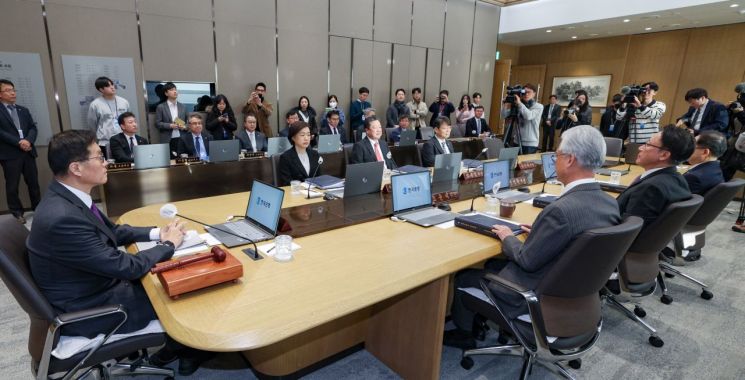 Bank of Korea Governor Lee Chang-yong is presiding over the Monetary Policy Direction Decision Meeting of the Monetary Policy Committee held at the Bank of Korea in Jung-gu, Seoul on the 30th of last month.
 [Photo by Yonhap News]
Opinions on the future direction of monetary policy were somewhat divided. Earlier, at a press conference on the 30th of last month, Bank of Korea Governor Lee Chang-yong explained that among the six Monetary Policy Committee members excluding himself, four expressed the view that the possibility of additional rate hikes should be kept open, while the remaining two believed it was appropriate to maintain the base interest rate at the current level.
According to the minutes, one member emphasized, "If the convergence speed toward the inflation target is judged to be slower than expected due to rising inflation expectations, additional policy responses should be considered."
Another member said, "In this meeting, while keeping the base interest rate unchanged, we should maintain a tightening stance until we are confident that the inflation rate can reach the target level by monitoring domestic and international economic trends, household debt, financial stability conditions such as real estate project financing (PF), and monetary policy decisions of major countries including the United States."
Another member stated, "To stably manage inflation expectations and housing price rise expectations, a high interest rate stance must be maintained," and one other member explained, "If the inflation path exceeds the current forecast and stabilization at the target level is expected to be further delayed, additional tightening should also be considered."
On the other hand, two other members said that rather than additional tightening, it is better to hold rates steady for now and decide while observing inflation and financial market conditions.
One member said, "Considering domestic and international economic and financial conditions, the current interest rate level is sufficiently tight. It is appropriate to keep the base interest rate at the current 3.50% level this time and observe the future trends of growth and inflation compared to the forecast path, as well as financial market conditions for the time being."
Another member said, "While the recovery in consumption is gradual, inflation continues a more rigid slowdown than expected, and financial imbalances caused by the accumulation of private debt appear to be worsening. Therefore, it is necessary to maintain the base interest rate at the current level and monitor changes in domestic and external conditions going forward."
At the October meeting, one member had suggested keeping the possibility of a rate cut open, but at last month's meeting, this opinion was withdrawn as some uncertainties, such as risks in the Middle East region, had been partially resolved.
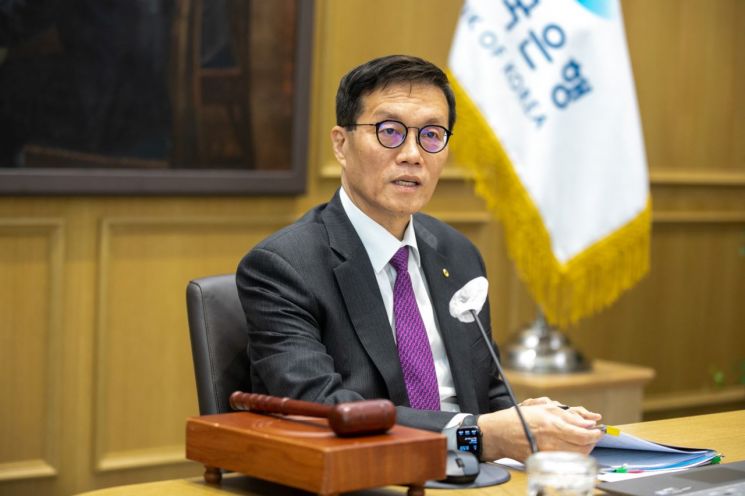 Bank of Korea Governor Lee Chang-yong is presiding over the Monetary Policy Committee meeting held at the Bank of Korea in Jung-gu, Seoul, on the 30th of last month.
 [Image source=Yonhap News]
Committee members emphasized the need to be cautious as concerns about household debt and the real estate PF sector could increase depending on future real estate market conditions.
One member explained, "Price increases and transaction volumes in the housing market have somewhat contracted, and government household debt management has been strengthened, so it is necessary to monitor the trends further. Although liquidity risks in the non-bank sector are easing, loan delinquency rates continue to rise at high levels, indicating that credit risk remains latent."
Another member pointed out, "There are persistent concerns due to difficulties in refinancing some PF-asset-backed commercial paper (ABCP) issuances amid high interest rates. Meanwhile, despite the high interest rate environment, household and corporate loan growth continues, increasing the need for macro leverage management."
One member said, "The delinquency rate on corporate loans in some non-bank sectors exceeds the mid-5% range, and net repayments of PF-ABCP continue, suggesting that market instability risks are accumulating due to prolonged high interest rates. On the other hand, household loans in the financial sector continue to increase at a high rate of over 6 trillion won, mainly through policy finance, raising ongoing concerns about the deepening of financial imbalances."
© The Asia Business Daily(www.asiae.co.kr). All rights reserved.



















