The distribution of counterfeit ‘K-brands’ in China has not been eradicated. The low rate of trademark registration by companies is also an obstacle to stopping the distribution of counterfeit goods. Both the willingness of companies to register trademarks and government support are becoming crucial.
The Korean Intellectual Property Office (KIPO) announced on the 19th that from April to October, it conducted an investigation into counterfeit Korean fashion brands (hereinafter K-fashion) sold in China, in collaboration with the Guangzhou Overseas Intellectual Property Center (IP-DESK) and the Korea Trade-Investment Promotion Agency (KOTRA), resulting in the detection and seizure of 6,000 counterfeit items.
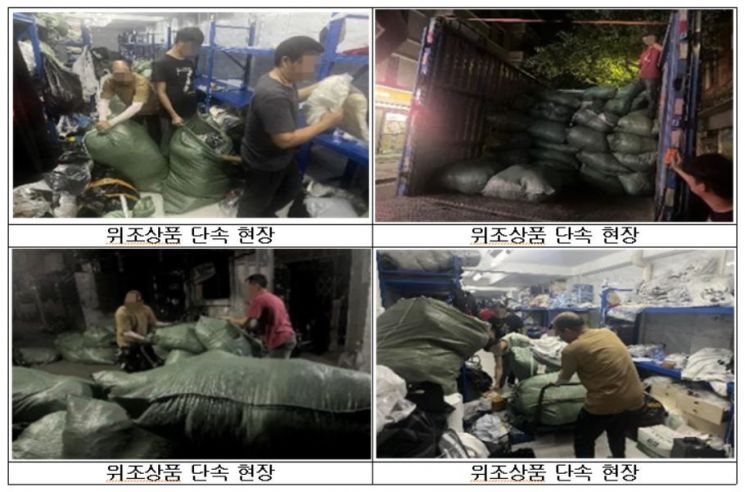
The investigation was launched after signs were detected in Guangdong Province, China, that counterfeit K-fashion products such as bags, clothing, and sunglasses were being disguised and distributed as Korean-made.
Following the investigation, KIPO and KOTRA shared the results with Guangzhou city authorities, leading to the crackdown on one warehouse storing counterfeit goods and the seizure of 6,155 counterfeit items from two domestic clothing brands. The estimated retail value of the seized counterfeit products is approximately 520 million KRW.
Through the investigation, KIPO and others also identified counterfeit products distributed at 19 offline wholesale markets in Guangdong Province and on 12 major online platforms. They purchased and analyzed 114 suspected counterfeit product samples from stores and links suspected of selling K-brand counterfeit goods, ultimately determining that 65 of these products were counterfeit.
Among the 65 counterfeit products identified, 34 included K-brand trademarks. However, 10 of these K-brand trademarks (29%) were not registered in China, making it impossible to crack down on the production and distribution of counterfeit goods and making it difficult to provide relief to affected companies.
In response, KIPO plans to strengthen targeted support for industries frequently affected by counterfeit goods overseas through the ‘K-Brand Counterfeit Goods Public-Private Joint Response Council.’
The council, launched last month, includes five associations: the Korea Food Industry Association, the Korea Cosmetic Association, the Korea Fashion Industry Association, the Korea Franchise Association, and the Korea Music Content Association. It aims to prevent and respond to the distribution of counterfeit goods affecting domestic exporters by addressing counterfeit damage frequently occurring overseas, led by sector-specific associations.
In line with this purpose, KIPO plans to continuously expand the council to promote customized responses to K-brand counterfeit goods considering product and service characteristics, as well as to gather industry opinions and reflect them in policies.
Lee In-sil, Commissioner of KIPO, stated, “Overseas intellectual property infringement can lead to a decline in trust in Korean products and a decrease in exports by domestic companies. KIPO will cooperate with KOTRA, overseas diplomatic missions, and local governments to expand exports of domestic companies and strengthen responses to prevent damage to local consumers through the public-private council.”
© The Asia Business Daily(www.asiae.co.kr). All rights reserved.