Song Young-gil, former leader of the Democratic Party, who is accused of involvement in the distribution of cash envelopes during the party's leadership election, was arrested on the 18th.
With the prosecution successfully securing custody of Song, who can be considered the biggest beneficiary of the cash envelope scandal, investigations into Democratic Party lawmakers who received the envelopes are expected to gain momentum.
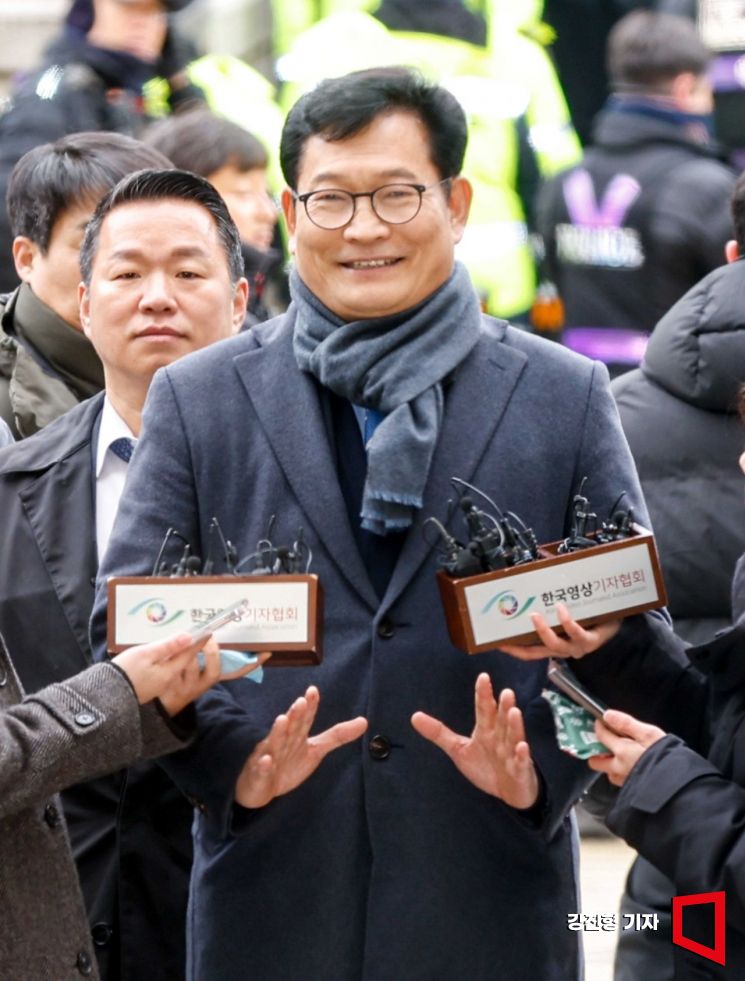 Song Young-gil, former leader of the Democratic Party of Korea, who is suspected of distributing money envelopes during the party convention, is responding to reporters' questions as he appears at the detention hearing held at the Seoul Central District Court in Seocho-gu, Seoul on the 18th. Photo by Kang Jin-hyung aymsdream@
Chief Judge Yoo Chang-hoon: “Criminal charges substantiated, case importance, and risk of evidence destruction”
On the day, Yoo Chang-hoon, chief judge in charge of warrants at the Seoul Central District Court, conducted the warrant hearing for Song, who was charged with violations of the Political Parties Act, Political Funds Act, and bribery under the Act on the Aggravated Punishment of Specific Crimes. At around 11:59 p.m., Yoo issued an arrest warrant for Song, stating, “The criminal charges are substantiated, and there is a risk of evidence destruction.”
Judge Yoo first stated, “It is clear that the suspect received a large amount of illegal political funds and was partially involved in the acceptance of money related to the party leadership election, making this a significant matter.”
He added, “Considering the suspect’s actions and all circumstances confirmed during the investigation regarding personal and material evidence, there is also a concern about the destruction of evidence.”
Earlier, on the 13th, the Anti-Corruption Investigation Division 2 of the Seoul Central District Prosecutors’ Office (led by Chief Prosecutor Choi Jae-hoon) filed an arrest warrant for Song on charges including violations of the Political Parties Act, Political Funds Act, and bribery under the Act on the Aggravated Punishment of Specific Crimes, related to the cash envelope scandal during the Democratic Party leadership election and donations received from the external support organization “Peace and Livelihood Issues Research Institute (Meoksa-yeon).”
Song is accused of being involved in the distribution of cash envelopes totaling 66.5 million KRW to Democratic Party lawmakers and regional headquarters chiefs during March to April 2021, ahead of the party leadership election. Additionally, he is charged with receiving a total of 763 million KRW in illegal political funds from seven individuals through Meoksa-yeon between January 2020 and December 2021. Among these, the 40 million KRW received from Park Yong-ha, former chairman of the Yeosu Chamber of Commerce and Industry, in July to August 2021 is also subject to bribery charges.
Song Young-gil: “An internal party feast, what kind of serious crime is this?” vs. Prosecution: “A serious crime infringing on the non-buyability of elections”
Regarding the cash envelope case, Song described the party leadership election as an “internal party feast” and claimed, “What kind of serious crime is this that over 100 people are being investigated by 14 prosecutors from the Anti-Corruption Investigation Division 2 of the Seoul Central District Prosecutors’ Office, involving section chiefs, for six months? It’s driving me crazy,” implying that it was not a serious crime.
On the other hand, the prosecution has investigated the case from the perspective that the distribution of tens of millions of won during the party leadership election is a “serious crime infringing on party democracy and the non-buyability (the nature of elections that cannot be bought with money) of elections.”
Regarding the charges related to violations of the Political Funds Act involving Meoksa-yeon, Song has maintained that “there were no issues as the accounting was conducted properly and transparently,” while the prosecution has stated that it was a “collusion between politics and business that transformed a public interest corporation into an external organization used as a warehouse for illegal political funds.”
Until now, Song has claimed that he was completely unaware of the cash envelope distribution and that there were no legal issues with Meoksa-yeon’s funds. However, with the court recognizing the seriousness of the charges and issuing an arrest warrant, the opposition party’s claim that this is a “political prosecution targeting” is becoming less convincing.
Song, who exercised the right to remain silent during prosecution investigation, actively testified in court
On the morning of the warrant hearing, Song appeared at the Seoul Central District Court in Seocho-dong, Seoul, and said, “While I exercised my right to remain silent during the prosecution investigation, I will humbly and sincerely explain everything with my lawyer in court.”
Regarding the illegal political funds charges, he argued, “The money was not received by me personally but was deposited into the official support account of the ‘Peace and Livelihood Issues Research Institute’ (Meoksa-yeon), and the expenditures were official and transparently reported. The cash envelope charges are unproven, so they are being investigated as a separate case.”
During the warrant hearing, about five prosecutors, including Seo Min-seok and Yoon Seok-hwan, deputy chiefs of the Anti-Corruption Investigation Division 2 who participated in the investigation, presented Song’s charges and the risk of evidence destruction through a PowerPoint presentation of approximately 250 pages.
In particular, the prosecution emphasized the necessity of detention by highlighting that Song replaced his previously used mobile phone upon returning from France and submitted it to the investigation team, and that there are indications he used a borrowed phone to monitor the investigation’s progress and to persuade related parties.
On Song’s side, lawyers Sun Jong-moon and Jeon Byung-duk attended and argued that Song was unaware of the cash envelope distribution and that there was no risk of flight or evidence destruction.
Song himself reportedly took the opportunity to speak in detail about his position during the warrant hearing, according to his lawyers.
Intense dispute between prosecution and Song’s side over the nature of Meoksa-yeon
The warrant hearing, which began at 10 a.m., lasted for six hours and 30 minutes until 4:30 p.m. Song reportedly took a lunch break inside the courtroom from 12:45 p.m. for about 50 minutes before resuming the hearing.
Judge Yoo reportedly listened to the prosecution and Song’s side in order regarding the charges Song faces: illegal political funds received through Meoksa-yeon, unreported political funds and bribery charges, and cash envelope distribution allegations, while clarifying any doubts.
Especially during the hearing, the prosecution and defense engaged in a fierce dispute over the nature of Meoksa-yeon, which was identified as a channel for illegal political funds.
After the hearing ended at around 4:33 p.m., Song said, “The prosecution summoned suspects five to six times each for investigation, and even summoned Lee Jung-geun, who is already indicted, for additional questioning to obtain favorable statements through continuous pressure investigations.”
He added, “During the pressure investigations, people could have died, and some even received psychiatric treatment. Shouldn’t those people be comforted? We called witnesses to check the situation for exercising our right to defense, but if that is claimed as evidence destruction, it is a very unfair game.”
Investigation into lawmakers who received cash envelopes likely to accelerate... Yoon Kwan-seok: “Mistakes made while helping party leader candidate”
With Song’s arrest, investigations into 20 incumbent Democratic Party lawmakers who received cash envelopes are expected to accelerate.
Meanwhile, the prosecution requested a five-year prison sentence at the sentencing hearing for independent lawmaker Yoon Kwan-seok, who was previously indicted in connection with the cash envelope scandal. For Kang Rae-gu, former standing auditor of the Korea Water Resources Corporation, who was also indicted, the prosecution requested one year imprisonment for violations of the Political Funds Act, two years imprisonment and a fine of 10 million KRW for bribery and other crimes, and a confiscation of 3 million KRW.
In his final statement, Yoon admitted and expressed remorse for his crimes, saying, “I lost vigilance and proceeded while disregarding illegal aspects, ultimately committing a serious mistake. I am very ashamed and devastated.”
He also admitted to distributing cash envelopes to help the party leader candidate at the time, Song Young-gil, saying, “Although I made mistakes while helping the party leader candidate, it was not to gain any special position or benefit.”
© The Asia Business Daily(www.asiae.co.kr). All rights reserved.
![Clutching a Stolen Dior Bag, Saying "I Hate Being Poor but Real"... The Grotesque Con of a "Human Knockoff" [Slate]](https://cwcontent.asiae.co.kr/asiaresize/183/2026021902243444107_1771435474.jpg)











