Alcohol Industry to Lower Soju Wholesale Prices Starting Next Year
Chamisul Down 10.6% · Cheoeumcheoreom Down 4.5%
Price Increase Reflection Minimizes Reduction Effect
The liquor industry has begun to consecutively lower the wholesale prices of soju starting next year. This price reduction is due to the government's introduction of a standard sales ratio for domestic distilled spirits from next year, which effectively lowers the taxes imposed on soju. However, since HiteJinro has already raised soju prices and Lotte Chilsung has increased the export price (standard taxable price) before lowering the wholesale price, the actual price impact felt by consumers is expected to be minimal as the industry has proactively implemented price hikes.
According to the liquor industry on the 19th, Lotte Chilsung announced that from January 1 next year, following the government's introduction of the standard sales ratio, the wholesale prices of soju products such as "Chum Churum" and "Saero" will be reduced by 4.5% and 2.7%, respectively. HiteJinro will also lower the wholesale prices of its soju products starting from January 1 next year.
Accordingly, diluted soju products like Lotte Chilsung's "Chamisul" and "Jinro," as well as distilled soju like "Ilpoom Jinro," will see their existing wholesale prices reduced by 10.6%, and fruit liqueurs will be lowered by 10.1%.
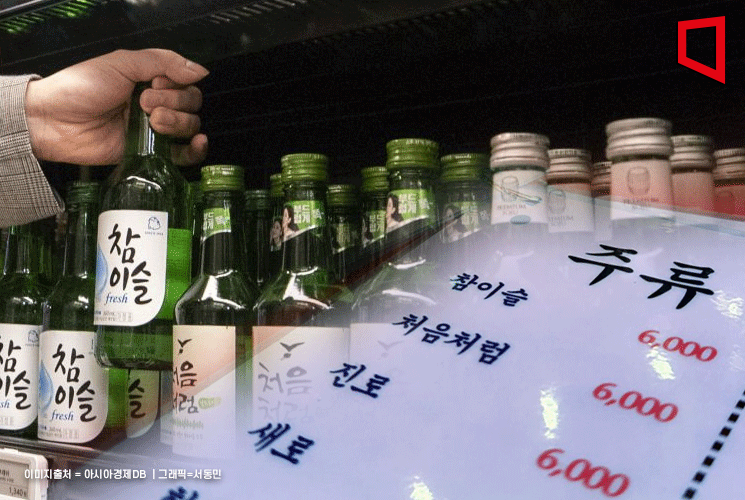
The decision by the two major domestic soju companies to reduce prices is due to the government's introduction of the standard sales ratio. The standard sales ratio is a kind of tax discount rate applied when determining the taxable base for calculating liquor tax. The higher the standard sales ratio, the smaller the taxable base, resulting in lower taxes. As taxes decrease, the reduction in wholesale prices increases, ultimately reducing the burden on consumers.
The government's stated reason for introducing the standard sales ratio for domestic distilled spirits is to address the limitations of the ad valorem tax system, which imposes higher taxes on domestic liquors compared to imported ones, thereby resolving tax discrimination. Currently, domestic distilled spirits such as soju and whiskey are taxed based on the export price, which includes "sales costs and profits." This means that margins such as selling, general, and administrative expenses and distribution costs are included beyond the manufacturing cost.
On the other hand, imported liquors are taxed based on the import declaration price before sales costs and profits are added, leading to claims of discrimination against domestic liquors. Liquor taxes are divided into ad valorem taxes, which are proportional to price, and specific taxes, which are proportional to quantity. Specific taxes apply to liquor volume, so there is no tax burden difference between domestic and imported liquors. However, for ad valorem taxes, differences in the timing of tax imposition between domestic and imported liquors cause discrepancies in tax bases, resulting in tax discrimination issues.
To resolve this issue, the government changed the taxation method for beer and Makgeolli to specific taxes starting in 2020. However, for distilled spirits, the introduction of specific taxes was delayed due to concerns that the price of cheaper soju would rise, increasing the burden on low-income consumers. Nevertheless, as demands for liquor tax reductions, especially for whiskey, continued, the standard sales ratio introduced in July to correct the imbalance in individual consumption tax between domestic and imported automobiles was proposed as an alternative and has been applied to liquors starting next year.
With this system introduction, the wholesale prices of domestic distilled spirits will decrease. For example, if the taxable base for domestic soju is discounted by 22.0%, the factory wholesale price of HiteJinro's Chamisul, currently 1,247 won, will be reduced to 1,115 won from next year, and Lotte Chilsung's Chum Churum will drop from 1,163 won to 1,110 won.
However, since the liquor industry proactively raised wholesale prices before the government's tax reduction decision, it is expected to be difficult for consumers to feel the effect of the price cuts. HiteJinro, the market leader in soju, raised the wholesale prices of its soju brands "Chamisul Fresh" and "Chamisul Original" by 6.95% starting from the 9th of last month. Following the leader's move, regional soju companies such as Muhak, Daesun Joojo, Mackis Company, and Bohae Brewery also joined the price hike trend simultaneously.
Due to last month's increase, the wholesale price of one bottle of Chamisul rose from 1,166 won to 1,247 won, and since it will drop again to 1,115 won next month, the actual reduction compared to last month is only 51 won.
Lotte Chilsung, which had delayed price increases, also raised the export prices (taxable base prices) of Chum Churum and Saero by 6.8% and 8.9%, respectively, from next year, then applied the standard sales ratio to lower the wholesale prices, resulting in a price reduction of only 52 won per bottle of Chum Churum.
With the wholesale price reduction per bottle of soju limited to about 50 won, it is uncertain whether this will translate into lower consumer prices at restaurants and bars. While retail prices at large supermarkets and convenience stores may decrease with lower wholesale prices, the government cannot mandate price reductions at restaurants, so the effect felt by consumers may be limited.
Meanwhile, as liquor companies have consecutively raised prices, the inflation rate for beer, soju, and other liquors also surged significantly last month. According to Statistics Korea, the consumer price index for beer last month was 112.45, up 5.1% compared to the same month last year. This is the highest rate in nine months since February this year (5.9%). Due to last year's price hikes by liquor companies, the beer inflation rate rose to 7.1% in October of that year but slowed down after the government requested restraint on price increases, remaining around 1.0% in October. However, it surged again to the 5% range last month. Soju prices also broke through the 0% increase range from April to October and rose 4.7% last month, marking the largest increase since February this year (8.6%).
© The Asia Business Daily(www.asiae.co.kr). All rights reserved.
![Clutching a Stolen Dior Bag, Saying "I Hate Being Poor but Real"... The Grotesque Con of a "Human Knockoff" [Slate]](https://cwcontent.asiae.co.kr/asiaresize/183/2026021902243444107_1771435474.jpg)
















