Reviewing Increase of Stock Transfer Tax Threshold from Current 1 Billion to Up to 5 Billion
Whether Individual Investors Release Stocks Will Determine Market Direction
In the domestic stock market, individual investors have sold stocks worth 3.6 trillion KRW just this month. Until last month, they maintained a net buying position on an annual cumulative basis, but recently they have shifted to a selling dominance. This is a chronic phenomenon that occurs to avoid the year-end 'major shareholder capital gains tax.' However, the government recently introduced the 'expansion of major shareholder criteria' card to ease this issue, drawing attention to the future moves of individual investors.
According to the Korea Exchange on the 19th, individual investors have net sold stocks worth a total of 3.598 trillion KRW from the 1st of this month to the day before. In contrast, during the same period, foreigners and institutions net bought 2.071 trillion KRW and 1.679 trillion KRW, respectively. On an annual cumulative basis, individual investors net sold 1.7166 trillion KRW. Until the end of last month, they were net buyers (1.832 trillion KRW), but the selling pressure has intensified this month, turning the figure negative.
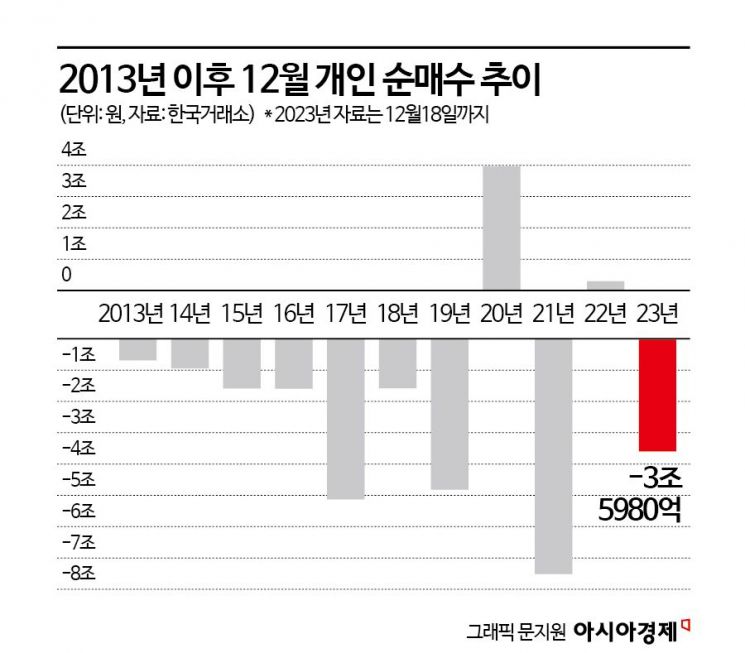
This is not just a phenomenon of this year. Typically, individual investors in the domestic stock market tend to pour out selling volumes as the year-end approaches. Looking at the historical December stock trading performance of individual investors since 2013, except for two years?2020 (net buying of 3.966 trillion KRW) and last year (net buying of 297 billion KRW)?all other years showed a selling dominance.
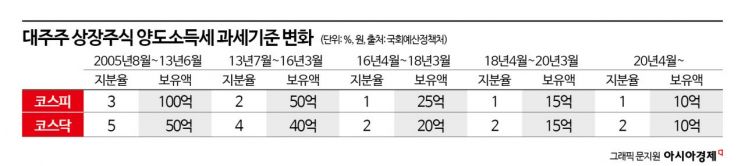
The main reason why individual investors particularly focus on selling stocks in December is undoubtedly the capital gains tax. In the past, the financial investment income capital gains tax was imposed only on individual investors holding stocks worth 10 billion KRW (or 3% stake) in KOSPI or 5 billion KRW (5% stake) in KOSDAQ. However, since June 2013, the taxable threshold was expanded to 5 billion KRW (2% stake) in KOSPI and 4 billion KRW (4% stake) in KOSDAQ, and the scope has gradually widened over three occasions. Under the current standard applied since April 2020, both KOSPI and KOSDAQ classify individuals holding more than 1 billion KRW in a specific stock as 'major shareholders,' subjecting them to capital gains tax. In other words, to avoid capital gains tax, investors holding more than 1 billion KRW in certain stocks tend to sell off large amounts.
Meanwhile, it has been reported that the government is considering raising the major shareholder threshold for stock capital gains tax from the current 1 billion KRW to 3 billion or 5 billion KRW. President Yoon Suk-yeol pledged during the presidential election to completely abolish the stock capital gains tax. However, abolishing the capital gains tax requires legislation by the National Assembly, making immediate implementation difficult. Instead, raising the major shareholder threshold can be applied immediately through a government ordinance revision and approval by the State Council. However, since there is little time left until the end of the year, a special State Council meeting will likely be necessary for quick implementation.
The securities industry welcomes the government's discussion on easing the major shareholder requirements. Lim Jeong-eun, a researcher at KB Securities, said, "Expectations for a year-end Santa rally are spreading, but the upward momentum will somewhat slow down. As the capital gains tax relief plan for major shareholders is expected to be decided this week, whether individual investors will release selling pressure accordingly will determine the market direction."
However, some voices urge caution, noting that this year’s tax revenue shortfall reaches 60 trillion KRW and that the stock capital gains tax issue was agreed upon in the National Assembly last year to maintain the current system until 2024. There are concerns that tax policies affecting national finances, along with recent short-selling issues, should not be used for political populism ahead of elections.
© The Asia Business Daily(www.asiae.co.kr). All rights reserved.



















