OECD 'International Student Assessment 2022'
High Rates of School Belonging and Safety
About 2 out of 10 Korean students are reportedly dissatisfied with their lives, according to a survey.
On the 17th, the results of the Organisation for Economic Co-operation and Development (OECD)'s 'Programme for International Student Assessment (PISA) 2022' showed that 22% of Korean students answered that they are "dissatisfied with my life." While Korean students rank among the top in academic achievement, their life satisfaction remained below the OECD average.
PISA is a survey conducted every three years since 2000 to compare the academic achievement and trends in mathematics, reading, and science literacy of 15-year-old students worldwide, who are typically in 9th to 11th grade. However, the survey was postponed by one year only during the COVID-19 pandemic in 2021. In this survey, which involved 81 countries, questionnaires covered not only academic achievement but also non-academic areas such as life satisfaction, school, and family life.
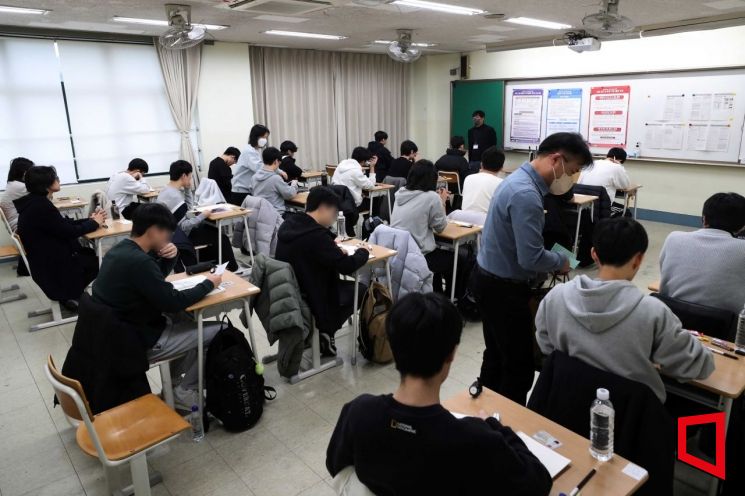 On November 16, when the 2024 College Scholastic Ability Test was held, examinees were preparing for the exam at Yongsan High School in Seoul. Photo by Joint Press Corps
When asked to rate their life satisfaction on a scale from 0 (lowest) to 10 (highest), the proportion of Korean students who rated between 0 and 4, indicating dissatisfaction with life, was 22%, similar to the 23% in the previous 'PISA 2018' survey. This is 4 percentage points higher than the OECD average (18%), suggesting that Korean students' life satisfaction is lower than the average of major countries.
This survey result contrasts with the high scores in academic achievement. In PISA 2022, Korean students scored significantly above the OECD average in all areas of mathematics, reading, and science. In terms of average score rankings, they ranked 2nd to 3rd out of 81 countries, placing them among the top tier.
Korean students have also ranked low in life satisfaction in previous surveys. In PISA 2018, the proportion of Korean students dissatisfied with life was 7 percentage points higher than the OECD average (16%), and in PISA 2015, it was 22%, exceeding the OECD average (12%) by 10 percentage points. By country, the proportion of students dissatisfied with life was highest in the UK (26%), followed by Germany (22%), Hong Kong (20%), Japan (18%), and Taiwan (15%).
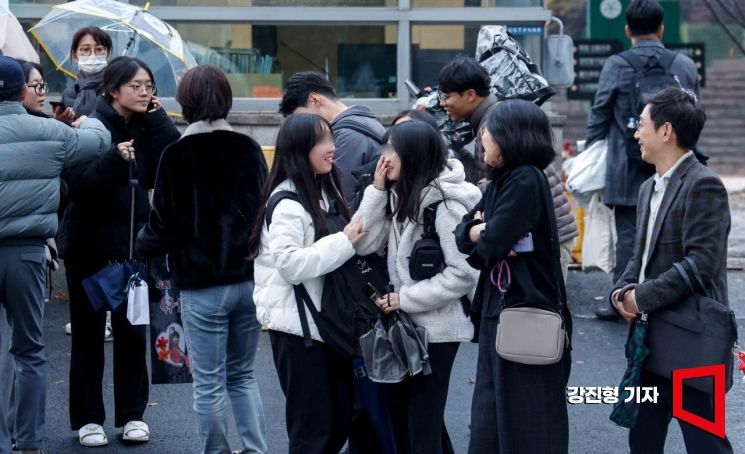 On the 16th, students who completed the CSAT are leaving the exam site at Ewha Girls' High School in Jung-gu, Seoul. Photo by Jinhyung Kang aymsdream@
Meanwhile, Korean students' sense of belonging at school was found to be higher than the OECD average. The proportion of Korean students who answered that they "make friends easily at school" was 78%, 2 percentage points higher than the OECD average (76%). The proportion of Korean students who "feel a sense of belonging at school" was also 79%, higher than the OECD average (75%). Conversely, only 9% of Korean students felt "like an outsider at school," which is lower than the OECD average (17%), and only 9% felt "lonely at school," also below the OECD average (16%).
The proportion of students who feel safe at school was relatively high as well. Only 5% of Korean students felt "unsafe on the way to school," lower than the OECD average (8%), and 4% felt "unsafe in the classroom," which is 3 percentage points lower than the OECD average (7%). The proportion of students who reported being victims of bullying several times a month or more was 10% for boys and 8% for girls, compared to the OECD averages of 21% for boys and 20% for girls.
© The Asia Business Daily(www.asiae.co.kr). All rights reserved.
![Clutching a Stolen Dior Bag, Saying "I Hate Being Poor but Real"... The Grotesque Con of a "Human Knockoff" [Slate]](https://cwcontent.asiae.co.kr/asiaresize/183/2026021902243444107_1771435474.jpg)

















