[2023 Telecommunications Industry Review]
Frequency, Network Usage Fees Cause Stir
Importance of Security in Telecommunications Industry Increases
Throughout 2023, the mobile telecommunications industry experienced a tumultuous year. The three major carriers, having failed to keep their promises to the public, faced cancellation of their 5G 28㎓ frequency allocations by the government, and the industry awaits the emergence of a fourth carrier. The high-profile lawsuit over network usage fees between Netflix and SK Broadband, dubbed the 'lawsuit of the century,' ended with a dramatic settlement. Amid ongoing global competition between Samsung Electronics and Apple, KT appointed a new leader, Kim Young-seop, and telecom companies are all pushing to transform into artificial intelligence (AI) enterprises.
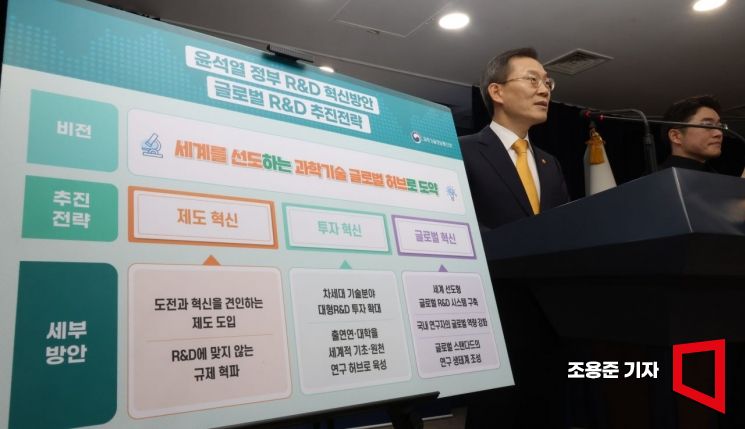 Minister Lee Jong-ho of the Ministry of Science and ICT is announcing the 'Yoon Seok-yeol Government R&D Innovation Plan' and the 'Global R&D Promotion Strategy' at the Government Seoul Office in Jongno-gu, Seoul. Photo by Jo Yong-jun jun21@
All Three Carriers Lose 28㎓ Frequencies... Will a Fourth Carrier Emerge?
Following the cancellation of 5G 28㎓ frequency allocations for KT and LG Uplus in December last year, SK Telecom also faced cancellation in May this year, resulting in an unprecedented situation where all three carriers relinquished their frequencies. The 28㎓ band attracted attention for offering speeds up to 20 times faster than LTE, but it has a shorter reach and weaker diffraction around obstacles compared to the 3.5㎓ band currently used nationwide. This requires a denser deployment of base stations, leading to enormous investment costs without a suitable business model. The government has introduced the fourth carrier option, planning to significantly lower the minimum competitive price and mandatory base station installation requirements to attract new entrants. Frequency allocation applications are being accepted until the 19th.
Netflix and SKB's 'Lawsuit of the Century' Ends in Dramatic Reconciliation
Netflix and SK Broadband signed a partnership and reconciled after three years, ending the much-publicized network usage fee dispute known as the 'lawsuit of the century.' When SKB demanded payment due to soaring transmission costs caused by increased Netflix traffic, Netflix filed a declaratory judgment lawsuit in April 2020 denying any debt. SKB won the first trial, but Netflix appealed, and SKB filed a counterclaim, leading to a second trial. Korea was the first country to raise the network usage fee issue, prompting discussions on sharing network investment costs in the U.S., European Union (EU), India, Vietnam, and others. Fair network usage cost sharing became a key topic in the global telecommunications industry. Then, in September, the two companies suddenly signed a partnership and mutually withdrew their lawsuits, shifting to a reconciliation mode. However, both parties remained silent on specific contract details such as network usage fee payments.
Hacked and Paralyzed by DDoS... LG Uplus Triples Security Investment
LG Uplus experienced unprecedented security incidents early this year, including customer information leaks and distributed denial-of-service (DDoS) attacks. In January, a hacker breach resulted in the leakage of information of approximately 290,000 customers. Additionally, on January 29 and February 4, DDoS attacks caused internet service access errors. To prevent recurrence, LG Uplus decided to expand its information security investment to 100 billion won, tripling the current level. The company also expanded its information protection organization, placing it directly under the CEO. Furthermore, LG Uplus offered compensation measures such as free USIM replacements for all customers and discounts for PC cafes.
End of 5-Month Management Vacuum... KT Launches 'Kim Young-seop Era'
KT, ranked 12th in the business world, experienced an unprecedented 'management vacuum' this year. Former CEO Koo Hyun-mo declined to renew his term, and Yoon Kyung-rim, who was recommended as the new CEO, officially resigned 20 days after appointment. The entire board also stepped down. This occurred in March. KT formed a task force (TF) to select a new CEO and board members. There were 27 CEO candidates, and after in-depth interviews with the final three, Kim Young-seop, former CEO of LG CNS, was chosen as the next CEO in August, ending the approximately five-month management vacuum. Known as a 'financial expert,' CEO Kim stated, "I will do my best to restore KT's trust as a leading ICT company and grow it into a global digital platform company." Recently, through year-end personnel changes, KT accelerated reforms by reducing executives at the senior manager level and above by 20%.
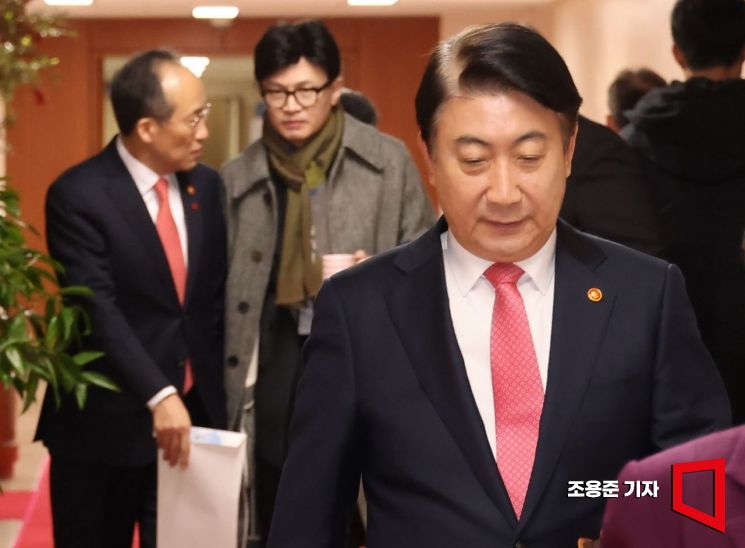
5G Mid-Tier Plans, 30,000-Won Plans, and Low-Cost Devices Launched
The government pursued measures throughout the year to reduce household communication expenses. This reflected President Yoon Suk-yeol's determination to ease the growing burden of communication costs amid high inflation. Key outcomes included the 'second 5G mid-tier plan,' 30,000-won plans, and low-cost devices. Last year, the three carriers introduced the 'first mid-tier plan' offering 20GB to 30GB of monthly data; from March this year, they launched the 'second mid-tier plan,' subdividing the mid-range tiers. Additionally, the lowest 5G plan price dropped from the mid-to-high 40,000 won range to the 30,000 won range. Following government measures, restrictions on plan subscriptions were eased so that 5G device users could subscribe to LTE plans and LTE device users to 5G plans. Previously, 5G devices could only use 5G plans, and LTE devices only LTE plans. Samsung Electronics aligned with the government's cost reduction policy by partnering with KT to release the Galaxy Jump3, priced at 438,900 won.
Three Carriers Mark the First Year of AI Enterprise Transformation
The three mobile carriers began to actively pursue 'beyond telecommunications' by launching AI services this year. SK Telecom announced its 'AI Pyramid Strategy' focusing on three areas: AI infrastructure, AIX, and AI services, aiming to become a global AI company. At the core of this strategy is the AI service 'A.Dot.' A.Dot has gained attention by offering various features, including call recording available on iPhones, music recommendations, and sleep management.
KT set the vision of being a 'digital innovation partner creating a better future for customers' and began full-scale AI business operations. After commercializing the super-large AI 'Mideum,' KT strengthened its AI research and development organization to establish AI governance. In addition to the existing AI2XLab and AI Tech Lab, new labs were established to accelerate digital innovation. LG Uplus announced the development of a telecom-customized AI called 'Ixigen.' The newly developed Ixigen will be used for telecom and platform services for its customers, while the super-large AI 'EXAONE,' developed in collaboration with LG AI Research, will be used for expert-level super-large AI services. Furthermore, LG Uplus plans to strengthen its super-large AI competitiveness through partnerships with overseas big tech companies such as Google and Microsoft.
Massive Cuts in R&D Budget
The government implemented cuts to R&D budgets across most domestic industrial sectors in next year's budget proposal. The R&D budget for next year is set at 25.9 trillion won, a sharp 16.6% decrease of about 6.1 trillion won compared to this year. While the government reduced the overall R&D budget, it claims to have increased funding for advanced industries. AI, bio, cybersecurity, and digital platforms were selected as four high value-added advanced service sectors, with an investment of 4.4 trillion won planned, a 22.2% increase from this year. However, this R&D budget allocation has drawn criticism from both opposition parties and the scientific community. Particularly in the current opposition-majority National Assembly, the passage of the budget bill is uncertain. The Democratic Party of Korea strongly opposed the government budget by increasing next year's R&D budget unilaterally in the National Assembly's Science, Technology, Information and Broadcasting Committee last month, causing the budget bill to miss the legal deadline for approval.
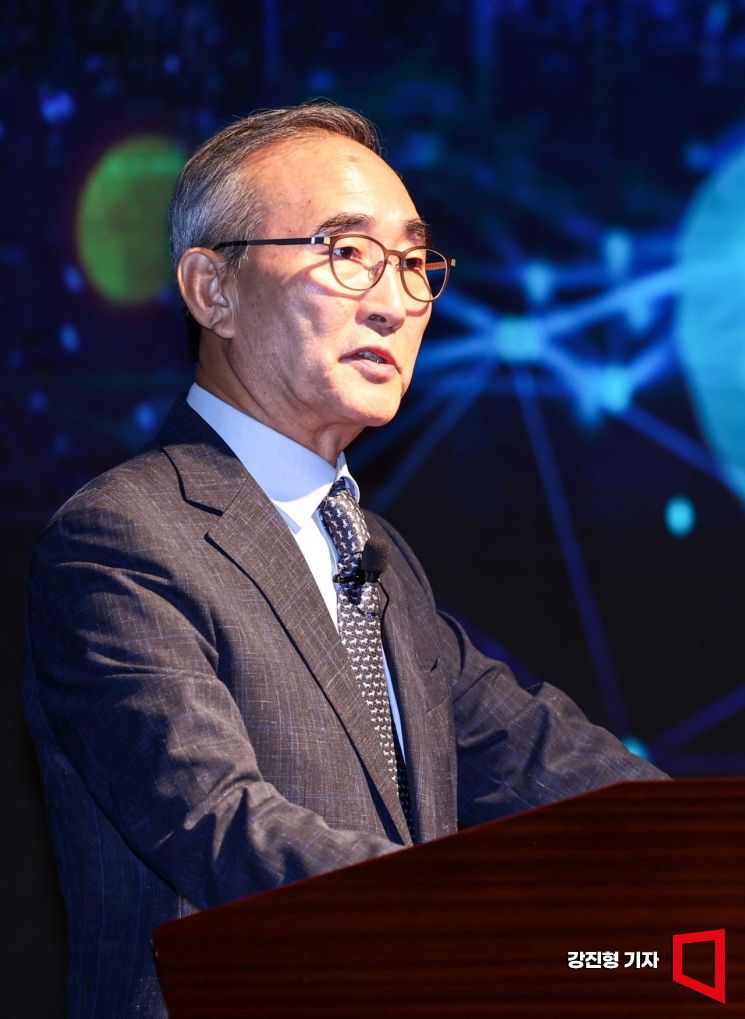 Kim Young-seop, CEO of KT, is delivering a speech at the 'Mobile360 Asia Pacific Conference' held at the Chosun Hotel in Jung-gu, Seoul. Photo by Kang Jin-hyung aymsdream@
Samsung Strengthens Korean Market... Apple Targets Samsung's Stronghold
2023 was the most fiercely contested year between the two major smartphone manufacturers, Samsung Electronics and Apple, in the Korean market. Samsung Electronics held its first-ever 'Galaxy Unpacked' event in Korea since launching the Galaxy S series in 2010, unveiling the Galaxy Z Fold and Flip 5. Amid the global Korean Wave, Samsung aimed to solidify its position as the pioneer of foldable smartphones by leveraging the Korean Unpacked event and its technological prowess. Apple also accelerated its Korean market strategy, opening its 6th and 7th stores domestically in Seoul Gangnam and Gyeonggi Hanam this year. Notably, the Gangnam store is located just 700 meters from Samsung Electronics' Seocho headquarters, dubbed 'Samsung's front yard,' and Hanam is Apple's first store outside Seoul.
Broadcasting and Communications Commission Chair Lee Dong-gwan Resigns After Three Months
The position of Broadcasting and Communications Commission chair also saw upheaval. Lee Dong-gwan, who took office in August, abruptly resigned on the 1st due to repeated impeachment attempts by opposition parties. He stated that if impeachment proceedings were initiated, it would take months for a verdict, during which the commission would effectively be in a vegetative state, leading him to choose voluntary resignation. Prosecutor-turned-candidate Kim Hong-il is scheduled for a confirmation hearing this month as his successor. If appointed, Kim is expected to continue the Yoon Suk-yeol administration's agenda, including public broadcasting reform, fake news eradication, and reducing household communication costs. However, since Kim still holds the position of Chair of the Anti-Corruption and Civil Rights Commission, opposition parties have criticized the situation as a "laughable farce."
© The Asia Business Daily(www.asiae.co.kr). All rights reserved.
![Clutching a Stolen Dior Bag, Saying "I Hate Being Poor but Real"... The Grotesque Con of a "Human Knockoff" [Slate]](https://cwcontent.asiae.co.kr/asiaresize/183/2026021902243444107_1771435474.jpg)


















