The Only Country Worldwide with a Birth Rate Below 1.0
"Population Structure Heading Toward the Worst-Case Scenario"
South Korea's low birthrate and aging population have been identified as extreme even among the member countries of the Organisation for Economic Co-operation and Development (OECD). A comparative analysis of historical future population projections predicts that by 2072, 50 years from now, South Korea's total population could decrease by nearly 30% from the current level, falling to the low 30 million range.
According to Statistics Korea's '2010?2060 Population Projections' released on the 17th, the total fertility rate for 2022 was projected at 1.37 for the medium variant and 1.00 for the low variant.
Statistics Korea presents optimistic (high variant) and pessimistic (low variant) scenarios based on the neutral 'medium variant.' However, the actual trend has followed the pessimistic path. The medium variant, which serves as the headline indicator in the recently announced 2022?2072 future population projections, is also considered unlikely to be achieved in reality.
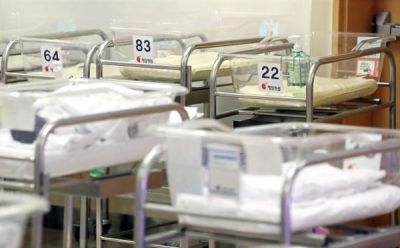
The number of births is also pessimistic. In the 2010?2060 population projections, Statistics Korea estimated the number of births in 2022 at 450,000 for the medium variant and 320,000 for the low variant. In the 2015?2065 projections, these figures were adjusted to 411,000 (medium variant) and 351,000 (low variant), respectively. However, the actual number of births in 2022 was only 246,000, which is about 70% of the low variant estimate.
Conversely, the aging trend is progressing faster than expected. The population structure is moving toward the worst-case scenario. In the 2010?2060 projections, the proportion of those aged 65 and over in the total population for 2022 was predicted to be 17.1% (low variant), 17.2% (medium variant), and 17.3% (high variant). The 2015?2065 projections forecasted the 65+ population share in 2022 as 17.2% for both medium and low variants, and 17.1% for the high variant.
The actual proportion of the population aged 65 and over in 2022 was 17.4%, exceeding even the high variant estimate. This means the aging process is advancing faster than the fastest predicted scenario.
South Korea's low birthrate and aging population, which exceed expectations, are more extreme compared to other major countries. A comparison between Statistics Korea's '2022?2072 Future Population Projections' and the United Nations (UN) World Population Prospects shows that South Korea's fertility rate is expected to remain the lowest among the 38 OECD countries from 2022 (0.78) through 2072 (1.08). South Korea is the only country with a fertility rate below 1.0.
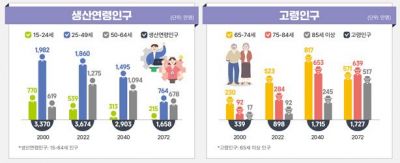 Statistics Korea 'Future Population Projections: 2022~2072' [Image source=Provided by Statistics Korea] [Image source=Yonhap News]
The proportion of the working-age population (ages 15?64) was the highest among the 38 countries at 71.1% in 2022, but by 2072, it is projected to drop to 45.8%, making South Korea the only country to fall below 50%.
The proportion of the elderly population aged 65 and over is expected to surge to 47.7% by 2072, ranking first overwhelmingly. South Korea is projected to be the only country with an elderly population exceeding 40% in 2072. Meanwhile, life expectancy is expected to be the highest at 91.1 years in 2072. Japan (90.9 years), Italy and Switzerland (90.3 years), and Spain (90.0 years) are among the five countries expected to surpass the 90-year threshold following South Korea.
The number of dependents per 100 working-age people is projected to rise from 40.6 in 2022, the lowest level among the countries, to 104.2 in 2072, ranking first. South Korea is also expected to record the lowest population growth rate of -1.3% between 2067 and 2072. The -1.0% range is unique to South Korea.
© The Asia Business Daily(www.asiae.co.kr). All rights reserved.


















