280 million people aged 60 and over
15% of the population are elderly aged 65 and over
It has been revealed that one out of every five people in China’s total population is aged 60 or older.
According to the "Report on the Causes and Development of an Aging Nation" released on the 14th by China’s Ministry of Civil Affairs, which is equivalent to South Korea’s Ministry of the Interior and Safety, as of the end of last year, the population aged 60 and above in China was 280.06 million, accounting for 19.8% of the total population. The population aged 65 and older reached 209.78 million, making up 14.9% of the total population.
If the proportion of the population aged 65 and above exceeds 14%, it is classified as an aging society, and if it exceeds 20%, it is classified as a super-aged society. China officially entered an aging society at the end of the 20th century and entered an aged society in 2021 when the proportion of those aged 65 and above reached 14.2%.
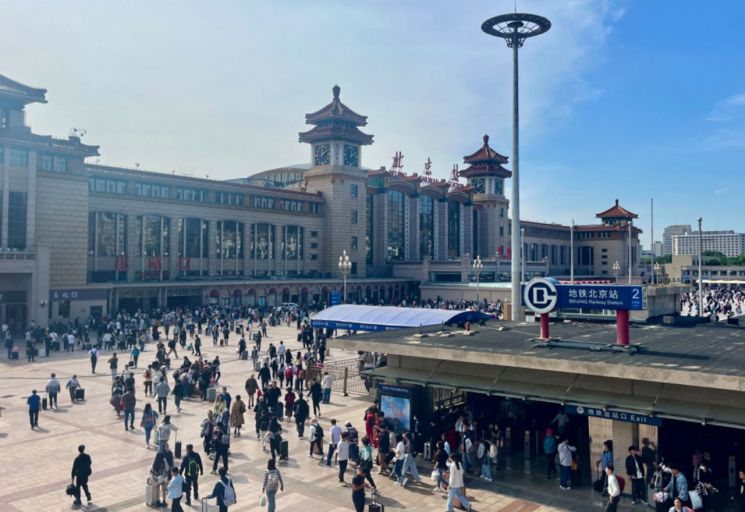 On September 28, ahead of the Mid-Autumn Festival and National Day golden holidays, Beijing Station, the capital of China, was bustling with travelers.
 [Photo by Yonhap News]
The proportion of elderly people in China is steadily increasing. The population aged 60 and above, which was 126 million in 2000, increased to 249 million in 2018 and reached 280.06 million last year. The proportion of elderly people also rose from 10.2% in 2000 to 17.9% in 2018, and further to 19.8% last year.
Moreover, China’s annual number of newborns is sharply declining, further accelerating population aging. According to data from the China Population and Development Research Center, China’s fertility rate is expected to fall to a record low of 1.09 in 2022.
There are also projections that the proportion of elderly people could reach its peak by the 2050s.
Professor Yuan Xin of the Population and Development Research Institute at Nankai University said in an interview with the state-run media Global Times, "By 2054, the elderly population is expected to peak at 520 million." Professor Yuan pointed out, "The pressure China faces in managing such a large elderly population is unprecedented not only in scale but also in the speed of increase."
Meanwhile, China, which has already entered an "aged society," has a labor force population with an average age approaching 40 years.
According to local media Di Yi Cai Jing on the 16th, the Central University of Finance and Economics in China recently announced in its "2023 China Human Capital Report" that as of the end of 2021, the average age of China’s labor force population was 39.2 years. The labor force population refers to the population aged 15 and above who are employed or fully unemployed.
The average age of China’s labor force population was 32.3 years in 1985 but increased by 6.9 years over 36 years, nearing 40 years. As of the end of 2021, the average age of the rural labor force population (40.39 years) had already surpassed 40 years, and in five provinces among the 31 provinces, municipalities, and autonomous regions, the average age of the labor force population also exceeded 40 years. Particularly, the three northeastern provinces with underdeveloped economies?Heilongjiang, Liaoning, and Jilin?ranked first to third in China for the highest average labor force age, at 41.17, 40.78, and 40.57 years respectively.
Consequently, there are calls to fully utilize the rapidly increasing elderly labor force. It is suggested that the labor market system should be made more flexible by extending retirement age or expanding part-time work opportunities.
© The Asia Business Daily(www.asiae.co.kr). All rights reserved.

















