Expansion of Academic Elitism Centered on the Jangmadang Generation
Tutors' Monthly Salary Estimated at Around 38 Dollars
It has been reported that private education for admission to prestigious universities exists even in North Korea, a communist country. There are testimonies that so-called 'Ilta-gangsa' (star instructors), who are famous for teaching well and attracting many students, also exist.
According to 'The North Korean Private Education Market and Educational Inequality Phenomenon,' presented by Researcher Ham Seung-su of the Soongsil Peace and Unification Institute at the domestic winter academic conference on the 16th, the perception that one must enter prestigious universities such as Kim Il-sung University and Kim Chaek University of Technology to succeed is spreading, especially among the market-experienced Jangmadang generation.
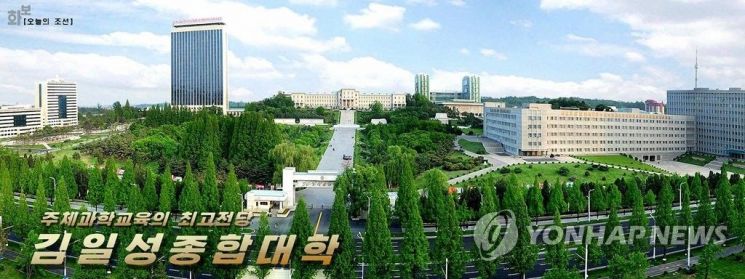 The North Korean monthly pictorial for external publicity, "Choson," featured a photo of the Kim Il-sung University campus, North Korea's top prestigious university, in its November issue.
 [Photo by Yonhap News]
Researcher Ham analyzed the private education market in North Korea, focusing on Pyongyang, by cross-analyzing testimonies from defectors who were former teachers and students, held by the National Democratic Institute (NDI).
Defector A, who followed the 'elite course' at Wonsan No. 1 Middle School and Pyongyang University of Science and Technology, stated, "I received private education from a young age," adding, "At first, I gave rice, but later I paid 300,000 won per month." Calculating at the Pyongyang Jangmadang exchange rate recently known to be around 8,000 won per 1 US dollar, the private tutor's monthly salary is about 38 US dollars. If a private tutor teaches three students, they can earn more than North Korea's average monthly income of 92 US dollars.
Many private education providers in North Korea are school teachers who receive low wages, and it is known that many university students and university professors have also entered the private education market. Recently, the number of instructors specializing in private education has increased.
On the other hand, North Korean teachers' salaries are said to be at a level where they can only buy about 0.5 kg of rice, making it impossible to maintain daily life. Although private education is officially prohibited in North Korea, it is not easy for poorly paid teachers to ignore the opportunity if it arises.
Most private education takes place at the homes of students or teachers. There were also eyewitness accounts that if a highly skilled teacher lives far away, parents pool their money to secure a nearby house.
Some come to Pyongyang from other cities to receive private lessons, and popular lectures have limited spots like Korea's 'Ilta-gangsa,' so registration must be done quickly.
Researcher Ham stated that the demand and supply of teachers who earn significant profits from the private education market align with the emerging forces who have earned money through the Jangmadang, suggesting that private education has become firmly established.
In South Korea, due to high educational enthusiasm, the government sets upper limits on tutoring fees to prevent excessive costs. The Gangnam Seocho Office of Education, which oversees the academy district in Daechi-dong, Gangnam-gu, Seoul, has set the upper limit for entrance exam consulting fees at 5,000 won per minute. This is the highest price in the country.
Based on the Daechi-dong academy district, entrance exam consulting fees can be up to 300,000 won per hour, but in reality, it is not uncommon for fees to exceed 1,000,000 won.
© The Asia Business Daily(www.asiae.co.kr). All rights reserved.

















