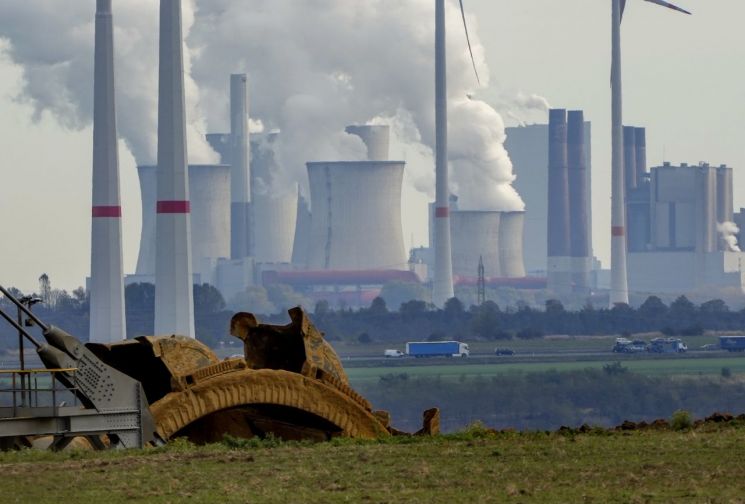
 Steam is rising from the chimney of a coal-fired power plant located near the Garzweiler open-pit coal mine in L?tzerath, Germany. [Image source=Yonhap News]
The International Energy Agency (IEA) forecasted on the 15th (local time) that global coal demand will reach an all-time high this year and then begin to decline starting next year.
This latest prediction came after the 28th United Nations Climate Change Conference of the Parties (COP28), which concluded two days ago, reached an agreement on the so-called 'fossil fuel phase-out' to prevent global warming.
In its annual coal report published on the same day in Paris, France, the IEA projected that global coal demand will increase by 1.4% compared to the previous year, surpassing 8.5 billion tons for the first time. The increase in coal demand is expected mainly in emerging and developing countries. The IEA attributes the rise in coal demand to increased electricity demand and a decrease in hydropower generation.
It was identified that coal demand increased by 220 million tons (4.9% year-on-year) in China alone this year, along with 98 million tons (8%) in India and 23 million tons (11%) in Indonesia. These three countries are the world's top three coal producers, accounting for more than 70% of global coal production.
In Russia, the world's fourth-largest coal consumer, accurate data was unavailable due to the war in Ukraine. Meanwhile, coal consumption in Europe is expected to decrease by 107 million tons (23%), and in the United States, it is estimated to decline by 95 million tons (21%) thanks to weakened industrial activity and a continued transition to renewable energy.
The IEA diagnosed that the center of gravity for coal demand and production is shifting rapidly to Asia. While China, India, and Southeast Asia accounted for only a quarter of global coal consumption in 1990, they are expected to represent three-quarters of global consumption this year.
In particular, coal consumption in Southeast Asia is expected to surpass that of the United States and the European Union for the first time this year. However, the IEA forecasted that due to the increasing share of renewable energy generation such as solar and wind power, global coal demand will decrease by 2.3% from this year through 2026.
In China as well, with the increase in renewable energy generation, coal demand is expected to decline starting next year and remain stagnant through 2026. The IEA stated, "The forecasted decline in coal demand, the largest source of carbon dioxide emissions, could mark a historic turning point, but market reports indicate that global consumption will still far exceed 8 billion tons by 2026," adding, "To meet the Paris Agreement goals, coal usage must be reduced much faster."
© The Asia Business Daily(www.asiae.co.kr). All rights reserved.

















