'Presentation on the Management Status and Policy Tasks of Small Business Owners'
Half of small business owners expect the business environment next year to be more difficult than this year.
The Korea Federation of SMEs announced on the 17th the results of the "Small Business Management Status and Policy Tasks" survey conducted from the 1st to the 24th of last month, targeting 1,000 small business owners in lifestyle-related industries and manufacturing sectors.
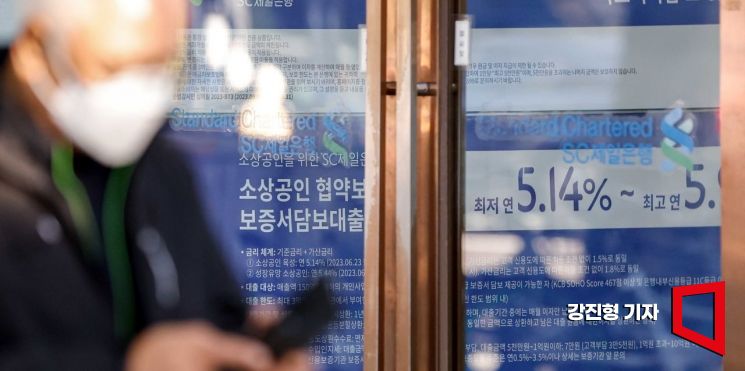 A notice regarding small business collateral loans is posted at a major bank in Seoul. Photo by Jinhyung Kang aymsdream@
92.5% of small business owners forecast that the business environment next year will either worsen (50.1%) or remain similar (42.4%) compared to this year.
The biggest management burden this year was identified as "high prices such as rising raw material and material costs" (33.8%), followed by "rising labor costs and difficulties in securing manpower" (21.8%), and "high interest rates, loan repayment burdens, and maturity arrivals" (18.3%).
However, 82.9% of small business owners responded that they are not considering closing their business within the next year. A representative from the Korea Federation of SMEs explained, "This is interpreted as being due to livelihood-type startups accounting for 89.0% of the total, driven by reasons such as difficulty finding employment or preparing for old age." It was confirmed that 91.1% of startups by small business owners aged 60 and over are livelihood-type, and 78.4% of small business owners aged 60 and over have maintained their business for more than 10 years.
The average preparation period for starting a business was 7.6 months, and the average startup cost was 450 million KRW. The status before starting a business was surveyed as wage workers (46.2%), small business owners maintaining the same industry (35.7%), and small business owners changing industries (9.2%).
From January to October this year, the average monthly sales of small business owners were 46.1 million KRW, operating profit was 5.07 million KRW, and loan principal and interest repayments were 2.89 million KRW. Among them, small business owners in the accommodation and food service industry had an average monthly loan principal and interest repayment of 6.6 million KRW, which was higher than the average.
The most needed support policy direction for small business owners in the field was "overcoming management crises through financial support, etc." (72.9%), followed by "fostering entrepreneurial small business owners and supporting digital transformation" (12.7%), and "improving overcrowded competition structure, supporting business closure and recovery" (10.4%).
Regarding policy issues to be discussed by the next National Assembly or government, responses included "increase in loan delinquency rates and worsening of non-performing loans" (33.6%), "labor cost burden and manpower supply issues" (32.1%), and "energy cost burdens such as electricity and gas bills" (19.4%).
Choo Moon-gap, head of the Economic Policy Headquarters at the Korea Federation of SMEs, said, "The business environment for small business owners is deteriorating due to the increase in marginal small business owners caused by the recent complex economic crisis and the decline in competitiveness due to micro and overcrowding," adding, "Comprehensive measures are needed, including guiding the smooth landing of marginal small business owners through the establishment of a social safety net and preparing plans to enhance the self-sustainability of small business owners."
This survey was conducted to understand the management status of small business owners struggling with the three highs?high prices, high interest rates, and high exchange rates?as well as loan repayment burdens, and to discover policy tasks that can be felt on the ground.
© The Asia Business Daily(www.asiae.co.kr). All rights reserved.

















