"Women's Empowerment: A Powerful Means to Promote Economic Growth"
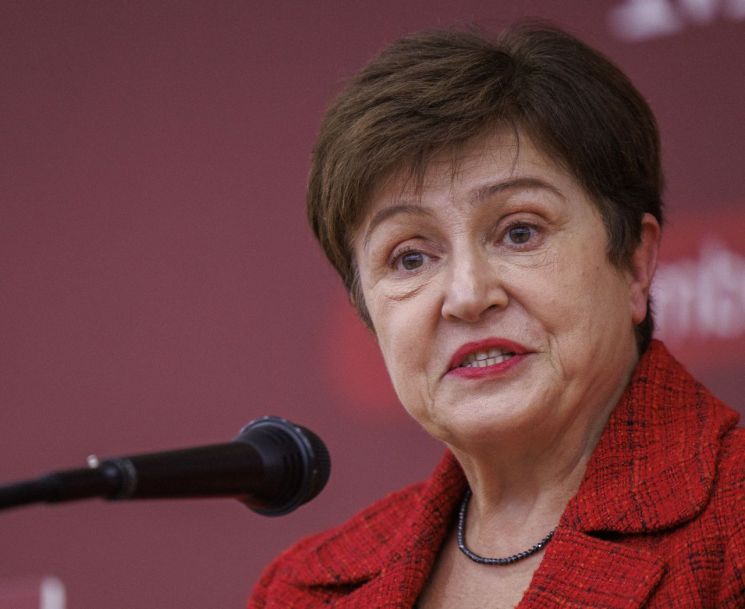
"South Korea remains one of the advanced countries with the widest gender gap. If South Korea reduces the gender gap in working hours to the average level of peer countries through appropriate policies, its per capita national income could increase by 18%."
Kristalina Georgieva, Managing Director of the International Monetary Fund (IMF), stated this on the afternoon of the 14th during a keynote speech titled "The Global Economy and Women's Empowerment" at a special forum hosted by the World Council of Women Directors (WCD) Korea Chapter, held on the 3rd floor of the annex building of the Government Complex. She said, "Despite global progress, the gender gap is not narrowing." Born in Bulgaria, Georgieva is the second female Managing Director in IMF history, following her predecessor Christine Lagarde (currently President of the European Central Bank).
Georgieva pointed out, "Although South Korea has made significant progress recently in increasing women's economic participation, the gender gap remains large," adding, "The number of working women in South Korea is 18% less than men, and their wages are 31% lower than men's."
She emphasized, "At a time when global growth is expected to be the lowest in decades over the next few years, empowering women economically is one of the most powerful means to stimulate economic growth. Increasing the female labor force can help alleviate the stagnation or decline in the working-age population faced by advanced countries, including South Korea."
Regarding South Korea's gender gap, she explained that it mainly stems from social norms and customs, as well as the dual structure of the labor market, which creates disparities between workers with job security and others. She said, "More women need to participate in the labor market through direct support, flexible labor markets, and improvements in customs." According to IMF research, if current trends continue, the gender gap will narrow but never be completely closed.
Increase Paternity Leave and Expand Flexible Work
Georgieva cited golf as one of the fields where Korean women excel. She said, "Among the world's top 100 female golfers, 33 are Korean women, thanks largely to their efforts," adding, "Just as companies support players and tournaments to nurture golfers, practical measures from companies and the government are necessary for women to advance in all fields."
First, she urged strengthening direct support so women can balance work and family responsibilities. Policies such as childcare support and parental leave should be expanded to include part-time workers and self-employed individuals, and support for re-education and career retention programs should be increased to help married women returning to the labor market enter high-wage sectors.
Flexible labor markets were also identified as a priority. She emphasized the importance of enabling more workers to use flexible working hours, as in Finland and Sweden, and reducing the costs of hiring and firing employees. Additionally, incentives should be provided for men to take parental leave, and efforts should be made to shift the pay system from seniority-based to performance-based.
She continued, "Empowering women leads to higher incomes and stronger company competitiveness," and stated, "According to IMF research, if South Korea reduces the gender gap in working hours to the average level of peer countries through appropriate policies, per capita national income could increase by 18%."
Georgieva added, "Financial institutions with higher gender diversity in senior positions and board composition tend to have lower non-performing loan ratios and greater financial stability," and "when there are more women leaders and gender-balanced decision-making, organizational performance can improve."
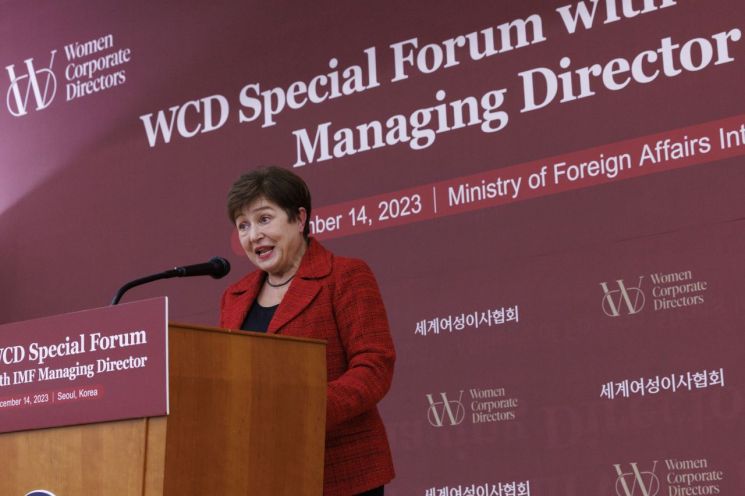
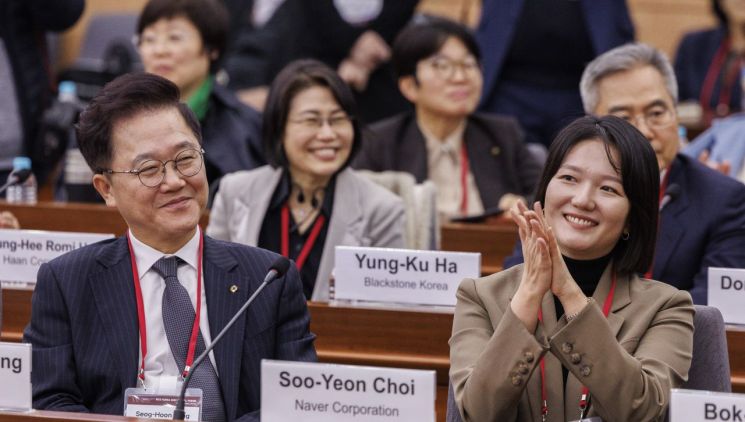
Following the keynote speech, a panel discussion was held with Managing Director Georgieva, Yoo Myung-soon, CEO of Citibank Korea, Seo Young-kyung, a member of the Financial Services Commission, Lee Bok-sil, Chair of the Lotte Card ESG Committee, and Choi Soo-yeon, CEO of Naver. During the panel, Seo Young-kyung introduced South Korea's ultra-low birthrate situation and inquired about long-term strategies to raise the birthrate.
Georgieva responded, "Countries like Sweden and Denmark have made parental leave very universal, and men also take a lot of parental leave," adding, "They support women to work longer by providing affordable childcare policies, achieving a good balance between work and life."
She also mentioned that societal perspectives on women are very important. She shared, "When I worked at the World Bank, most senior positions were held by men, and when I visited offices of high-ranking politicians like prime ministers on business trips, most people thought I was an interpreter (laughs)." She said, "The way I dealt with this was to ask male team members to introduce me," explaining that while social norms are unavoidable, instead of just complaining about them, smiling and finding ways to overcome them can lead to better outcomes.
When asked about IMF's measures to promote women's participation within organizations, she emphasized, "First, it is important to identify the categories where women face challenges." Georgieva gave specific examples: "In Washington DC, the burden of childcare was a major challenge," and "We provided more financial support to employees with children to cover childcare costs, which employees valued highly." She also said, "When women are a minority in an organization, it is difficult to form the desired dynamics," and "We supported men to actively participate in gender equality efforts and enabled women to consider career development through mentoring."
Only 2.4% of CEOs in Korea’s Top 1000 Companies Are Women
When Naver CEO Choi Soo-yeon asked about ways to promote female leadership in the AI era, Georgieva stressed the importance of ensuring that boards of directors in the corporate business world are not composed solely of male candidates. Choi emphasized, "Only 2.4% of CEOs among Korea's top 1000 companies are women, and among them, only 0.5% are women who are neither founders nor related by blood," adding, "To move beyond perceiving female CEOs primarily as women rather than CEOs, there must ultimately be more female CEOs."
Georgieva shared a personal tip she learned through experience. She said, "Women should never try to become like men. It is important to promote diversity as women. Believe in and show your true self."
She cited an example from when she was in charge of recruitment at the European Union (EU). She said, "Male candidates met three out of five criteria and were considered the best fit, while female candidates met only three out of five and did not meet the other two," adding, "Just as it is hard to attract people who do not fight or actively step forward, women should stop hesitating, believe in themselves, and act proactively."
She recalled, "When I first went to work at the World Bank wearing a floral jacket, I saw that there were no other women around and no one wore floral jackets, so I thought about changing into a black suit, but now I no longer wear gray suits," encouraging, "Show your true self." On this day as well, Georgieva wore a striking red-toned outfit.
Georgieva candidly admitted that balancing work and life was not easy. She said, "There were many sacrifices in my personal life," and "There were many times I missed my child's birthday because of work." She added, "However, we have an obligation to share time with friends and family," and "The most precious time is the time I spend with my two grandchildren and my daughter," urging, "Make sure to spend time with your family."
Meanwhile, the World Council of Women Directors (WCD), which hosted the event, is a nonprofit global membership organization founded with the goal of expanding and nurturing female directors on corporate boards. The WCD Korea Chapter contributed to the amendment of the Capital Market Act, which mandates that listed companies with assets exceeding 2 trillion won cannot form boards composed of only one gender, effectively requiring at least one female director.
© The Asia Business Daily(www.asiae.co.kr). All rights reserved.



















