IBM Announces Support for Korea-US-Japan University Quantum Education at US Embassy in Korea
Korea Joins US-Japan Quantum Computer Collaboration Centered on US and Japan
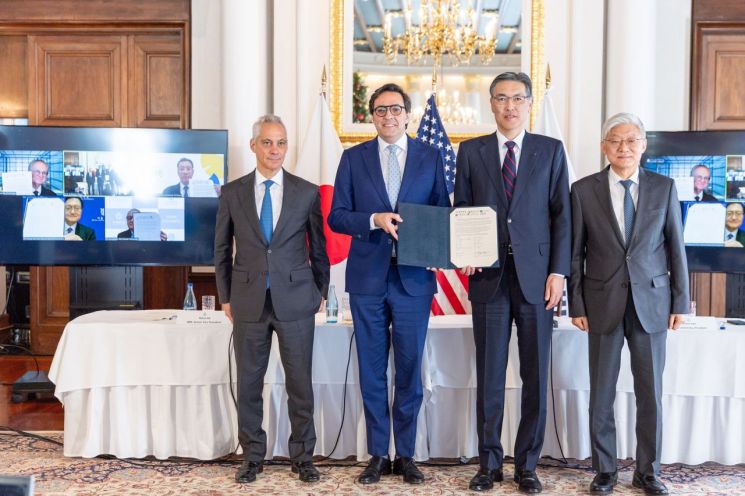 From the left) Rahm Emanuel, U.S. Ambassador to Japan; Dario Gil, Senior Vice President of IBM and Director of IBM Research; Kohei Itoh, President of Keio University; Deokmin Yoon, South Korean Ambassador to Japan. Photo by IBM
South Korea is now officially joining the quantum computer alliance previously led by the United States and Japan. The trilateral cooperation among South Korea, the U.S., and Japan is expected to intensify in response to China's rapid growth in quantum computing.
On the 14th, at the U.S. Embassy in Tokyo, Japan, a statement was announced supporting the training of quantum computing personnel at universities in South Korea, the U.S., and Japan. The announcement was attended by Ram Emanuel, U.S. Ambassador to Japan, and Yoon Deok-min, South Korean Ambassador to Japan, with IBM, a U.S. technology company, spearheading the initiative.
The core of this statement is that IBM, which is leading quantum computer development, will support quantum education activities at Yonsei University, Seoul National University, Keio University, the University of Tokyo, and the University of Chicago to train 40,000 quantum professionals over the next decade. IBM plans to develop a robust quantum curriculum with these universities to educate the next generation of computing scientists capable of using quantum computers as scientific tools.
This statement stands out because South Korea has joined a collaboration that was originally centered on the U.S. and Japan. The U.S. and Japan have been strengthening cooperation to counter China's state-driven quantum computing industry development. In May last year, U.S. President Joe Biden signed a national security memorandum and an executive order to strengthen the National Quantum Initiative Advisory Committee, summarizing plans to prepare for the quantum computing era. In May this year, during the G7 summit held in Hiroshima, IBM and Google announced donations of $100 million and $50 million respectively to support quantum computing research at the University of Chicago in the U.S. and the University of Tokyo in Japan.
The trilateral quantum-related cooperation among South Korea, the U.S., and Japan followed a discussion between South Korean President Yoon Suk-yeol and Japanese Prime Minister Fumio Kishida at Stanford University in the U.S. last November, where they emphasized cooperation between South Korea and Japan in AI, quantum, and semiconductor fields.
Ram Emanuel, U.S. Ambassador to Japan, indirectly expressed the importance of trilateral quantum cooperation to counter China. He said, "The monumental trilateral collaboration among IBM and world-leading universities in the U.S., South Korea, and Japan represents a significant advancement in quantum education, ensures sustained technological leadership, and exemplifies the spirit of international cooperation and technological progress essential in today’s interconnected world."
Yoon Deok-min, South Korean Ambassador to Japan, also stated, "Since the Camp David Accord, cooperation among the three countries?South Korea, the U.S., and Japan?has expanded into various fields including security, economy, advanced technology, health, and cyber. In cutting-edge technology areas such as quantum computing, trilateral cooperation is increasingly essential."
© The Asia Business Daily(www.asiae.co.kr). All rights reserved.

















