Other countries offer various options like 'family plans'
South Korea forces expensive plans through 'bundling'
"Fair Trade Commission investigation and regulatory intervention must be expedited"
With a 42% increase in YouTube Premium prices (from the previous 10,450 KRW per month to 14,900 KRW per month), consumer dissatisfaction over the 'YouTube Music bundling' is growing. The controversy, which had been quiet due to the advantage of watching videos without ads and unlimited use of music at a price similar to other music platforms (7,000 to 9,000 KRW per month) at around 10,450 KRW per month, is reigniting due to the excessive price hike. Unlike other countries where users can choose a cheaper plan that only removes ads without music services or select a family plan, the lack of options in Korea has even led to comments like "Are Koreans suckers?"

"Expensive package, forced purchase with no choice"
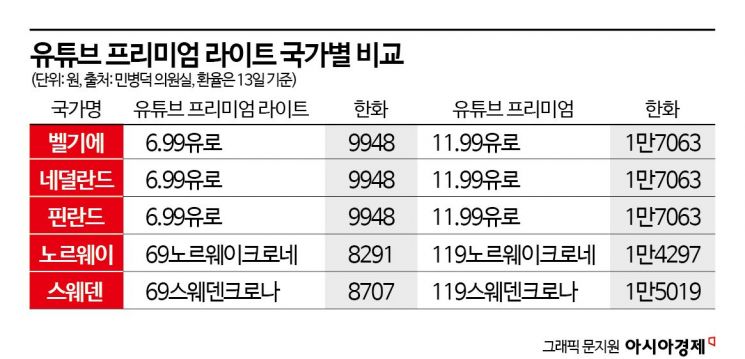
In some European countries, there is a cheaper 'YouTube Premium Lite' plan that excludes YouTube Music and only includes basic features like ad removal. In Sweden, it costs 69 Swedish Krona (8,707 KRW). This is 43% cheaper compared to the 'YouTube Premium' plan with YouTube Music at 119 Swedish Krona (15,019 KRW). Denmark, Norway, Finland, Belgium, and others also offer such plans at about half the price of the premium plan.
However, such plans do not exist in Korea. Only two plans are available: the 'YouTube Music Premium' plan that allows use of only YouTube Music, and the 'YouTube Premium' plan that adds ad removal to YouTube Music. Choi Kwang-ho, Secretary General of the Korea Music Content Association, said, "If there was a cheaper plan in Korea that only removed ads, it would sell like hotcakes. But since only bundled products exist now, people have no choice but to buy the expensive package reluctantly."
Moreover, family plans or student plans available in other countries do not exist in Korea. Only individual plans are available. The family plan allows up to six people to use premium features under one account. If all six use it, the cost is about 25% of the individual plan. The student plan costs about 60% of the individual plan. During this year's National Assembly audit of the Fair Trade Commission, Min Byung-duk, a member of the Democratic Party, pointed out, "Only Korea and Slovenia have individual plans only," and said, "They are forced to use a single pricing plan."
"Fair Trade Commission should expedite investigation"
Experts unanimously stated, "YouTube Music bundling infringes on consumer choice by leveraging its monopolistic position." Professor Eun-hee Lee of Inha University's Department of Consumer Studies said, "Forcing consumers to pay for things they do not need when there are no alternatives is problematic as a market dominator. Especially problematic is the forced use of an expensive 'single plan' to avoid ads even for users who do not need music features, and the disruption of the music platform market through bundling by leveraging platform influence."
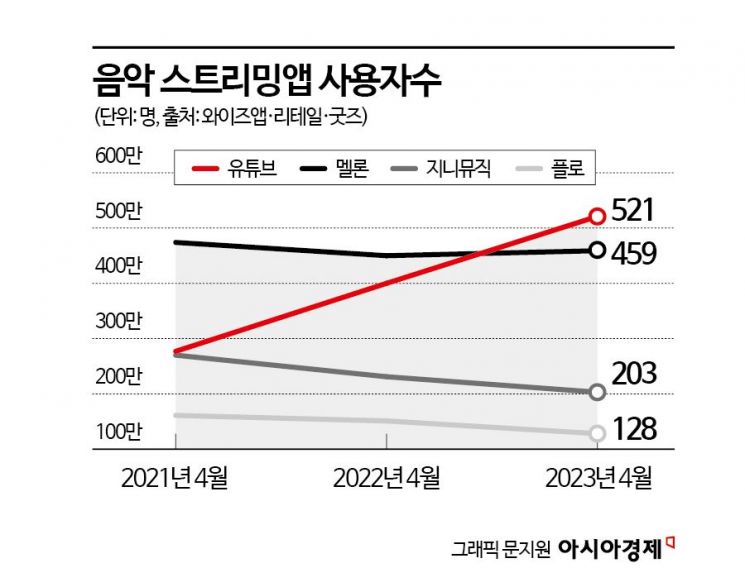
In fact, YouTube Music has surpassed Melon to become the number one domestic music platform by number of users. This is thanks to the bundling plan that allows ad removal and unlimited music use, which absorbed users from existing music platforms. The influence of YouTube, the 'national media,' is immense. People of all ages and from both urban and rural areas watch YouTube. The monthly active users (MAU) as of last October was 41.07 million, closely trailing the undisputed number one KakaoTalk at 41.22 million. Secretary General Choi Kwang-ho said, "Even if you bundle bread instead of YouTube Music, the bread would become number one, and if you bundle books, that book would become number one."
Under the Fair Trade Act, bundling is classified as a type of unfair trade practice called 'tying.' It refers to selling a popular product together with a less popular product. The Fair Trade Commission conducted an on-site investigation in February to verify whether Google Korea abused its monopoly position through 'YouTube Music bundling.' However, nearly a year later, there has been no news. Professor Eun-hee Lee said, "If the issue is clearly problematic but left unattended, Google will treat Korean consumers even more carelessly. Even multinational companies must respect and protect consumer rights against unfair prices or services."
© The Asia Business Daily(www.asiae.co.kr). All rights reserved.



















