Possibility of Bank of Korea Rate Cut in Q2 Spreads
BOK "Monetary Policy Stance Remains Unchanged"
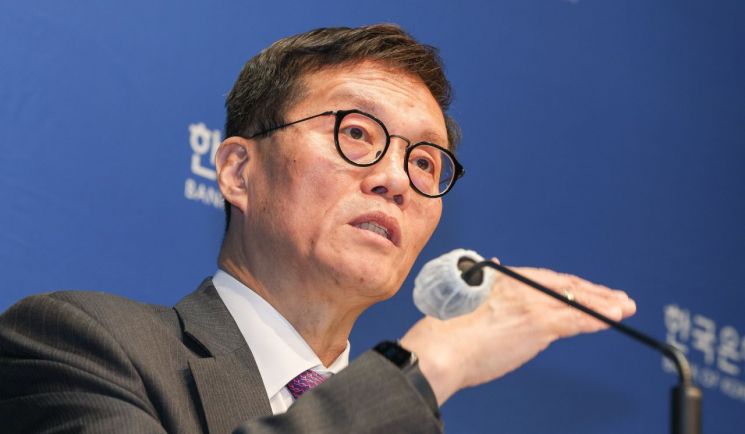 Governor Lee Chang-yong speaking at the Financial Monetary Committee press conference
 [Photo by Yonhap News]
The U.S. Federal Reserve (Fed) has signaled the end of its rate hike cycle and forecasted three rate cuts next year, sparking debates over the timing of South Korea's benchmark interest rate cuts. Jerome Powell's dovish remarks, which were stronger than expected, have further fueled expectations for rate cuts, leading to rapid speculation that South Korea's rate cut timing may be brought forward.
On the morning of the 14th, the Bank of Korea (BOK) stated at the 'Market Situation Review Meeting' that "since the November Federal Open Market Committee (FOMC), expectations of a policy shift have formed in the market, as evidenced by the slowdown in U.S. inflation indicators and dovish remarks from Fed officials, causing U.S. Treasury yields to fall significantly. The December FOMC results are expected to further strengthen these market expectations."
Yoo Sang-dae, Deputy Governor of the BOK, said, "Going forward, attention to the Fed's monetary policy operations will likely focus on the timing of rate cuts, during which volatility in financial and foreign exchange markets may frequently increase. We will closely monitor the U.S. inflation and economic trends and changes in monetary policy stance to carefully assess their impact on the domestic economy and financial and foreign exchange markets."
U.S. Rate Cuts Possibly as Early as Q1... Accelerated Timing of Cuts
Experts note that the market sentiment, which had anticipated high rates and a prolonged period, has shifted over the past month, and Powell's remarks have raised expectations, prompting close attention to the impact on South Korea's monetary policy. Initially, the U.S. rate cut timing was expected in the second to third quarter of next year, but growing market expectations suggest it could happen as early as the first quarter, leading to opinions that South Korea's rate cut timing will also be advanced.
Jo Yong-gu, a researcher at Shin Young Securities, said, "The downward revision of core inflation forecasts in the U.S. economic outlook by 50 basis points (bp) by the end of this year and 20 bp by the end of next year means that the timing of rate cuts will be brought forward and the magnitude of cuts will increase. We are revising our forecast to have the U.S. start rate cuts in June next year."
The view that South Korea could cut rates before the U.S. due to an earlier monetary policy shift in the U.S. is fading amid expectations that the U.S. monetary policy transition may occur sooner than anticipated. Kwon Hyo-sung, an economist at Bloomberg Korea, said, "While the pace of inflation slowdown in the U.S. is rapid, South Korea's inflation rate is expected to remain in the high 2% range until the second quarter of next year, delaying the slowdown. The U.S. rate cuts are expected to begin in the second quarter, and South Korea's cuts will likely be possible only in the third quarter."
From the BOK's perspective, it breathed a sigh of relief as the Fed is expected to hold policy rates steady at the December FOMC and signal rate cuts next year, expanding the scope for monetary policy maneuvering. However, concerns about the timing and number of rate cuts have increased. Kim Jung-sik, Emeritus Professor of Economics at Yonsei University, pointed out, "The BOK, which is seriously concerned about household loan growth and persistent cost-push inflation pressures, will find it difficult to hastily lower rates following the U.S. If inflation is not controlled, additional hikes must be seriously considered. A situation where rates neither rise nor fall may continue for some time, and differentiated monetary policies depending on inflation and economic conditions cannot be ruled out."
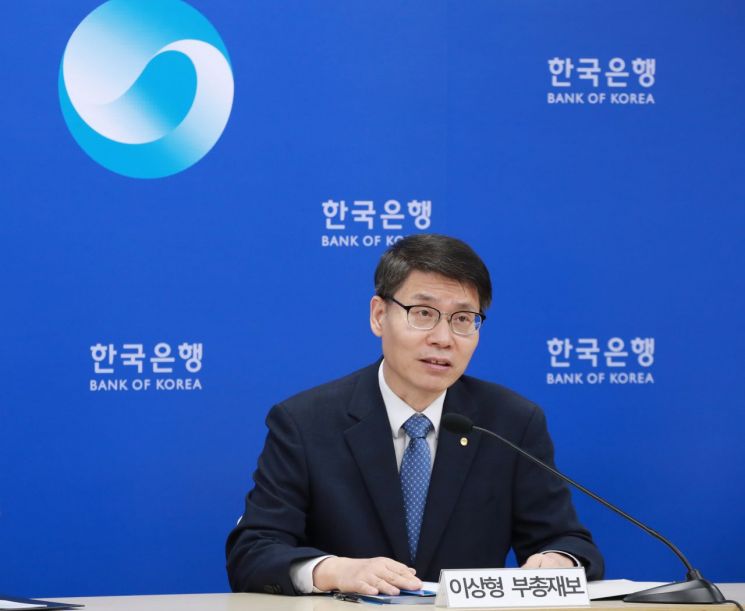 Lee Sang-hyung, Deputy Governor, speaking at the Monetary Credit Policy Report briefing session [Photo by Yonhap News]
On the day the BOK released its 'Monetary and Credit Policy Report,' a briefing was held where reporters asked questions about future monetary policy following the recent U.S. FOMC results. However, the BOK stated that discussions on rate cuts are not currently taking place within the Monetary Policy Committee, and the existing monetary policy stance remains unchanged.
Lee Sang-hyung, Deputy Governor of the BOK, said, "Although today's FOMC results are viewed as dovish by the market, the Monetary Policy Committee will decide monetary policy comprehensively considering various indicators including growth and inflation, including today's FOMC results. At present, there is no change in the policy direction to maintain tightening for a sufficiently long period until there is confidence that inflation will converge to the target level."
Regarding the downward revision of the median rate forecast by 0.5 percentage points (from 5.1% to 4.6%) at the December U.S. FOMC, he explained, "The lowered rate on the dot plot still remains in the mid-to-high 4% range, and it is important to assess whether the inflation environment will return to that of the 2010s in the medium to long term. Considering the U.S. labor market situation, inflation expectations, global supply chains, climate change responses, and major countries' monetary policy changes, we continue to maintain the view that it will be difficult to return to the pre-COVID environment in the short term."
BOK: "No Discussions on Rate Cuts... Inflation is Key"
The biggest variable for future monetary policy shifts was identified as inflation. Deputy Governor Lee emphasized, "Above all, whether inflation will converge to the target level (2%) is the most important factor. Along with this, we will comprehensively consider indicators such as household debt, financial stability, and growth."
When asked whether market expectations for rate cuts following the U.S. FOMC results are excessive, Deputy Governor Lee responded, "While the Fed's impact on the global economic and financial situation is significant and a major consideration, it is not appropriate to mechanically link our monetary policy to changes in the Fed's policy. It is difficult to judge solely by short-term market interest rate movements how market expectations are reflected. We will monitor how these expectation changes affect household loans and continue to communicate with the market."
© The Asia Business Daily(www.asiae.co.kr). All rights reserved.


















