Bank of Korea Releases December Monetary and Credit Policy Report
Signs of Recovery Centered on Bonds
The Bank of Korea advised that the expansion of private sector overseas securities investment in the third quarter of this year should be carefully monitored for the possibility of leading to instability in the foreign exchange market.
In the Monetary and Credit Policy Report released on the 14th, the Bank of Korea mentioned this regarding the recent increase in private sector overseas securities investment.
According to the Bank of Korea, private overseas securities investment sharply slowed down after the U.S. Federal Reserve began its interest rate hike cycle in March last year, but in the third quarter of this year, net investment expanded as asset management companies increased their overseas bond investments and individuals increased their U.S. Treasury bond investments.
Overseas stock investment appeared to have slowed due to the possibility of exchange losses caused by high exchange rates and high exchange rate volatility. According to the Bank of Korea, stock investments employing a foreign exchange open strategy have been shrinking since the second half of last year.
The Bank of Korea expressed concern, stating, "While the expansion of private overseas securities investment improves external soundness by increasing net external assets and investment income and performs a positive function by flowing back domestically during crises to help stabilize the market, in situations where foreign exchange supply is limited, it can exacerbate market supply-demand imbalances, leading to exchange rate increases and foreign exchange market instability."
U.S. Treasury Yields Increasingly Affect South Korea’s Yield Curve
Regarding the influence of U.S. Treasury yields on South Korea’s yield curve (the difference between long- and short-term government bond yields), it was evaluated that this influence is expanding frequently.
According to the Bank of Korea, recently, major countries’ yield curves steepened significantly in September and October due to fluctuations in medium- to long-term government bond yields of 2-3 years or longer, but have shown rapid flattening since last month.
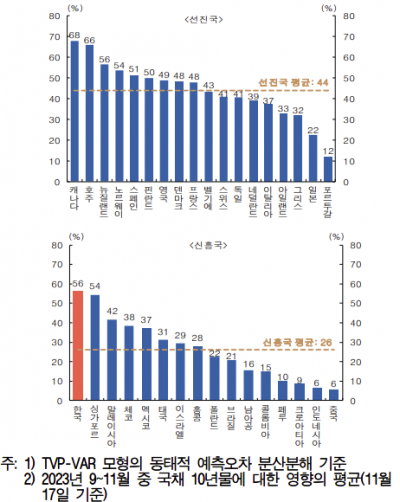 The impact of U.S. Treasury yields on the sovereign bond yields of other countries. Source: Bank of Korea
The Bank of Korea explained, "Major countries’ yield curves generally showed highly synchronized movements, either steepening sharply or flattening significantly," and added, "It is assessed that the sharp fluctuations in U.S. Treasury yields mainly transmitted to other major countries through the term premium." The term premium refers to compensation for the risk associated with holding bonds for a long period.
It continued, "In South Korea’s case, with no significant changes in domestic monetary policy expectations or government bond supply-demand conditions, the influence of U.S. Treasury yields has expanded, causing large fluctuations in the yield curve," and advised, "Given the high uncertainty regarding the monetary policy paths of major countries, it is important to note that this influence will continue to expand frequently, potentially creating financial market conditions that diverge from the domestic economic situation. Therefore, market forecasts and expectations should be observed more carefully."
© The Asia Business Daily(www.asiae.co.kr). All rights reserved.


















