International Conference on the 14th: 'Digital Currency: Navigating the Changing Financial Environment'
Choo Kyung-ho "A Double-Edged Sword with Innovation and Instability... Need for International Organization Cooperation"
A Forum for Digital Currency Discussion... Exploring the Possibility of Cross-Border CBDC Use
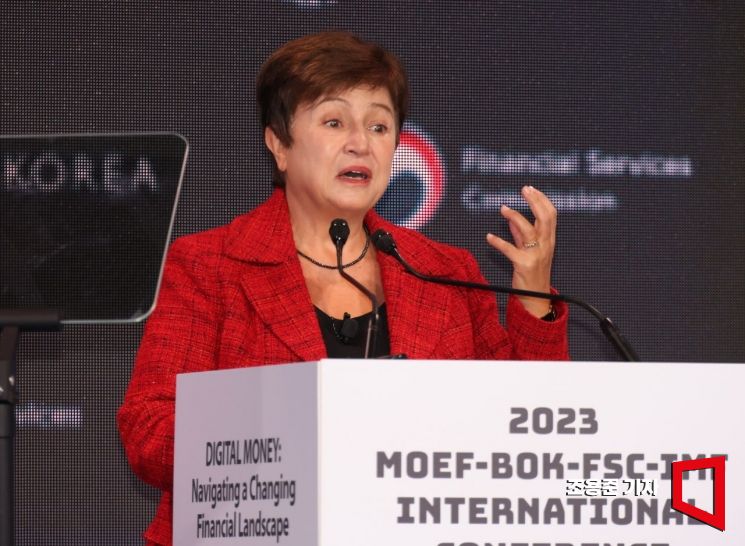 Kristalina Georgieva, Managing Director of the IMF, who visited Korea for the first time, is giving a speech at the Korea-IMF Digital Asset Conference held on the 14th at the Four Seasons Hotel in Jongno-gu, Seoul. This event features panel discussions on the economic impact and prospects of digital currency, directions for virtual asset regulation, the future of money, and the role of central banks. Photo by Yongjun Cho jun21@
"An affordable, stable, and reliable central bank digital currency (CBDC) utilizing blockchain technology is necessary. To achieve this, it is important to comply with international standards such as anti-money laundering and to establish public infrastructure."
Kristalina Georgieva, Managing Director of the International Monetary Fund (IMF), emphasized the need for public efforts to enhance the stability of crypto assets and lay the foundation for CBDC development at the international conference "Digital Currency: Exploring the Changing Financial Environment," held on the 14th at the Four Seasons Hotel in Gwanghwamun, Seoul, co-hosted by the Ministry of Economy and Finance, the Financial Services Commission, the Bank of Korea, and the IMF.
She mentioned that Korea is showing leadership in creating a safe environment for the use of crypto assets. Managing Director Georgieva stated, "Appropriate regulation and discipline for crypto asset issuers and issuing institutions are necessary to build infrastructure for a more efficient, interoperable, and accessible financial system," adding, "Korea has recently demonstrated leadership by amending the Anti-Money Laundering Act and preparing new legislation on crypto assets."
She continued, "To prevent a future where crypto assets undermine macro-financial stability, it is essential to establish a proper legal framework and set good rules that lead to (desirable) innovation." This is a recommendation to ensure that as virtual assets gain a larger foothold in the financial environment, they do not jeopardize macro-financial stability.
At the conference, high-level officials from the co-hosting organizations attended, including Deputy Prime Minister and Minister of Economy and Finance Choo Kyung-ho, Bank of Korea Governor Lee Chang-yong, and Financial Services Commission Vice Chairman Kim So-young, along with domestic and international digital currency experts.
Deputy Prime Minister Choo Kyung-ho pointed out in his opening remarks that digital currency is a double-edged sword with both innovation and instability. He said, "Digital currency can open new industries and markets, such as tokenized securities, creating opportunities for economic growth and job creation, but it is somewhat vulnerable in terms of reliability and stability." He added, "As existing monetary policies become less effective and the current financial crisis response system, which mitigates sudden capital inflows and outflows, deteriorates."
Therefore, he emphasized, "It is the government's role to establish an institutional foundation so that digital currency does not undermine the stability of the current economic and financial system." To this end, "The government must design flexible policies and systems within an appropriate regulatory framework, seek alternatives to secure platform stability such as CBDC, and establish global standards through cooperation among international organizations."
Financial Services Commission Vice Chairman Kim So-young introduced global regulatory trends and the current policy status, including the enforcement of domestic virtual asset laws aligned with these trends. She also mentioned the need to strengthen international cooperation to build an effective regulatory system due to the frequent cross-border nature of transactions.
Discussion on Directions for Utilizing Digital Currency... Exploring the Possibility of Cross-Border CBDC Use
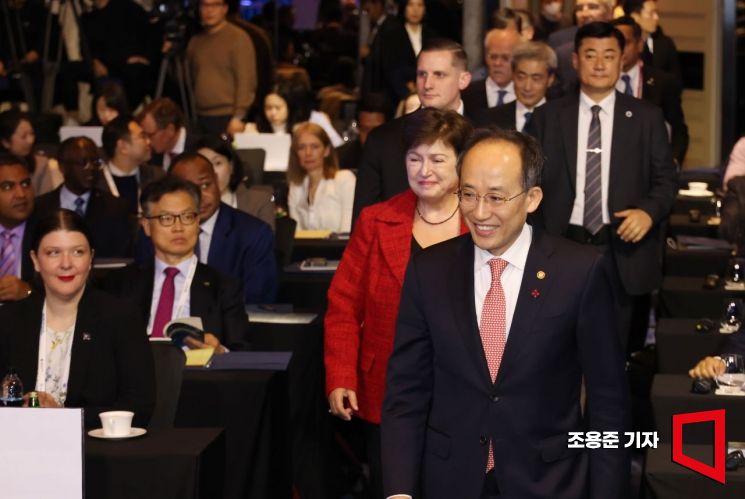 On the 14th, at the Four Seasons Hotel in Jongno-gu, Seoul, Choo Kyung-ho, Deputy Prime Minister and Minister of Economy and Finance, Kristalina Georgieva, Managing Director of the IMF, and others are entering the Korea-IMF Joint Digital Asset Conference. Photo by Jo Yong-jun jun21@
This conference is the first joint event held by the Korean government and the IMF in six years since 2017, taking place over two days from the 14th to the 15th.
On the first day of the conference, discussions focused on digital currency. In the first session, Managing Director Georgieva and Vice Chairman Kim discussed the impact of digital currency on the macroeconomy and financial systems. Shin Hyun-song, Director of the Bank for International Settlements (BIS), who participated in the discussion, said, "Crypto assets were created to circumvent legal frameworks, so a public infrastructure approach is necessary," adding, "The Bank of Korea is currently working on connecting tokenized deposits and various digital assets through CBDC."
The second session is planned to explore various potential uses of digital currency and discuss regulatory and technical foundations for stable utilization. The final session of the first day will involve discussions on regulatory trends for virtual assets in various countries and the need for internationally consistent regulations.
The second day of the conference will focus on CBDC. Discussions will cover the impact of digital currency on the role of central banks, the potential coexistence between stablecoins and CBDC, and the use of cross-border CBDC.
The final session will feature a high-level policy discussion involving Bank of Korea Governor Lee Chang-yong and the Governor of the National Bank of Cambodia, addressing the role of central banks in the digital economy and the benefits and risk factors of digital currency.
© The Asia Business Daily(www.asiae.co.kr). All rights reserved.


















