The U.S. central bank, the Federal Reserve (Fed), kept the benchmark interest rate unchanged as expected at the final Federal Open Market Committee (FOMC) meeting of the year and officially signaled rate cuts next year. Through the dot plot, it lowered the year-end rate forecast to 4.6% (median), suggesting the possibility of three rate cuts over the course of the year. The market immediately cheered the dovish Fed, calling it an "early Christmas gift." On the New York Stock Exchange, the Dow Jones Industrial Average hit a record high.
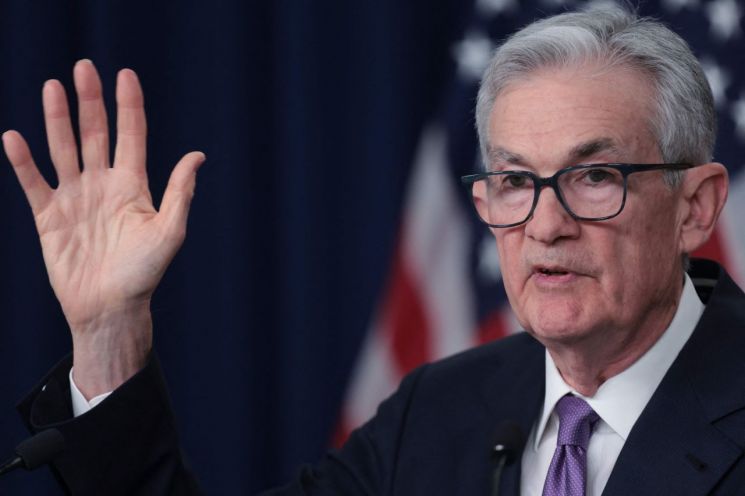
New Dot Plot Projects Year-End Rate at 4.6%... "Dovish Powell"
On the 13th (local time), the Fed announced unanimously to keep the federal funds rate unchanged at 5.25?5.5% through the policy statement released after the regular FOMC meeting. This marks the third consecutive hold following September and November. The FOMC stated, "Recent indicators suggest that economic activity slowed from a strong pace in the third quarter," and assessed that "inflation has eased over the past year but remains elevated." This hold maintained the interest rate gap between South Korea and the U.S. at 2 percentage points (based on the upper bound of U.S. rates).
Since the rate hold was widely anticipated, market attention focused on the outlook reflected in the dot plot. The Fed lowered the year-end rate forecast for next year from 5.1% (September) to 4.6% in the new dot plot. This signals the possibility of a total 0.75 percentage point cut, or three 0.25 percentage point rate cuts, over the next year. According to the dot plot, 17 out of 19 FOMC members expect rate cuts next year. The largest group of six members forecast rates between 4.5% and 4.75%. The lowest forecast (one member) was between 3.75% and 4.0%.
Fed Chair Jerome Powell said at the subsequent press conference, "Discussions about when policy easing (rate cuts) would be appropriate have become more visible." When asked whether the addition of the word ‘any’ before the phrase ‘further policy tightening’ in the policy statement meant that no more rate hikes would be made, he replied, "It was added based on the recognition that rates have peaked or reached their peak." This reflects a nuance shift in the Fed’s stance on further tightening.
Powell also said, "I think the likelihood of further rate hikes is very low, but I do not rule out the possibility." He added, "We will maintain a restrictive policy until clear evidence confirms progress toward the 2% inflation target," while emphasizing, "Rate hikes are no longer the baseline scenario as they were 60 to 90 days ago." Considering Powell’s usual reputation for ambiguous answers, this press conference was widely regarded as more dovish than expected.
Dovish tones were also evident in the assessments of inflation and the labor market. Notably, the phrase "inflation has eased over the past year" was newly added to the policy statement. David Russell, Global Market Strategist at TradeStation, said, "The Fed’s acknowledgment of easing inflation is dovish," and described it as "a change in wording indicating less need for aggressive tightening." Powell also assessed the labor market, saying, "The era of extreme labor shortages is over," and "We are seeing the labor market becoming more balanced."
He distanced himself from recession concerns. While he said, "We cannot rule out the possibility," he also stated, "There is little evidence to suggest the economy is in a recession." These remarks further strengthened market expectations for a soft landing. Charlie Ripley, Chief Investment Strategist at Allianz Investment Management, said, "Powell definitely created a dovish atmosphere," adding, "Not only a declaration of victory over inflation but also a signal that the foundation for a soft landing has been laid." Kali Cox of eToro also said, "The Fed believes the soft landing has been successful."
On the same day, the Fed lowered its forecast for the personal consumption expenditures (PCE) price index inflation rate next year from 2.5% to 2.4% in its economic outlook update. The growth forecast for year-end next year was slightly lowered from 1.5% to 1.4%. Meanwhile, the unemployment rate forecast remained steady at 4.1%. Bloomberg reported that "this reflects growing confidence among Fed officials that inflation can be controlled without significant job losses."
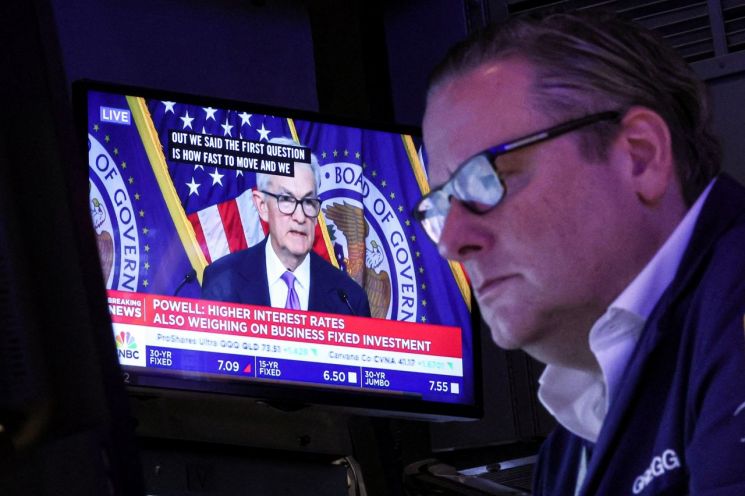
Focus on Rate Cuts in First Half... New York Stock Rally
The key question is when rate cuts will begin amid this confidence in a soft landing. Market expectations for rate cuts in the first half of next year have strengthened. According to the Chicago Mercantile Exchange (CME) FedWatch tool, federal funds futures currently price in a greater than 78% chance of a 0.25 percentage point or more rate cut in March next year and over 97% chance in May next year. Earlier that morning, these probabilities were 48% and 78%, respectively. Goldman Sachs, which had initially expected cuts in the third quarter, moved up its forecast to June following the FOMC meeting.
The market cheered. The three major indices on the New York Stock Exchange all closed up more than 1% that day. The blue-chip Dow Jones Industrial Average surpassed 37,000 for the first time ever. The large-cap S&P 500 index also crossed 4,700 for the first time since January this year. Treasury yields fell. The 10-year U.S. Treasury yield dropped to around 4.0%. The 2-year yield, which is sensitive to monetary policy, fell to about 4.43%. Gina Volbin, Chair of Volbin Wealth Management Group, said, "The Fed gave the market an early (Christmas) holiday gift," adding, "The Santa rally could continue."
However, there is also caution about the market’s overly widespread expectations for rate cuts. Dennis Lockhart, former President of the Federal Reserve Bank of Atlanta, said, "At this point, it does not appear there is close consensus within the Fed on how many rate cuts will be made next year," and pointed out, "The market tends to get ahead of officials." Brad Conger, Chief Investment Officer (CIO) at Hirtle Callaghan & Co., expressed concern, saying, "Today’s statement was a perfect opportunity for Chair Powell to curb the market’s easing expectations," but "instead, they took it as a chance to celebrate mission accomplished." David Kelly, Chief Global Strategist at JPMorgan, noted, "The riskiest time for the economy is when a tightening Fed shifts to easing," warning that while consumers wait for rate cuts, loan demand could sharply decline, potentially causing negative economic effects."
© The Asia Business Daily(www.asiae.co.kr). All rights reserved.


















