Establishment of Annual Economic Security Dialogue Between the Two Countries on Economic Security, Supply Chains, Nuclear Power, Carbon-Free Energy, ICT, and Defense Cooperation... Completing the Global Semiconductor Alliance
President Yoon Suk-yeol and Dutch Prime Minister Mark Rutte held a summit on the 13th (local time) and signed a total of six memorandums of understanding (MOUs) focusing on economic security, supply chains, nuclear power, carbon-free energy (CFE), information and communication technology (ICT), and defense cooperation.
The MOUs signed this time include ▲Economic Security Cooperation MOU ▲Core Item Supply Chain Cooperation MOU ▲Intergovernmental Cooperation MOU in the Nuclear Power Sector ▲Carbon-Free Energy Cooperation MOU ▲ICT Cooperation MOU ▲Defense Cooperation MOU, with a focus on diversifying economic cooperation based on semiconductors.
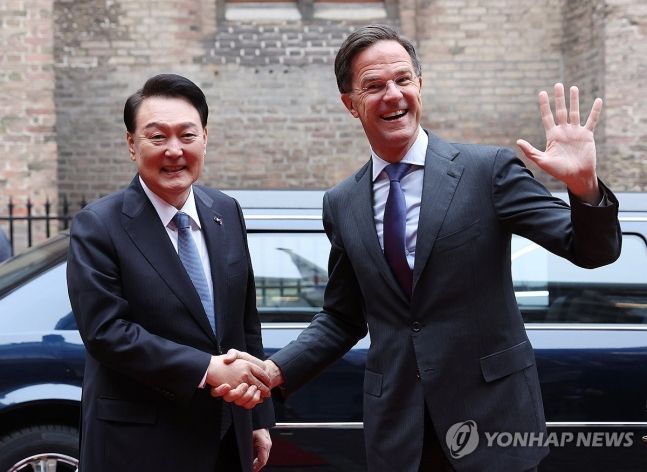 President Yoon Suk-yeol, on a state visit to the Netherlands, arrived at the Prime Minister's Office in The Hague on the 13th (local time) and shook hands with Mark Rutte, the Prime Minister of the Netherlands.
 [Photo by Yonhap News]
First, the two countries will establish an annual economic security dialogue through the 'Economic Security Cooperation MOU.' This is a follow-up measure following the formalization of the 'semiconductor alliance' between Korea and the Netherlands during President Yoon's state visit. The Presidential Office has established cooperation channels with major global semiconductor powers such as the United States, Japan, and the United Kingdom, but with the establishment of the semiconductor dialogue with the Netherlands, it is seen as completing a 'global semiconductor supply chain alliance' that connects the entire cycle of design, materials/components/equipment (SoBuJang), and manufacturing.
The 'Core Item Supply Chain Cooperation MOU (Ministry of Trade, Industry and Energy of Korea - Ministry of Foreign Affairs of the Netherlands)' aims to enhance bilateral cooperation for supply chain crisis response, including the operation of an early warning system related to supply chains. The nuclear power cooperation MOU (Ministry of Trade, Industry and Energy - Ministry of Economic Affairs and Climate Policy) focuses on cooperation across the entire cycle of nuclear power technology, personnel, and fuel.
Additionally, through the 'Carbon-Free Energy Cooperation MOU' signed between the Ministry of Trade, Industry and Energy and the Ministry of Economic Affairs and Climate Policy, the two countries will support exchanges and joint technology development in carbon-free energy policies and the fields of hydrogen, wind power, and solar power. The 'ICT Cooperation MOU (Ministry of Science and ICT - Ministry of Economic Affairs and Climate Policy)' includes strengthening cooperation in artificial intelligence, quantum technology, and next-generation networks.
Furthermore, the 'Defense Cooperation MOU' was signed this time after a year of review between the defense authorities of both countries following the Dutch side's MOU proposal during Prime Minister Rutte's visit to Korea last year. Through the Defense Cooperation MOU, the two countries plan to promote defense exchanges and cooperation in areas such as security issues, peacekeeping operations (PKO), cyber, artificial intelligence, maritime security, and defense industry, and encourage the expansion of joint training.
© The Asia Business Daily(www.asiae.co.kr). All rights reserved.

















