North American Funds Record Highest Returns Among Major Country Funds
India, Japan, Brazil Also Show Strong Performance
China-Related Funds Post Negative Returns... Recovery Expected Next Year
This year, the stock markets in the United States and China have shown divergent trends, resulting in starkly contrasting returns for related funds. North American funds have posted returns exceeding 40% since the beginning of the year, while China-related funds remained in negative territory.
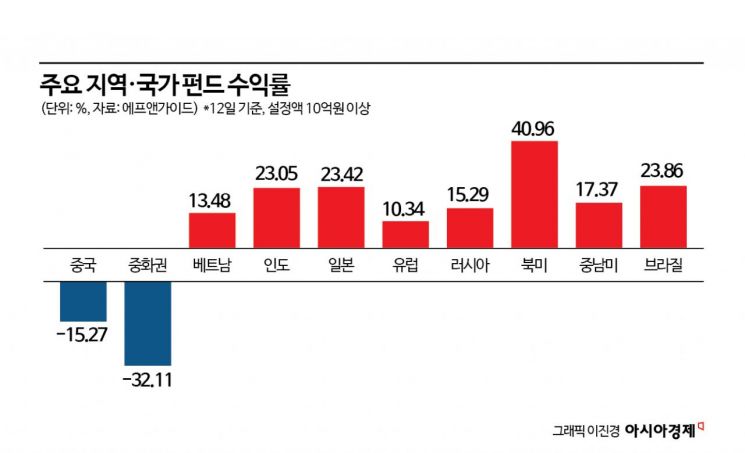
According to financial information provider FnGuide on the 14th, as of the 12th of this month, North American funds recorded a year-to-date return of 40.96%, the highest among overseas equity funds with assets under management of over 1 billion KRW, categorized by major regions.
Despite fluctuations due to interest rate paths, the U.S. stock market has generally shown a robust trend this year, supported by a favorable economic environment, which is interpreted as the reason North American funds achieved high returns. The U.S. stock market has continued its strong momentum, hitting new highs even this month. On the 12th (local time), the S&P 500 index closed at 4643.70, up 0.46% from the previous day, marking its highest closing level since January 14 last year. The Dow Jones Industrial Average also rose 0.48% to 36,577.94, reaching its highest level since January 4 last year. The Nasdaq index closed at 14,533.40, up 0.70%, setting a new high since March 29 last year. Year-to-date, the Nasdaq has risen 39%, the S&P 500 by 21%, and the Dow Jones by 10%.
Funds focused on India, Japan, and Brazil also recorded solid returns exceeding 23%. Indian funds rose 23.05%, Japanese funds 23.42%, and Brazilian funds 23.86% since the start of the year. The Indian Nifty 50 index has recently been hitting record highs consecutively, rising nearly 16% year-to-date. As of the end of last month, the market capitalization of companies listed on the Indian stock exchange was $3.989 trillion (approximately 5,247.5 trillion KRW), surpassing Hong Kong's $3.984 trillion to become the world's 7th largest stock market. The Japanese stock market also showed a boom this year, with the Nikkei 225 index reaching its highest level in 33 years. The Nikkei 225, which was in the 25,000 range at the beginning of the year, climbed to the 33,000 level. On the 20th of last month, it surpassed 33,800 intraday, marking the highest level in 33 years and 8 months since March 1990.
While most global stock markets showed strength and related funds recorded favorable returns, China-related funds were left behind.
Greater China funds fell 32.11% year-to-date, the worst performance among major regional funds. China funds followed with a -15.27% return. All funds related to China posted negative returns. BRICS (Brazil, Russia, India, China, South Africa) funds declined by -8.56%, and Chindia (China and India) funds dropped -5.46%.
Amid delayed economic recovery in China, a real estate crisis emerged, and recently, credit ratings were downgraded, continuing the negative factors. The Shanghai Composite Index recently fell below the 3,000 level again, down more than 4% year-to-date. The Hong Kong Hang Seng Index dropped over 19%. Particularly, the Hong Kong stock market was more sluggish due to the impact of high U.S. interest rates. Seong Yeon-ju, a researcher at Shin Young Securities, explained, "Due to the dollar peg system, Hong Kong interest rates move in tandem with U.S. interest rates regardless of the local economy." She added, "Because of the high U.S. interest rates this year, Hong Kong interest rates were raised to 5.75% as of July, the highest level since December 2007." She further noted, "The rise in interest rates tightened market liquidity and negatively affected the Hong Kong stock market."
Choi Seol-hwa, a researcher at Meritz Securities, analyzed, "The Chinese stock market has declined for three consecutive years, making it the worst performer among global stock markets. Based on the MSCI China Index, the average annual investment return over the past three years was -18.3%, contrasting with an average annual return of 3.4% for investors in emerging markets outside China during the same period." She added, "This explains why confidence in the Chinese stock market has decreased while investment in the Indian market has gained attention."
There are forecasts that the sluggish Chinese stock market will recover next year. Researcher Choi Seol-hwa said, "Next year, China is likely to return to potential normal growth rates based on expansionary fiscal policies, which could lead to a valuation rerating of the currently undervalued Chinese stock market." She predicted, "Having already undergone about three years of adjustment and reflected significant negative factors, the Chinese stock market has a low possibility of further decline next year."
© The Asia Business Daily(www.asiae.co.kr). All rights reserved.
![Clutching a Stolen Dior Bag, Saying "I Hate Being Poor but Real"... The Grotesque Con of a "Human Knockoff" [Slate]](https://cwcontent.asiae.co.kr/asiaresize/183/2026021902243444107_1771435474.jpg)

















