Unification Research Institute Next Year's Political Outlook
Putin Likely to Win Re-election in March 17 Presidential Election
CTBT Withdrawal Sparks High Possibility of Nuclear Test Resumption After 30 Years
North Korea Expected to Follow with 7th Nuclear Test
China and Russia Mark 75th Anniversary of Diplomatic Relations Next Year
Strengthening Anti-US Tripartite Alliance
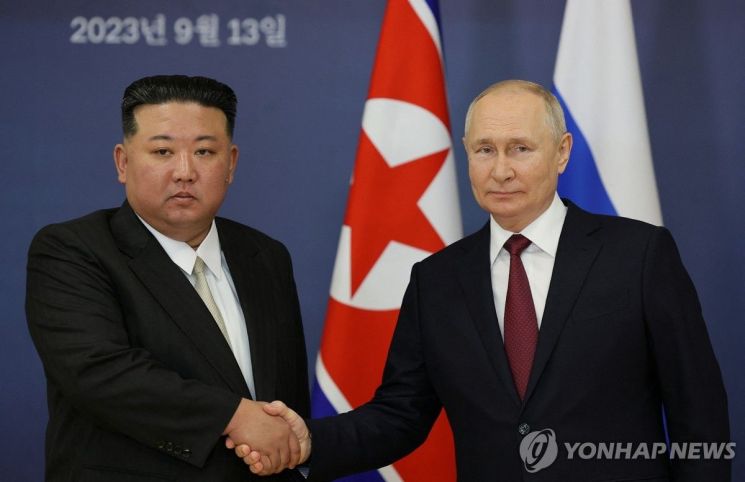 North Korean State Affairs Commission Chairman Kim Jong-un (left) and Russian President Vladimir Putin held a meeting and shook hands on September 13 (local time) at the Vostochny Cosmodrome in Amur Oblast, Russia. This is the first time the two leaders have met in 4 years and 5 months since April 2019.
If Putin succeeds in his re-election in the Russian presidential election scheduled for March 17 next year, there is a prospect that the joint nuclear tests of the North Korea-Russia 'international pariah' alliance could resume. Since Russia withdrew from the Comprehensive Nuclear-Test-Ban Treaty (CTBT) last October, and if Putin’s re-election solidifies a '30-year rule' system, it is highly likely that nuclear tests will be resumed as part of anti-American (anti-US) performances. If North Korea also cooperates by conducting a 7th nuclear test, the international order will once again be engulfed in sharp turmoil. As the 75th anniversary of China-Russia diplomatic relations approaches, the establishment of an 'anti-US tripartite alliance' could also be strengthened.
Hyun Seung-soo, a research fellow at the International Strategy Research Office of the Korea Institute for National Unification, presented this outlook at the '2024 Korean Peninsula Situation Forecast' briefing hosted by the institute at the President Hotel on the 13th. He predicted, “Putin’s victory in next year’s election is certain. He will strengthen the anti-US front, and in this gap, North Korea’s bargaining power will increase.” He also pointed out that if Russia attempts nuclear tests for the first time in 30 years, North Korea will conduct a 7th nuclear test as a sign of cooperation, and the pariah alliance protecting North Korea at the UN Security Council will continue. He added, “As the level of military cooperation, which is not transparently understood between the two countries, strengthens compared to this year, security threats will increase.”
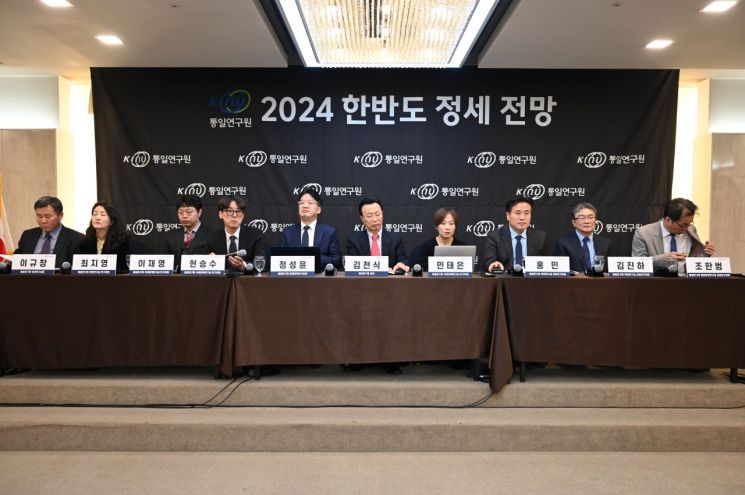 On the 13th, the Korea Institute for National Unification held a press briefing on the theme of 'Prospects for the Situation on the Korean Peninsula' at the President Hotel.
Earlier, on November 2, Russia signed the withdrawal from the Comprehensive Nuclear-Test-Ban Treaty (CTBT). The CTBT, adopted by the UN in 1996, prohibits nuclear tests of any form, scale, or location. It has been signed by 196 countries and ratified by 162. With Russia’s withdrawal from the CTBT, concerns have persisted that nuclear tests could resume for the first time in over 30 years since the Soviet era. The possibility of resuming nuclear tests has been mentioned as a way for Russia to gain an advantage in the Ukraine war and find a breakthrough against Western sanctions pressure.
The strengthening of close ties between North Korea and Russia is also expected to complicate South Korea-Russia relations. Research fellow Hyun predicted, “Russia will encourage South Korean companies to participate in post-war reconstruction in the areas of Ukraine occupied by Russia.” However, there was also an assessment that the North Korea-Russia closeness has clear limits. Senior researcher Cho Han-beom said, “Since Russia lacks competitive industries, the North Korea-Russia alliance only opens a space like a brief shower in a drought and is not sustainable. Distortion of the North Korean economy and the creation of military tensions are inevitable.”
The problem is that China and Russia are also likely to strengthen their ties as they mark the 75th anniversary of diplomatic relations next year. The China-Russia leaders already met at the Belt and Road Forum on October 18, and the North Korea-Russia foreign ministers’ talks have been held in succession since the 19th. Lee Jae-young, a research fellow at the International Strategy Research Office, said, “China will actively pursue diplomacy opposing multipolarization and bloc formation through solidarity with North Korea.” Jeong Seong-yoon, head of the Unification Policy Research Office, pointed out, “Next year’s international situation will see a tendency to suppress the other side rather than dialogue within the interaction of the North Korea-China-Russia alliance, which opposes the trilateral cooperation of South Korea, the US, and Japan.”
© The Asia Business Daily(www.asiae.co.kr). All rights reserved.


















