France Imposes Notification Obligation on Large Distribution Channels
"Government Must Strive to Prevent Consumer Deception"
The government has taken measures to penalize 'shrinkflation'?where product volume is reduced while prices remain the same or increase?by imposing fines for such 'tricky price hikes.' There are calls to prevent consumer deception by holding major distribution channels accountable for notifying changes in product volume, referencing cases from other countries.
Shrinkflation is a compound word combining "shrink," meaning to reduce quantity, and "inflation," referring to rising prices. It describes the practice of reducing product volume while keeping prices the same or increasing them to achieve an effective price hike.
On the 13th, the Korea Consumer Agency announced that, based on processed foods managed by Chamgag and media reports, an investigation into shrinkflation revealed that over the past year, the volume of 37 products across 9 categories had actually decreased.
In response, the government has initiated countermeasures. According to the "Plan to Expand Information Provision on Volume Reduction, etc." announced at the Emergency Economic Ministers' Meeting chaired by Deputy Prime Minister and Minister of Economy and Finance Choo Kyung-ho, the government plans to curb irregular price hikes by ▲improving systems to expand unit price labeling by retailers ▲strengthening monitoring by the Korea Consumer Agency ▲and establishing measures such as providing volume change information through voluntary agreements with manufacturers and distributors.
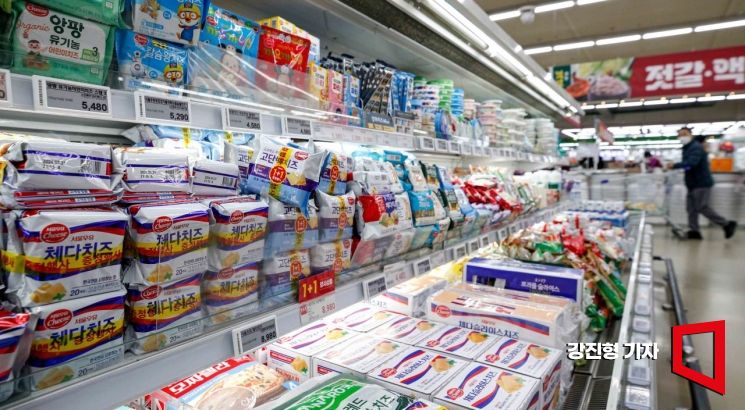 The Korea Consumer Agency announced that, as a result of investigating shrinkflation in processed foods managed by Chamgagyeok and products mentioned in media reports, the volume of 37 products across 9 categories has actually decreased over the past year. The photo shows Seoul Milk Cheddar Cheese displayed at Hanaro Mart Yangjae Branch in Seocho-gu, Seoul, on the 13th. Photo by Jinhyung Kang aymsdream@
However, since some manufacturers have already been providing volume change information on their websites, questions remain about the effectiveness of these measures. It is difficult for consumers to check each company's website individually before purchasing, and especially vulnerable groups may find it hard to compare products.
Economic commentator Jung Cheol-jin explained in an interview with YTN's "News Live" that "From the consumer's perspective, since the product price is fixed, they feel the price has not increased, but the actual volume has decreased. In the bigger picture, this actually raises prices and deceives consumers."
Jung added, "There are doubts about whether all companies will notify changes according to government policy and whether this can actually lower prices. Nevertheless, since shrinkflation itself is an act of deception, the government must do its best to ensure consumers are clearly informed of the facts."
He continued, "Volume has been indicated before. Even for products that experienced shrinkflation by reducing volume, unit prices per 10g were disclosed. But from the consumer's standpoint, there are hardly any consumers who check how much each product cost per gram (g) previously. The government's new policy is to notify consumers of the fact of changes."
Shrinkflation is a global issue. According to a report by the Wall Street Journal (WSJ) last month, cookie manufacturer "Oreo" was suspected of reducing the amount of cream. Accordingly, governments worldwide have prepared measures against tricky price hikes.
In France, major retailers and distribution channels are held responsible for notifying changes, while in Germany, authorities manage shrinkflation through intensive monitoring akin to a full-scale investigation, according to commentator Jung.
© The Asia Business Daily(www.asiae.co.kr). All rights reserved.

















