Mycoplasma pneumonia is spreading in South Korea. Unlike the common cold, if symptoms such as prolonged high fever continue, Mycoplasma pneumonia should be suspected.
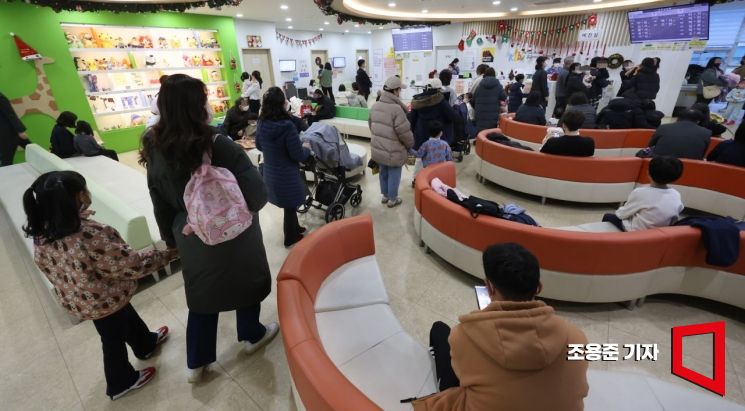 A children's hospital in Seongbuk-gu, Seoul, is bustling with children and parents who have come for medical treatment. Photo by Jo Yongjun jun21@
According to Professor Park Junsung of the Department of Pediatrics at Seoul Asan Medical Center on the 12th, Mycoplasma pneumonia shows symptoms such as prolonged high fever, cough with sputum, and body aches, unlike the common cold. These symptoms are similar to the flu, but Mycoplasma pneumonia patients often show abnormal lung sounds or severe pneumonia when chest X-rays are taken or auscultation is performed. If these symptoms persist for a long time, Mycoplasma pneumonia should be suspected. Professor Park explained, "The common cold usually starts with a runny nose and cough, and improves on its own after about 3 to 4 days. Since Mycoplasma is a bacterium, if not properly treated, it can worsen continuously, and symptoms such as cough, sputum, fever, chills, and sore throat can become severe."
Professor Park also explained that adults infected with Mycoplasma often show no symptoms, but the younger the patient, the more likely symptoms are to manifest. Currently, children under 12 years old make up the majority of Mycoplasma pneumonia patients in South Korea. The number of hospitalized patients in the country increased from 174 in the first week of November to 249 in the first week of this month. Most hospitalized patients were children under 12 years old, accounting for 78.3% as of the first week of December. Professor Park said, "The most common symptom when infected with Mycoplasma is no symptoms. Some children with symptoms develop pneumonia, and the younger they are, the more symptoms tend to appear."
One of the characteristics of Mycoplasma pneumonia is its strong resistance to antibiotics. A 2019 domestic survey found that about 80% of Mycoplasma strains already had resistance. Professor Park explained, "The guideline is to use first-line treatment drugs when infected with Mycoplasma pneumonia. If the child is very ill and does not respond to treatment, oral steroids can be added."
Treatment of Mycoplasma pneumonia mainly involves the use of two or more antibiotics. This is because Mycoplasma bacteria, unlike other bacteria, lack a cell wall. Professor Park explained, "Generally, when treating bacteria, antibiotics work by breaking down the cell wall to kill the bacteria, but since Mycoplasma already lacks a cell wall, common antibiotics are ineffective. Therefore, antibiotics that target bacteria without cell walls like Mycoplasma are added to the prescription."
If prescribed antibiotics, they should be taken for the full duration even if symptoms improve. Professor Park advised, "If antibiotics are stopped prematurely or used insufficiently, it can actually increase resistance. Even if all symptoms have resolved, it is best to take the medication for the prescribed treatment period."
Children showing severe symptoms suspected of having Mycoplasma pneumonia should visit a pediatric emergency room for evaluation. Criteria for severe symptoms include ▲increased respiratory rate ▲cyanosis where lips turn blue ▲use of neck or rib muscles to breathe due to low oxygen saturation or difficulty breathing. Altered consciousness in the child can also indicate severity.
However, the fatality rate of Mycoplasma pneumonia is not high. Professor Park said, "It is rare for patients to require intensive care or to die," but added, "In very rare cases, it can progress to encephalitis, so if a child infected with Mycoplasma shows very lethargic consciousness, refuses to eat, or has a significantly deteriorated condition, it is advisable to get tested at a higher-level hospital."
Since Mycoplasma spreads through droplets, it can be prevented by wearing masks and practicing hand hygiene. Professor Park emphasized, "Because Mycoplasma is transmitted via droplets, if both the infected person and those around them wear masks, infection can be minimized. It is important to follow general preventive measures such as proper hand washing."
On the 6th, the Korea Disease Control and Prevention Agency held a joint inspection meeting with the medical community and related ministries to discuss countermeasures. The Ministry of Health and Welfare plans to check the supply of pediatric beds in preparation for the increase in cases and, together with the Disease Control Agency, will consider expanding the usage criteria for treatments available for resistant patients. However, experts attending the meeting evaluated that since the treatment methods for Mycoplasma pneumonia are well known, there is no need for excessive fear.
Pharmaceutical companies are developing antibiotics and diagnostic products to respond to Mycoplasma and other viruses. Daewoong Pharmaceutical has started developing antibiotics that can overcome bacterial resistance in collaboration with Noah Biotech. HLB Panagen is also developing diagnostic products in the fields of pneumonia, respiratory infectious diseases, and antibiotic resistance.
© The Asia Business Daily(www.asiae.co.kr). All rights reserved.
![Clutching a Stolen Dior Bag, Saying "I Hate Being Poor but Real"... The Grotesque Con of a "Human Knockoff" [Slate]](https://cwcontent.asiae.co.kr/asiaresize/183/2026021902243444107_1771435474.jpg)
















