Republicans Oppose Environmental Review Waiver
Concerns Over Semiconductor Factory Construction Delays
Lumondo: "National Security Conflicts with Environmental Regulations"
U.S. Commerce Secretary Gina Raimondo expressed concern on the 11th (local time) that the development of the U.S. semiconductor industry is being delayed as semiconductor companies face difficulties in improving environmental assessment procedures for building local factories. There are worries that restrictions on operating new local factories will arise as Republican lawmakers oppose a bill that would grant environmental impact assessment exemptions to companies receiving government support under the Inflation Reduction Act (IRA).
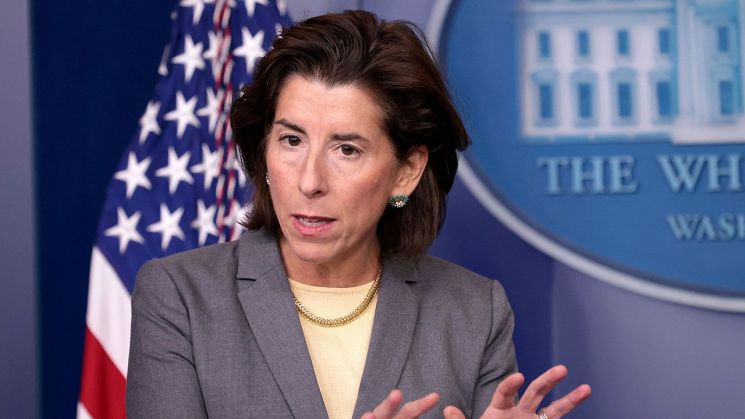
On the 11th (local time), Secretary Raimondo stated in an interview with Bloomberg, "If companies have to go through environmental assessment procedures, the U.S. efforts to build a semiconductor industry ecosystem could be delayed by several years."
In October, Raimondo urged Congress to pass a bill granting environmental impact assessment exemptions to companies receiving subsidies under the IRA. Bloomberg explained that such exemptions were one of the key support policies the U.S. government provided to semiconductor companies. However, the bill faced opposition from Republican lawmakers, including House Speaker Mike Johnson, and was removed from the National Defense Authorization Act.
Generally, the U.S. government evaluates whether companies building facilities violate environmental regulations. However, since the continuous construction of semiconductor factories is aimed at fostering the domestic semiconductor industry through subsidies, critics argue that applying existing regulations equally is unreasonable. Semiconductor companies have also expressed concerns that if environmental impact assessments last for years, their business operations could be disrupted.
Regarding the failure to pass the exemption bill, Secretary Raimondo warned, "Future construction of semiconductor factories could be halted for several years," and cautioned that this could signal a conflict between climate legislation and national security goals.
She added, "We want to do everything to protect the environment," but also said, "National security is the priority, and this is a time to move quickly," indirectly criticizing Republican opposition.
With the bill blocked by Republican opposition, disruptions to the construction of U.S. factories by global semiconductor companies have become inevitable. Micron, which has been producing semiconductors in Japan and Taiwan, announced plans to invest up to $100 billion (approximately 131.45 trillion won) over the next 20 years to build a semiconductor factory in Clay, northern New York. Taiwan's TSMC is investing $40 billion to build a factory in Arizona, and Intel plans to spend over $20 billion to build a factory in Ohio.
There are also concerns that environmental impact assessment regulations could cause the U.S. to fall behind in technological competition with China. Bloomberg reported, "Environmental regulations could halt the construction of semiconductor factories, which are the result of U.S. efforts, for an extended period," and added, "Currently, the U.S. is under significant pressure as China begins to develop its own semiconductor capabilities."
© The Asia Business Daily(www.asiae.co.kr). All rights reserved.

















