Analyzing Urban Wealth Gap Using AI
The Area Where Our Organization Gathers Is the Wealthiest
Is there a 'prime land' in North Korea as well? According to research results, the Daedonggang and Nakrang districts in Pyongyang, the capital of North Korea, are at a level that can be called the so-called 'North Korean version of Gangnam.' This means that North Korea also has severe wealth disparities depending on the region.
On the 12th, Lee Si-hyo, a research fellow at the Soongsil Peace and Unification Research Institute, examined spatial disparities within Pyongyang using artificial intelligence (AI) and announced these analysis results. The researcher utilized deep learning satellite imagery and geographic information system (GIS) data analysis, which have been actively used recently in urban poverty studies.
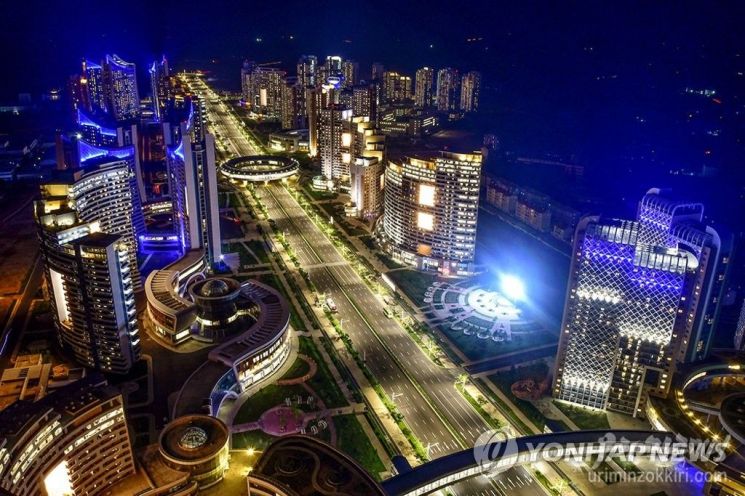 Songhwa Street in the Songhwa District of Pyongyang, completed in April last year, features an 80-story apartment building as its tallest structure.
 [Image source=Yonhap News]
Comparing the map classified by groups with satellite images of Pyongyang, 'Class 3,' identified as areas where lower-class poor residents live, was concentrated in the factory zones south of the Daedonggang River and the outskirts with low-rise residential areas. These places are surrounded by poor social infrastructure, such as significantly scarce green spaces and tangled unpaved roads.
Meanwhile, the 'Class 5' district, presumed to be inhabited by the uppermost class, was concentrated in the Jung District, where Kim Il-sung Square is located. This area is also where major administrative institutions of the North Korean Communist Party are densely located. Its characteristics include more mid-rise apartments rather than high-rise ones, and abundant paved roads, green spaces, and plazas.
The 'Class 4' area, where the upper-middle class resides, is reportedly home to many so-called 'donju,' North Korean-style capitalists. Class 4 areas are concentrated in the Daedonggang and Nakrang districts. These areas have many high-rise apartments, wide roads, and green spaces. The residential styles appear to be a mix of apartments, commercial buildings, and houses.
Researcher Lee explained, "This study is meaningful in presenting a new urban research methodology for extremely closed cities with insufficient statistical data through a mixed study of deep learning-based satellite image extraction analysis and in-depth interviews with urban defectors."
However, he added, "Additional research on other cities will be necessary to generalize urban poverty in North Korea."
© The Asia Business Daily(www.asiae.co.kr). All rights reserved.

















