Cytotoxicity Tests Conducted on 25 Domestic and International Sanitary Pad Brands
18 Products Show Low Cell Survival Rates
As a result of cytotoxicity tests conducted on 25 types of sanitary pads both domestic and international, cytotoxicity was confirmed at a high rate of 72%, once again putting the safety of sanitary pads under scrutiny.
On the 12th, a research team led by Professor Park Cheon-gwon of the Department of Biomedical Engineering at Sungkyunkwan University announced that, in collaboration with a private company (Audrey Sun), cytotoxicity was confirmed in 18 out of 25 types of domestic and international sanitary pads (72%).
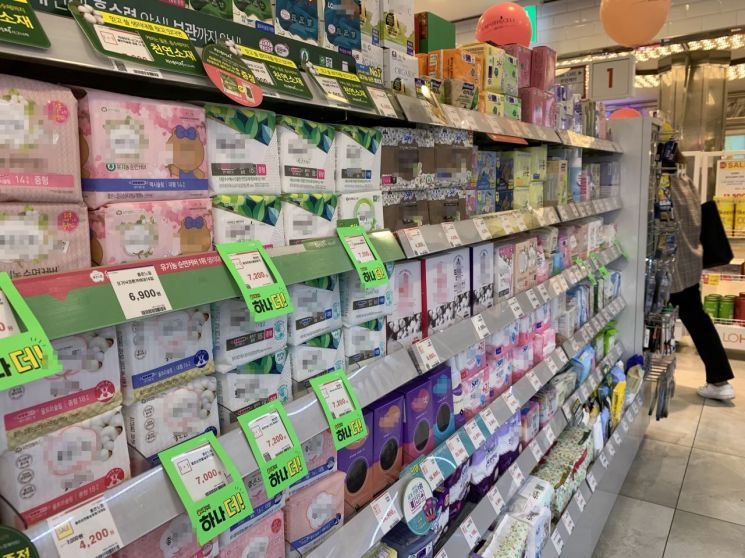 As a result of cytotoxicity tests conducted on 25 types of domestic and international sanitary pads, cytotoxicity was confirmed at a high rate of 72%, once again putting the safety of sanitary pads under scrutiny.
 [Photo by Yonhap News]
The test subjects included 6 types of organic sanitary pads and 10 types of regular sanitary pads distributed domestically, and 9 types of sanitary pads distributed in Europe, totaling 25 types.
Among these, 2 out of 6 domestic organic sanitary pad products showed cell viability between 60% and 75%. Among 10 domestic regular sanitary pad products, as many as 9 showed cell viability below 80%.
In particular, 6 regular sanitary pad products showed cell viability below 60%, and 3 products showed very low cell viability below 40%, indicating that regular sanitary pads had significantly lower cell viability compared to organic sanitary pads.
Cytotoxicity testing is a method that evaluates cell viability compared to an untreated control group through cell culture tests. When cell viability is assessed 24 hours after exposure to the test substance, if it is 80% or less compared to the control group, cytotoxicity is determined.
Cytotoxicity Confirmed in 7 out of 9 European Products
This test was conducted on a total of 25 types of sanitary pads by treating cells with cell culture media eluted with chemical components from the sanitary pads, then culturing the cells for 24 hours to measure viability. The experiment used L929 (mouse fibroblasts) and HaCaT (human keratinocytes), which are commonly used to evaluate cytotoxicity caused by reactive substances. Growth and death caused by chemicals extracted from the sanitary pads were analyzed for each cell type.
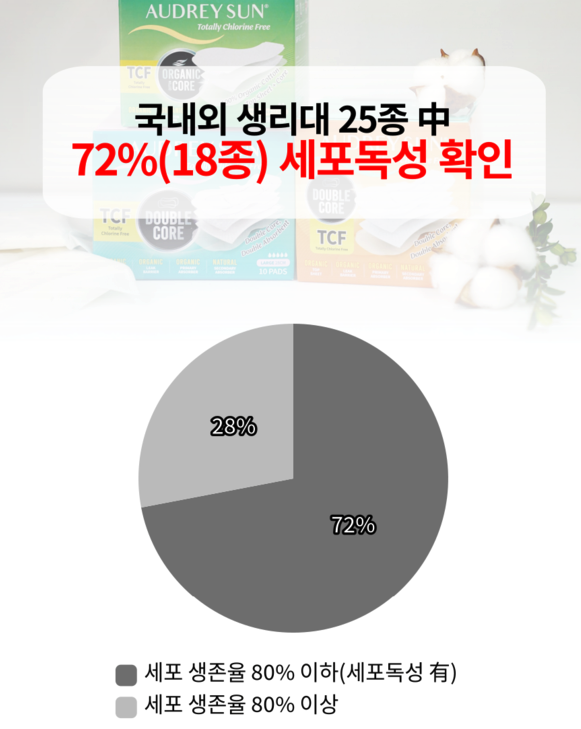 Among six domestic organic sanitary pad products, two showed cell viability rates of 60-75%, while among ten domestic regular sanitary pad products, as many as nine showed cell viability rates of 80% or less.
 [Photo by Audrey Sun]
Additionally, among 9 European sanitary pad products, cytotoxicity was confirmed in 7 products, accounting for 78%. Two products showed viability below 60%, and 5 products showed even lower viability below 50%.
One product showed an extremely low cell viability below 10%. However, the European sanitary pads were tested without distinguishing between organic and regular sanitary pads.
Professor Park Cheon-gwon stated, "One of the important components of sanitary pads is the absorbent layer, which absorbs menstrual blood. Organic sanitary pads use natural materials such as cotton or nonwoven fabric for the absorbent layer. However, most regular sanitary pads use superabsorbent polymer (SAP)." He added, "For those who are particularly sensitive, it is recommended to use NO-SAP sanitary pads like organic sanitary pads rather than those using SAP."
Earlier, the research team conducted a primary 'cytotoxicity test' in August on 6 types of organic sanitary pads distributed domestically and reported that cytotoxicity was confirmed in 2 of these products.
Professor Park said, "To clarify the clear causal relationship related to health issues associated with sanitary pads, in-depth analyses in various fields such as exposure and absorption studies, vaginal mucosal irritation tests, and toxicological studies considering combined exposures are necessary." He added, "Through such research, it is essential to investigate possible links between sanitary pad use and health problems and establish evidence to take safety measures if needed."
© The Asia Business Daily(www.asiae.co.kr). All rights reserved.
![Clutching a Stolen Dior Bag, Saying "I Hate Being Poor but Real"... The Grotesque Con of a "Human Knockoff" [Slate]](https://cwcontent.asiae.co.kr/asiaresize/183/2026021902243444107_1771435474.jpg)

















