Shin Ramyun Specially Displayed at Local Marts
Flying Off Shelves Despite Being Twice the Price of Local Ramen
Buldak Bokkeum Myeon, the Dual Pillars of K-Ramen
Captivating Local Tastes with Spicy and Stimulating Flavors
Preparing 'Halal Certification' from Early Market Entry
Targeting Market with KMF Certification
The landmark of Kuala Lumpur, the capital of Malaysia, is the Petronas Twin Towers. This building, with 4 underground floors and 88 above ground, reaches a height of 452 meters and holds the title of the tallest twin towers in the world. Although the title of the tallest building in Malaysia disappeared with the completion of the Merdeka 118 Tower (678m) in Kuala Lumpur, the symbolic significance of the Petronas Twin Towers locally remains considerable. It is a building that frequently appears in Malaysia's national promotions.
The Petronas Twin Towers house Suria Mall, the largest shopping mall in Malaysia. And in the basement of this mall, there is a large supermarket called Cold Storage, frequented by both locals and foreign tourists. This supermarket sells Asian food products from Japan, Korea, and other countries all on one shelf. Among these, the standout product is Nongshim's Shin Ramyun. There is even a separate display dedicated solely to Shin Ramyun products. It stands tall as a representative Korean ramen product in the heart of Malaysia's capital.
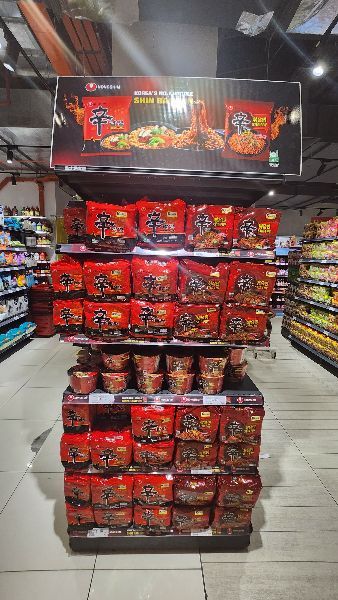 At NSK Mart, which is said to be the most popular among locals in Malaysia, a special display stand is set up for Shin Ramyun. Photo by Seongpil Jo gatozz@
Shin Ramyun Receives Special Treatment in Supermarkets
In Malaysia, the price of Shin Ramyun is about 20 ringgit (approximately 6,000 KRW) for a pack of five. This is not much different from the domestic price of about 1,000 KRW per pack. However, compared to other local ramen, the story is different. Local ramen prices are around 2 to 3 ringgit (600 to 900 KRW) per pack, about half the price of Shin Ramyun. Despite this, the popularity of Shin Ramyun is soaring, as evidenced by its special display in supermarkets.
The special display for Shin Ramyun is not only found at Cold Storage. It can also be seen at NSK Mart, about a 20-minute walk from the Petronas Twin Towers where Cold Storage is located. NSK Mart is known as a 'local mart' most frequented by Malaysians. Here too, Shin Ramyun is regarded as a popular ramen brand showcased in a special display.
The local popularity of Shin Ramyun is also reflected in sales. According to Nongshim, Shin Ramyun's sales in Malaysia were only $700,000 in its first year of entry (2007), but rose to $4.5 million last year. Nongshim attributes this to "the popularity of K-culture and the expansion of Hallyu content, which has increased interest in K-food as well," adding, "Shin Ramyun is maintaining its identity while continuously making efforts to approach the local market as a familiar and friendly brand by expanding various flavor types recently." Nongshim currently sells five products locally, including Shin Ramyun Original, Shin Ramyun Black, and Shin Ramyun Kimchi.
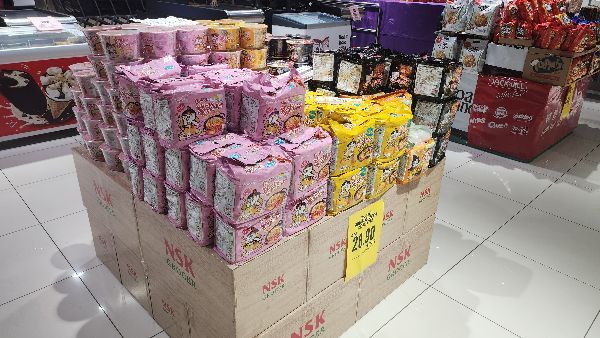 Alongside Shin Ramyun, Samyang's Buldak Bokkeum Myun is also very popular locally in Malaysia. The photo shows Buldak Bokkeum Myun displayed at NSK Mart in Kuala Lumpur. Photo by Seongpil Jo gatozz@
Buldak Bokkeum Myun Rivals Shin Ramyun
Samyang's Buldak Bokkeum Myun is also a leading K-ramen brand driving popularity alongside Shin Ramyun in Malaysia. While Shin Ramyun, a soup-based ramen, has captured local tastes, Buldak Bokkeum Myun represents the fried noodle (migoreng) style of K-food. Reflecting this, both Cold Storage and NSK Mart have separate displays for Buldak Bokkeum Myun products, just like Shin Ramyun.
Buldak Bokkeum Myun began exporting to Malaysia in 2015, eight years later than Shin Ramyun. Despite the later entry, it has gained tremendous popularity locally, with the 'Buldak Bokkeum Myun Challenge' spreading through social media platforms like YouTube. A local distribution official explained, "In Malaysia, Sichuan cuisine from China and spicy curry culture originating from India have long been popular," adding, "Malaysians prefer spicy and stimulating flavors, which explains the popularity of Buldak Bokkeum Myun."
Samyang credits the popularity of Buldak Bokkeum Myun to its 'distinctiveness.' A Samyang representative said, "Consumers in Southeast Asian countries, including Malaysia, are familiar with fried noodle products, but there were not many spicy ramen options like Buldak Bokkeum Myun. It has been evaluated as a unique ramen not commonly seen locally, and recently, the series has expanded with various spicy flavors such as Carbonara Buldak Bokkeum Myun and Cheese Buldak Bokkeum Myun, allowing us to secure a broad consumer base."
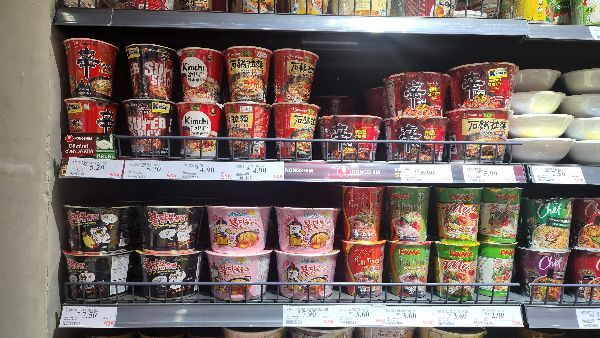 In Malaysia, spicy K-ramen such as Shin Ramyun and Buldak Bokkeum Myun can be easily found. Photo by Seongpil Jo gatozz@
Thorough Preliminary Research Led to Success
A hidden key to the success of Shin Ramyun and Buldak Bokkeum Myun is the 'halal certification.' Malaysia is a Muslim country where food must strictly undergo religious inspection for meat. Halal certification institutionalizes this. Pork, forbidden by Islamic culture, is never used, and permitted meats such as beef and chicken must be slaughtered according to specific sacred standards to receive certification.
Halal certification is so important locally that it can determine whether a product survives in the market. A Korean distribution official met locally said, "I had heard about halal before entering Malaysia, but I did not realize how crucial it was. Products without halal certification are simply not sold." Both Nongshim and Samyang recognized the importance of halal from the beginning of their Malaysian market entry and have been targeting the market by obtaining certification through the Korea Muslim Federation (KMF).
Analyzing Malaysian consumer characteristics also contributed to maximizing profits. Another Korean distribution official met locally said, "Malaysians are relatively less price-conscious when purchasing goods. If they want to buy something, they tend to do so without comparing prices with similar products or worrying about the cost." This means that somewhat higher prices are not a problem.
© The Asia Business Daily(www.asiae.co.kr). All rights reserved.



















