Dobong-gu Produces 11 Graduates of the 1st Cohort in the Joint Certification Credit System for Education for Sustainable Development (ESD)
Collaboration Between UNESCO Korea Committee and Hankuk University of Foreign Studies, Established as a 4-Credit Liberal Arts Course in March This Year
Awarded Excellence Prize at the '2023 Korea Sustainable Development Contest,' Highly Rated as a Field-Integrated Program
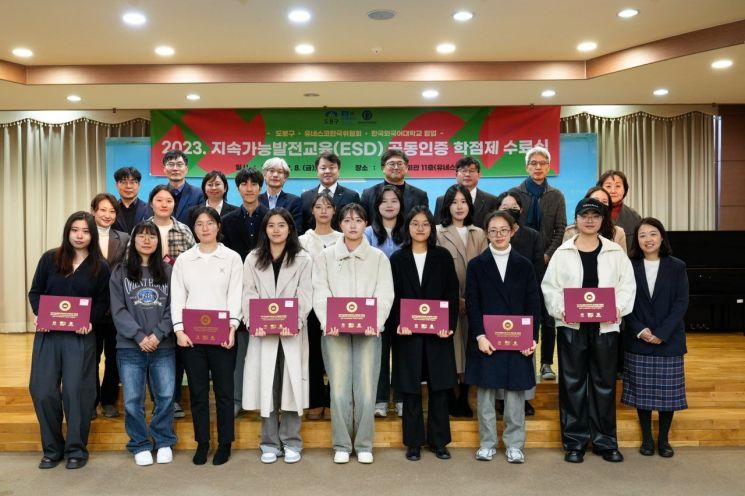
Dobong-gu (Mayor Oh Eon-seok) held a completion ceremony for the "Sustainable Development Education (ESD) Joint Certification Credit System" on the 8th at the UNESCO Hall on the 11th floor of the Korean National Commission for UNESCO, jointly with the Korean National Commission for UNESCO and Hankuk University of Foreign Studies.
The Sustainable Development Education (ESD) Joint Certification Credit System is an educational program promoted through collaboration among three institutions?the Dobong-gu district office (local government), the Korean National Commission for UNESCO (international organization), and Hankuk University of Foreign Studies (higher education institution)?for the first time nationwide to expand sustainable development education (ESD) at the higher education level.
Since March this year, the program has been offered and operated as a total of 4 liberal arts credits at the Minerva College of Liberal Arts at Hankuk University of Foreign Studies, with the first semester course (ESD I - Theory and Issues) and the second semester course (ESD II - Field Practice).
A total of 11 students completed the program, and certificates of completion signed by the heads of the three institutions were awarded to the graduates to support their future personal competency development and employment.
Graduate Pandora (KFL undergraduate) said, "In the first semester classes, lectures by various experts and discussions with Dobong citizens broadened my perspective. The second semester team-based ESD project (field practice), which started during the vacation, allowed me to learn many things that I could not experience at school and collaborate with many people, which was great."
The Sustainable Development Education (ESD) Joint Certification Credit System is praised for combining the expertise and field relevance of the three institutions.
ESD officials unanimously described the program as experimental and challenging, especially highlighting ▲ special lectures and discussions by domestic and international experts linked to each lecture topic ▲ classes and ESD projects operated by the three institutions based on themes and types ▲ learner-centered, field-oriented problem-based learning (PLB) operation ▲ and open lectures for local residents linked with the 6th Dobong Sustainable Development University.
In the "2023 Korea Sustainable Development Contest," the program received an excellence award as a "field-integrated sustainable development education (ESD) course," differentiating itself from similar courses related to sustainable development education (ESD) and ESG (environment, social, governance) subjects offered at other universities.
Oh Eon-seok, Mayor of Dobong-gu, stated, "Sustainable development spans all areas and is inseparable from the youth, who are the core of future generations. As the climate crisis and social inequality become more prominent, the role of future generation youth must be solid. Next year, we will establish this program as an advanced sustainable development education (ESD) model and share and expand it to other local governments and institutions."
© The Asia Business Daily(www.asiae.co.kr). All rights reserved.

















