Despite Global Demand Contraction and Unstable External Environment, 680,000 TEU Increase Compared to Previous Year
UNCTAD Announces Port Connectivity Index, Ranked 4th Worldwide for 5 Consecutive Years
Despite ongoing global inflation, the prolonged Russia-Ukraine war, and Middle East conflicts, which are adverse external conditions, Busan Port's container throughput in 2023 is expected to achieve an all-time high.
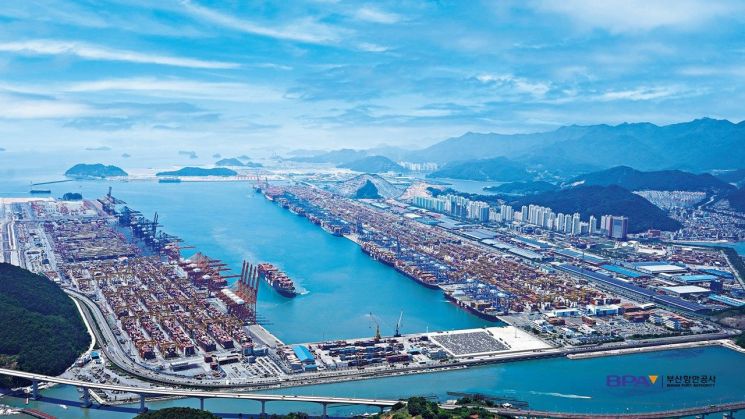
According to Busan Port Authority (BPA) on the 11th, the container throughput at Busan Port in 2023 is projected to reach 22.75 million TEU, a 3.1% increase compared to the previous year, setting a record high.
Import and export throughput increased by 2.9% to 10.61 million TEU, and transshipment throughput rose by 3.2% to 12.14 million TEU. This is expected to surpass the record set in 2021 when global demand surged to its peak.
The final throughput figures for 2023 are scheduled to be confirmed around January 20, 2024, through the Ministry of Oceans and Fisheries’ Marine Logistics Information System (PORT-MIS).
In particular, this year’s performance in handling cargo at Busan Port was achieved despite challenging conditions such as globally shrinking demand and declining maritime freight rates, demonstrating once again the excellent competitiveness of Busan Port.
In 2023, import and export volumes increased in 12 of the top 20 trading countries of Busan Port. Among them, trade with China recorded 2.5 million TEU (3.8%), Mexico 370,000 TEU (33.0%), and the Philippines 150,000 TEU (27.9%), driving the overall growth in Busan Port’s import and export volumes.
The increase in Busan Port’s transshipment throughput is primarily attributed to the effect of global foreign shipping company A’s investment in equity at Busan New Port container terminal in 2021, which has become a key transshipment hub.
Company A’s transshipment volume increased by about 18% (approximately 400,000 TEU) compared to the same period last year. Notably, it is consolidating export cargo from North China, a core hinterland for Busan Port’s transshipment, at Busan Port. Consequently, it is expanding routes not only to Europe, North America, and South America but also independently to India, Southeast Asia, and Africa, clearly demonstrating how much global shipping companies’ terminal investments impact transshipment volume growth.
Additionally, under the leadership of President Kang Jun-seok, BPA made surprise visits to the headquarters of global alliances (THE, OCEAN) shipping companies in June. The BPA delegation focused on explaining Busan Port’s transshipment competitiveness, including cost reduction models, the status of attracting Japanese regional cargo owners, and superior punctuality compared to competing ports, encouraging them to deploy additional routes to Busan Port.
Furthermore, BPA has made considerable efforts to expand global shipping companies’ use of Busan Port by continuously collecting improvement feedback from shipping companies’ staff to their representatives.
As a result, Busan Port recorded a Port Liner Shipping Connectivity Index (PLSCI) score of 128.8, up 6.8 points (5.6%) from the previous year, maintaining its 4th place globally for five consecutive years behind Shanghai, Ningbo, and Singapore ports, and achieving the highest growth rate among the world’s top 10 ports in connectivity. The number of weekly regular container liner services increased by 11 from the previous year to a record high of 287, further solidifying its status as the largest transshipment port in Northeast Asia.
The Port Liner Shipping Connectivity Index (PLSCI) is calculated based on six criteria: weekly ship calls at the port, annual port capacity, number of regular liner services, number of shipping companies providing regular services, maximum ship size accommodated, and the number of ports connected by direct liner services.
Kang Jun-seok, President of BPA, stated, “Despite difficult conditions such as global demand contraction and the Middle East crisis, the joint efforts of shipping companies using Busan Port, terminal operators, and related industries have led to the opening of new routes and increased throughput. In 2024, we will continue to maintain Busan Port’s competitiveness by steadily advancing the development of new container berths at the New Port and persistently working to improve port operation efficiency.”
© The Asia Business Daily(www.asiae.co.kr). All rights reserved.

















