Clicking Internet Links Installs Malicious Apps
Be Careful of Texts from National Pension Service and Cheongcheopjang Invitations Too
Fraud crimes exploiting the deaths of others are rampant, requiring caution. This is the so-called 'obituary smishing,' which even abuses feelings of grief and sympathy.
Smishing is a combination of SMS (Short Message Service) and phishing. When a user clicks on an internet link within a text message, malicious code is installed on their smartphone, causing small payment damages without the victim's knowledge or leading to theft of personal and financial information.
Typical examples include messages like '●Obituary● The mother passed away today, we respectfully inform you. Funeral hall: hxxp://swyg[.]link/*****' or 'Since the parents have passed away, we inform you of the obituary as follows. Funeral hall han.gl/*****' and 'Respectfully informing you of the father's passing. Funeral hall hxxps://me[.]kr/****,' among others.
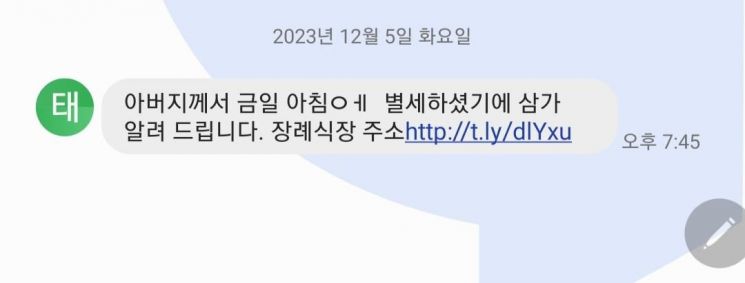 Fraud crimes exploiting the deaths of others are rampant, requiring caution. This so-called 'obituary smishing' even takes advantage of feelings of grief and sympathy.
 [Photo by Yonhap News]
However, clicking on these URLs installs an Android application package (APK) file containing a malicious app. Once this malicious app is installed, it can resend obituary smishing messages to contacts saved in the phonebook from the infected phone number, causing additional harm to acquaintances.
Even if nothing seems to happen after clicking the URL, you cannot be assured of safety. The moment the link is clicked, invisible malicious code is likely implanted in the phone.
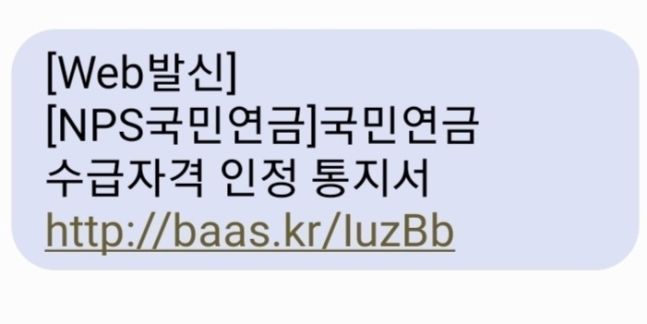 On the 11th, the National Pension Service announced that it had discovered cases of smishing messages impersonating the service and urged caution.
 [Photo by National Pension Service]
Through remote control, your personal and financial information can be leaked, and fake obituary text messages can be sent to acquaintances registered in your phonebook.
The police and experts say that while awareness and vigilance against impersonation scams pretending to be investigative agencies or the Financial Supervisory Service have increased, smishing that infiltrates daily life is becoming more sophisticated, and damages continue.
It is necessary to verify with the person involved before clicking on any link, and if a link is accidentally clicked, it is advised to check for any installed unknown apps, files, or malicious code and to reset the phone to factory settings.
Meanwhile, smishing crimes take various forms beyond obituaries, including those impersonating the National Pension Service and wedding invitations, requiring special caution.
Smishing Victims Reach 3,800 in the Last 5 Years
In the past five years, the number of victims of 'smishing,' a fraud method using text messages, has reached 3,800. Among them, 8 out of 10 victims suffered fraud related to parcel delivery.
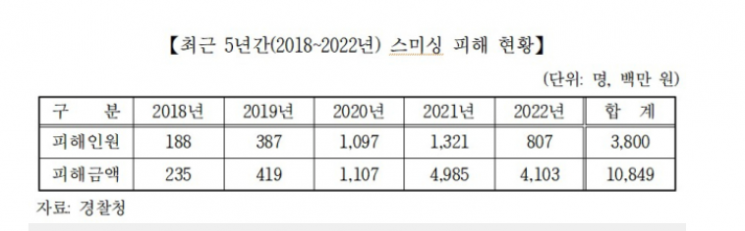 Last September, the National Police Agency analyzed the "Smishing Damage Status in the Last 5 Years (2018-2022)" and found that the number of victims steadily occurred each year, with 188 people in 2018, 387 in 2019, 197 in 2020, 1,321 in 2021, and 807 in 2022. The cumulative number of victims is 3,800.
 [Photo by National Police Agency]
According to an analysis by the National Police Agency around last September on 'Smishing Damage Status in the Last 5 Years (2018?2022),' the number of victims steadily occurred each year: 188 in 2018, 387 in 2019, 197 in 2020, 1,321 in 2021, and 807 in 2022. The cumulative number of victims is 3,800.
The amount of damage reached a total of 10,849 million KRW, with 235 million KRW in 2018, 419 million KRW in 2019, 1.07 billion KRW in 2020, 4.985 billion KRW in 2021, and 4.13 billion KRW in 2022.
By age group, people in their 50s suffered the most smishing damage. Over the past five years, 1,017 victims in their 50s accounted for 26.8% of the total. This was followed by 848 victims in their 40s (22.3%), 705 in their 20s (18.6%), 603 aged 60 and above (15.9%), 504 in their 30s (13.3%), and 40 in their teens (1.1%).
Regarding impersonation types, parcel delivery accounted for 1,555,900 cases, making up 80.9% of the total 1,924,338 cases. Other impersonations included support funds, sponsorships, stock trading rooms at 193,094 cases (10%), public institution impersonations at 97,180 cases (5.1%), acquaintance impersonations at 70,284 cases (3.7%), and financial impersonations at 7,880 cases (0.4%), in that order.
© The Asia Business Daily(www.asiae.co.kr). All rights reserved.
![Clutching a Stolen Dior Bag, Saying "I Hate Being Poor but Real"... The Grotesque Con of a "Human Knockoff" [Slate]](https://cwcontent.asiae.co.kr/asiaresize/183/2026021902243444107_1771435474.jpg)


















