"Seoul's Spring" Surpasses 6 Million Cumulative Viewers
Compared to 2021 Release "Yukgun, Uri Yukgun"
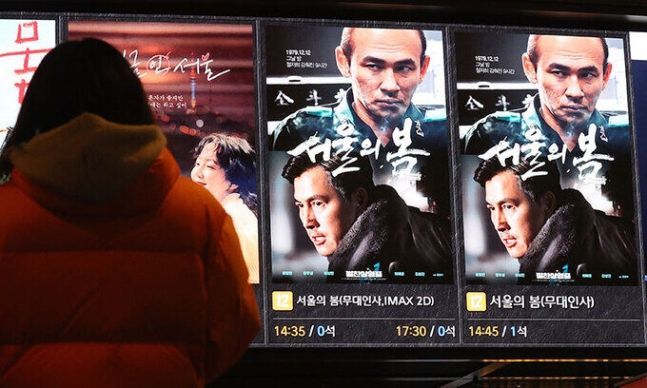
The film 'Seoul Spring,' which was released on the 22nd of last month, has surpassed 6 million cumulative viewers in just 9 days, raising expectations that it might become this year's first 10 million viewer film. Amid this, the 40-year-old military song 'Jeonseoneul Ganda,' used as the OST for 'Seoul Spring,' is also gaining attention.
While the existing military song is receiving praise, criticism of the military song 'Yukgun, Uri Yukgun' released in 2021 is resurfacing.
On the 10th, harsh reviews of the military song 'Yukgun, Uri Yukgun' continued online. New comments have been added to the 'Yukgun, Uri Yukgun' video posted on YouTube two years ago following the release of 'Seoul Spring.'
The video received comments such as "I came here after watching Seoul Spring," along with criticisms like "A military song that extinguishes fighting spirit with a fire hose," "The song is good, but the lyrics are terrible," and "Too much English is used."
On an online community, a post comparing 'Jeonseoneul Ganda' and 'Yukgun, Uri Yukgun' was uploaded. Comments included opinions like "Why use English in our country's military songs?" and "Do they actually sing this while running?" There was a notable aversion to lyrics that were far from the song's context and the use of English.
There were also positive reactions. Among the comments on the YouTube video 'Yukgun, Uri Yukgun' were opinions such as "I found it somewhat good as I heard it at the training center," "It's catchy," and "I liked it as soon as I heard it." Some also regarded it as a military song suited to the changing times and younger generations. One netizen commented, "It's a military song that the new generation can joyfully sing during their military service."
Criticism of 'Yukgun, Uri Yukgun' existed even at the time of its release. When the Army first unveiled it on April 22, 2021, the title was 'Yukgun, We Yukgun,' but due to backlash from Korean language groups and criticism for devaluing Hangul, the title was changed to 'Yukgun, Uri Yukgun' in May of the same year.
The lyrics were also partially changed. 'Go warrior' and 'Go victory' were replaced with 'Strong Army' and 'Good Army.' However, lyrics such as 'AI drone bot' and 'Army tiger' still remain.
Military songs are sung to boost morale and inspire military spirit and military ideology. They are characterized by march-style melodies with lyrics about military life and combat activities. Since 1991 until last year, the Army selected and sang the 'Top 10 Military Songs.' However, the term 'Top 10 Military Songs' is no longer used.
Currently, 18 songs are included in the military song booklet according to soldiers' preferences. The included military songs are 'Aegukga' (National Anthem), 'Yukgunga,' 'Jinjja Sanai,' 'Jeonwoo,' 'Jeonseoneul Ganda,' 'Joguk-eul Wihae,' and others. 'Yukgun, Uri Yukgun' is also included. In 2012, the Army released 'Nareul Neomneunda,' a military song similar to a pop song, sung by Park Hyo-shin. 'Haebyeong Seungjeonga,' written and composed by Lee Chan-hyuk of the sibling group Akmu in 2019, was officially adopted after winning the 'Marine Corps 70th Anniversary Military Song Contest.'
© The Asia Business Daily(www.asiae.co.kr). All rights reserved.

















