2019: 4 Cases, 2020: 7 Cases, 2021: 12 Cases, 2022: 7 Cases, 2023: 17 Cases
Stock Price Fluctuations Determine Success After Tender Offer Proposal
Tender Offers Easier for Delisting Than for Securing Management Rights

MBK Partners, the largest private equity (PE) firm in South Korea, has attempted a tender offer for Korea & Company, bringing renewed attention to other past tender offer cases with mixed success and failure.
According to the Financial Supervisory Service's electronic disclosure system on the 11th, there were 17 tender offer result reports submitted by listed companies this year, excluding the ongoing Korea & Company case. There were 4 cases in 2019, 7 in 2020, 12 in 2021, and 7 last year.
A tender offer is a public purchase of a company's shares outside the stock market, with the purchase period, price, and quantity announced in advance. It is mainly used for hostile mergers and acquisitions (M&A), rapid acquisition of management rights, conversion to a holding company system, or delisting. This year, the most common purpose disclosed for tender offers was 'M&A' with 7 cases. 'Meeting holding company requirements' accounted for 6 cases, 'delisting' for 5 cases, 'management stability' for 2 cases, and 'others (enhancing shareholder value)' for 1 case.
The first tender offer case in South Korea occurred in 1994. At that time, the U.S. company Nike made a tender offer for Samna Sports, a domestic joint venture, at 56,349 KRW per share, close to the market price. This was to convert the Korean entity into a 100% wholly owned subsidiary of the U.S. headquarters. After the successful tender offer, Nike delisted Samna Sports.
The 2004 tender offer by Kumkang Korea Chemical (KCC) for Hyundai Elevator is considered a failure. At that time, Hyundai was embroiled in a management dispute known as the 'Brother-in-law Rebellion' between Hyundai Elevator Chairman Hyun Jung-eun and her uncle-in-law, the late Honorary Chairman Jeong Sang-young of KCC. Jeong's side, facing the need to dispose of some shares due to violation of the '5% rule' under the Capital Market Act (requiring reporting when holding 5% or more of a listed company), launched a counterattack by tendering about 570,000 shares (approximately 8%) of Hyundai Elevator at 70,000 KRW per share. However, Chairman Hyun consolidated her position at the shareholders' meeting and secured other friendly shares, resulting in Jeong's failure to gain management control.
The 2008 tender offer by Mars No.1, a private equity fund of Woori Investment & Securities, for Sempio Foods also ended in failure. Mars No.1 planned to tender 890,305 shares of Sempio Foods at 30,000 KRW, higher than the market price in the 22,000 KRW range. However, within a week after the tender offer announcement, the stock price soared well above the tender offer price of 30,000 KRW. Consequently, existing Sempio Foods shareholders did not respond to the tender offer, and Mars No.1 was only able to acquire about 89,511 shares, approximately 10% of the target amount.
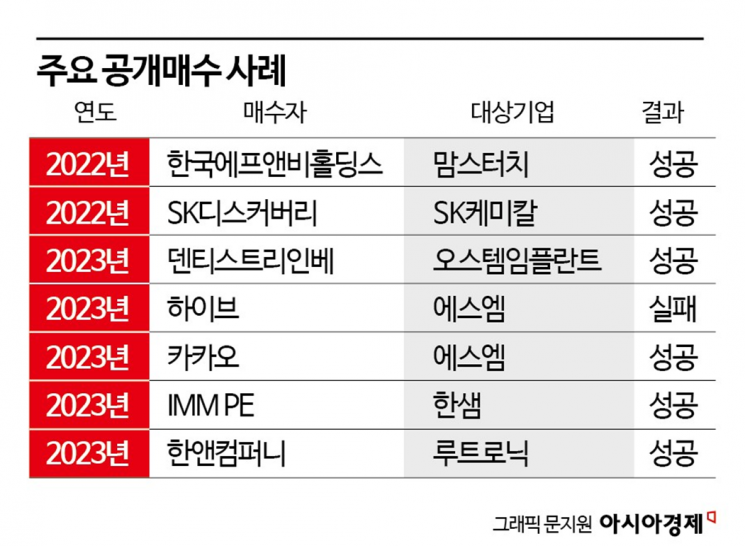
This year, tender offers have been particularly active. Notably, the tender offer for Osstem Implant by a consortium (Dentistry Investment) formed by MBK Partners and UCK Partners is regarded as the largest domestic deal ever, valued at around 2 trillion KRW. In the two rounds of tender offers, existing minority shareholders were offered the same purchase price of 190,000 KRW per share as the largest shareholder, and Dentistry Investment succeeded in acquiring a 96.1% stake, leading to Osstem Implant's delisting.
Summarizing previous cases, stock price fluctuations after the target price announcement have determined the success or failure of tender offers. If the stock price is expected to rise above the target price, existing investors may find it more beneficial not to participate in the tender offer. The management dispute at SM Entertainment (SM) earlier this year was similar. HYBE set the tender offer target price at 120,000 KRW, but the stock price surged afterward, resulting in only a 0.98% acquisition. Kakao offered a higher price of 150,000 KRW and succeeded in the tender offer. However, prosecutors have indicted Kakao on charges including 'market manipulation' for allegedly driving up SM's stock price to hinder HYBE's tender offer.
The stated purpose of the tender offer by the buyer greatly influences stock price movements. When the purpose is management control acquisition, there is often an expectation that the stock price will rise further, leading existing shareholders to refrain from tendering. Conversely, if delisting is the main purpose, the situation differs. If the successful buyer meets the delisting requirements, existing shareholders holding the stock find it difficult to sell their shares otherwise. The Osstem Implant case is also evaluated as having increased existing shareholders' participation by disclosing the delisting purpose early.
Ultimately, price fluctuations are likely to be a significant variable in the Korea & Company tender offer as well. Cho Hyun-sik, advisor and eldest son of Cho Yang-rae, Honorary Chairman of Korea & Company Group (formerly Korea Tire Group), partnered with MBK Partners and launched a tender offer for shares on the 5th. The day before the tender offer, Korea & Company's stock price was 16,820 KRW, but it surpassed 20,000 KRW on the day of the announcement. The closing price on the 8th was 22,150 KRW. This tender offer will continue until the 24th.
Advisor Cho plans to increase his stake up to 46.25%, surpassing the current largest shareholder, Chairman Cho Hyun-bum, who holds 42.03%. However, as the stock price has risen above the target price of 20,000 KRW, there is a risk that existing shareholders may not participate in the tender offer. Accordingly, there is speculation that the target price may be raised. The buyer may increase the target price after observing the tender offer subscription trend.
© The Asia Business Daily(www.asiae.co.kr). All rights reserved.


















