Banks reduce production volume due to environmental protection
Monopoly of used goods traders' volume also a problem
The shortage of bank calendars continues. While young people are also seeking calendars due to the superstition that "hanging a bank calendar brings money," banks have reduced the number of calendars they distribute.
On the 7th, a post titled "It's hard to get a bank calendar" was uploaded on a local mom cafe.
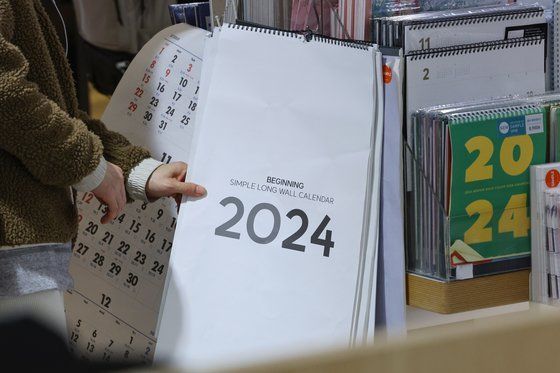 On the afternoon of the 26th of last month, a citizen visiting Kyobo Hottracks Gwanghwamun branch in Jongno-gu, Seoul, is looking over the 2024 calendar.
 [Photo by Yonhap News]
The author wrote, "I had many errands at the bank between late November and early December last year, so naturally, after finishing my business, they gave me a calendar, and I hung one at home and gave the rest to people around me," adding, "I went to the bank yesterday and today, but there isn’t a single place giving out wall calendars. Has anyone received a calendar?"
The post received many comments providing information such as when calendars would be available and which banks had more calendars. Unlike before, when calendars were easily obtained without much effort, now one must know the information and seek them out to get one.
As the situation continues, more people are selling bank calendars secondhand. On the 10th, a post appeared on a secondhand trading site offering two sets of Industrial Bank of Korea calendars for 23,000 won.
In the past three months, there have been 141 posts about bank calendars on 'Junggonara' (a secondhand marketplace), with prices ranging from as low as 1,000 won to as high as 50,000 won.
Especially, Woori Bank’s calendar, featuring advertising model IU, is very popular. Although the bank significantly increased the number of calendars issued this year, demand still outpaces supply, leading people to purchase calendars through secondhand transactions.
Due to this situation, some banks have taken measures to ensure fair distribution, such as limiting calendars to one per person on a first-come, first-served basis to prevent complaints. Woori Bank and Hana Bank, among others, are even accepting calendar applications through their own mobile apps.
The number of calendars distributed annually at each branch has sharply decreased over the past 2 to 3 years, causing shortages at some branches.
The five major banks?Kookmin, Shinhan, Hana, Woori, and Nonghyup?produced and distributed approximately 6,359,000 calendars for the 2024 New Year. This is a 19.6% decrease (about 1,547,000 fewer) compared to the 7,906,000 calendars produced in 2019, four years ago. The production volume sharply declined in 2021 (5,902,000) and 2022 (5,903,000) but slightly increased this year.
Banks state that with the rise in mobile calendar usage, demand for paper calendars has decreased compared to the past, and given the growing importance of ESG management such as environmental protection, it is difficult to increase the production volume of paper calendars.
Within the banking sector, the shortage of bank calendars is attributed to the proliferation of secondhand trading. Calendar dealers who sell calendars they received for free in the secondhand market are increasing, causing customers who genuinely need calendars to make fruitless trips and end up buying them for money in the secondhand market, creating a vicious cycle.
According to an interview with Maeil Newspaper, a banking official said, "The banks are troubled by secondhand trading," and added, "If there is leftover stock, it becomes difficult to handle, so it is challenging to increase the issuance volume."
© The Asia Business Daily(www.asiae.co.kr). All rights reserved.

















