Canadian Research Team Analyzes Stomach Contents
"Juvenile Tyrannosaurus Also Hunted Alone"
The fossil of a juvenile Tyrannosaurus containing the bones of two small dinosaurs in its stomach has been discovered for the first time. This is notable as evidence supporting the age-specific ecology of the representative large carnivorous dinosaur, Tyrannosaurus.
Dr. Fran?ois Therrien's team at the Royal Tyrrell Museum of Palaeontology in Canada announced on the 9th through the scientific journal Science Advances that they had discovered a well-preserved fossil of a tyrannosaurid dinosaur (Gorgosaurus libratus) with the bones of two small dinosaurs in its stomach.
The research team analyzed the fossil of Gorgosaurus libratus found in December 2009 in the Upper Cretaceous Dinosaur Park Formation in Alberta, Canada.
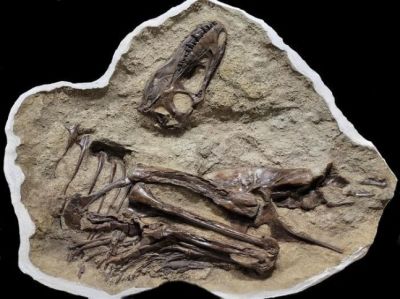 Fossil of a juvenile Gorgosaurus with stomach contents preserved inside
 [Image source: Darla Zelenitsky, University of Calgary (specimen courtesy of Royal Tyrrell Museum)]
This dinosaur, which lived about 75.3 million years ago, was a juvenile aged 5 to 7 years at the time of death, with an estimated body weight of about 335 kg, approximately 13% that of an adult. Its skeleton, including joints and ribs, remained intact, and the bones of animals believed to have been eaten were well preserved in its stomach.
Analysis revealed that the bones in the stomach belonged to two small herbivorous dinosaurs with beaks, Citipes elegans. Dr. Therrien stated, "As far as we know, this specimen is the first case where stomach contents of a tyrannosaur have been found."
Until now, it was known that fully grown Tyrannosaurus preyed on large herbivorous dinosaurs such as ceratopsians and hadrosaurs. However, it was unclear whether juvenile Tyrannosaurus hunted in packs and shared adult prey or hunted prey suitable for their own size independently.
This study supports the hypothesis that juvenile Tyrannosaurus hunted small animals they could take down alone. Dr. Therrien said, "This result is direct fossil evidence showing the diet and feeding behavior of juvenile Tyrannosaurus, indicating that they hunted small animals by themselves."
He added, "Tyrannosaurid dinosaurs seem to have lived as mid-level predators hunting small animals when young, becoming apex predators as adults. Modern large reptiles like crocodiles and Komodo dragons also hunt prey of various sizes throughout their lives in this way," he explained.
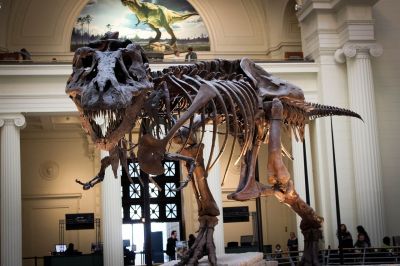
Tyrannosaurus is exceptional among large theropod dinosaurs for having many fossil specimens discovered, including fossils from various age groups, providing scientists with abundant information. In 2021, a research team led by paleontologist Jack Tseng at the University of California, Berkeley, secured a fossil specimen that revealed the jaw strength of adolescent Tyrannosaurus, estimating that "because their jaw strength was weaker than adults, they likely hunted small herbivorous dinosaurs."
Experts believe that such limitations in juvenile Tyrannosaurus were not weaknesses but rather strengths. Different prey hunted by different age groups reduces competition within the species, benefiting all.
Dr. Therrien said, "This dietary shift likely helped juvenile and adult Tyrannosaurus coexist in the same ecosystem by minimizing conflicts."
© The Asia Business Daily(www.asiae.co.kr). All rights reserved.


















