"The Black Death Population Decline → Wage Increase → Industrial Revolution Followed"
"Thinking About How to Pass a Better World to Children"
"South Korea's population decline surpasses the population decrease caused by the Black Death in 14th-century Europe." This analysis by Ross Dowsett, a columnist for the New York Times (NYT), on the 2nd (local time) has heightened concerns about low birth rates.
In his column titled "Is South Korea Disappearing?", Dowsett pointed out that South Korea's population could decline at a faster rate than during the medieval European period when the Black Death caused a sharp population drop in the 14th century. He warned, "There will inevitably be neglect of the elderly generation, vast ghost towns and desolate high-rise buildings, and young generations with no future burdened by elder care will emigrate overseas."
South Korea's total fertility rate has been on a downward trend since it fell below 1.0 in 2018. Earlier, on the 29th of last month, Statistics Korea announced that the total fertility rate for the third quarter was 0.7, down 0.1 from a year earlier.
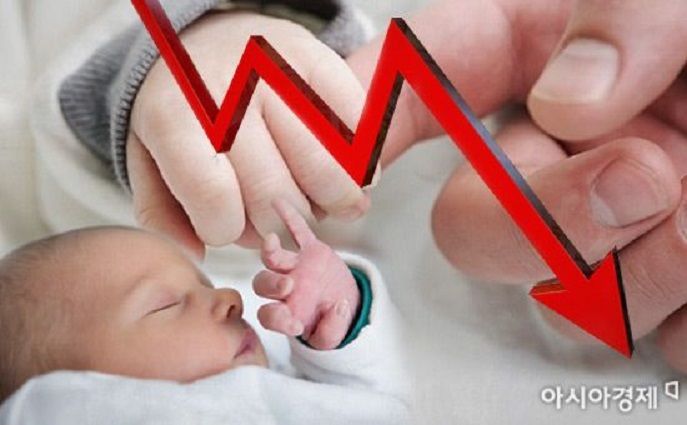
However, according to economic history, there is also a counterargument that environmental improvements can occur when the population decreases. The suggestion is to not view population decline solely as a fear but to focus on its positive aspects and prepare measures for the future.
Jang Young-wook, a senior researcher at the Institute for Foreign Policy, said on the 8th on SBS Radio's "Kim Tae-hyun's Political Show," "There are dark prospects related to population decline, and they have some validity, but that is not the only future. Ultimately, people and humanity will find balance, so a somewhat bright future can also be expected."
Jang added, "Population increase or decrease is determined by external environments, and what we need to worry about is whether we can live joyfully and happily on this land. Population decline is a resultant figure, and we should think about how the people living now can live happily and how to pass on a better world to the children born now."
He then referred to Dowsett's NYT column comparing South Korea's population decline to the Black Death. Jang said, "Although it was a tragedy, many good things happened to those who survived after the Black Death," citing wage increases as an example.
He explained, "Because many peasants died at that time, labor became very scarce, and the surviving peasants saw their wages increase significantly. In Suffolk, England, the payment for harvesting one acre was originally 3 pence, but after the Black Death, it rose to 5 pence. In Oxfordshire, weekly wages were 2 shillings, but after the Black Death, they became 10 shillings."
He added, "As the number of children decreased, more resources could be invested in each child, which also led to the accumulation of human capital."
He also argued that high wages caused by labor shortages were one of the triggers for the Industrial Revolution. Jang said, "One of the decisive backgrounds for the Industrial Revolution in the 18th century was high wages due to labor shortages. The level of science had already developed, but because wages were high, it became profitable to convert that scientific knowledge into technology."
Jang concluded, "Of course, there is a need to worry about population decline, but there is no need to tremble in fear. It depends on us. I believe we can sufficiently change the future."
© The Asia Business Daily(www.asiae.co.kr). All rights reserved.

















