Deputy Finance Ministers and Deputy Governors of Central Banks from major Asian countries including Korea, China, and Japan have agreed to improve the institutional framework of the regional financial safety net (CMIM). They decided to launch a new program that allows for rapid financial support in the event of external shocks such as pandemics like COVID-19, and also agreed to restructure the funding framework of CMIM. Additionally, they plan to lower the penalty interest rates to enhance accessibility to financial support.
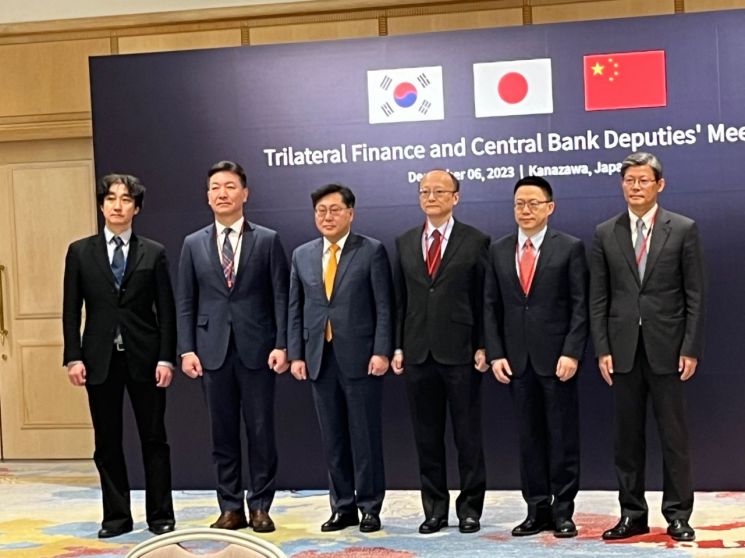 Choi Ji-young, Director General of International Economic Affairs at the Ministry of Strategy and Finance, is attending the Korea-China-Japan Deputy Finance Ministers and Central Bank Deputy Governors Meeting held in Kanazawa, Japan, and is taking a commemorative photo.
According to the Ministry of Economy and Finance on the 8th, from the 6th to the 7th, Choi Ji-young, Director General for International Economic Affairs, chaired the ‘Korea-China-Japan Deputy Finance Ministers and Deputy Governors of Central Banks Meeting’ held in Kanazawa, Japan, and attended the ‘ASEAN+3 (Korea, China, Japan) Deputy Finance Ministers and Deputy Governors of Central Banks Meeting.’
At the meeting, it was decided to improve the institutional framework for the effective operation of the regional financial safety net, CMIM (ASEAN+3 regional multilateral currency swap). They reached a principle agreement to launch a new Rapid Financing Facility (RFF) program that provides swift financial support in times of crisis caused by external shocks, which is expected to receive final approval at the ministerial meeting next year. The RFF is a program designed to respond to balance of payments crises caused by external shocks such as pandemics and natural disasters, providing small-scale funds quickly without pre- or post-conditions.
They also agreed to review restructuring the funding framework of CMIM to enhance the certainty of financial support. This includes considering a shift to a ‘capital contribution method,’ where member countries contribute capital to form a fund that raises money during normal times and provides support during crises. Alongside this, they agreed to lower the penalty interest rates to improve accessibility to CMIM’s financial support.
Director General Choi Ji-young emphasized the importance of the regional financial safety net playing a substantive role, stating, “As Korea will serve as a co-chair country in 2024, we will actively lead discussions on restructuring the funding framework.” She also mentioned, “We will complete follow-up measures on agreed matters such as the rapid financing program and lowering penalty interest rates, and make active efforts to prepare for the ASEAN+3 ministerial meeting to be held in Georgia in May next year.”
Regarding economic trends, the regional macroeconomic research organization (AMRO) forecasted stable growth driven by robust domestic markets, recovery in tourism, and exports among member countries. ASEAN+3 countries are expected to grow by 4.5% next year, with Korea projected to grow by 2.4%. However, they identified ongoing risks such as persistently high inflation levels and continued geopolitical tensions, emphasizing the need for continuous monitoring.
Additionally, AMRO approved the establishment of an additional senior position after discussions over the past year. The main point is to transfer financial and fiscal surveillance functions from the chief economist’s monitoring role to the new deputy director position. Director General Choi said, “This will strengthen AMRO’s surveillance functions over finance and fiscal matters, which have become increasingly necessary for stable management post-COVID, thereby contributing to regional economic stability.”
© The Asia Business Daily(www.asiae.co.kr). All rights reserved.
![Clutching a Stolen Dior Bag, Saying "I Hate Being Poor but Real"... The Grotesque Con of a "Human Knockoff" [Slate]](https://cwcontent.asiae.co.kr/asiaresize/183/2026021902243444107_1771435474.jpg)











