Last Regular Session of the 21st National Assembly: Delayed Passage of the 'Gichokbeop' and Others
Yellow Envelope Act and Broadcasting 3 Acts on Track for Repeal
KRW 657 Trillion 2024 Budget Bill Scheduled for Passage on the 20th
To prevent financial accidents such as incomplete fund sales and large-scale embezzlement that have occurred repeatedly in recent years, a bill to strengthen internal controls of financial companies will be passed at the National Assembly plenary session on the 8th. The Legislation and Judiciary Committee of the National Assembly, which had been repeatedly disrupted due to partisan conflicts, resumed normal operation after about two months, and at the plenary session of the 21st and final regular National Assembly held that day, a large number of pending livelihood economy bills are expected to be passed. However, the budget bill for next year is unlikely to pass the regular National Assembly again this year as no agreement has been reached between the ruling and opposition parties. The Yellow Envelope Act and the Broadcasting Three Acts, which President Yoon Seok-yeol requested a veto on, face strong opposition from the People Power Party, making their rejection likely on that day.
The National Assembly will hold a plenary session in the afternoon to process 162 bills, including the “Amendment to the Act on the Governance of Financial Companies,” which strengthens the internal control monitoring role of the board of directors of financial companies such as securities firms and banks.
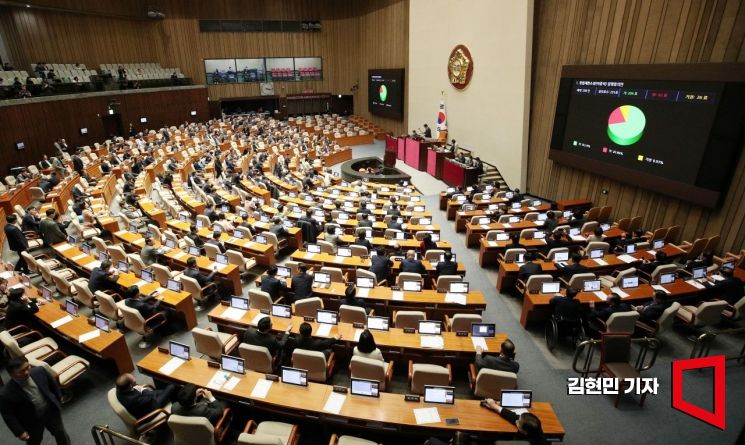 On the 30th, the National Assembly plenary session approved the appointment consent bill for Lee Jong-seok as Chief Justice of the Constitutional Court with 204 votes in favor, 61 against, and 26 abstentions out of a total of 291 votes. Photo by Kim Hyun-min kimhyun81@
In particular, the amendment to the Financial Company Governance Act includes the establishment of an “Internal Control Committee” within the board of directors of financial companies to strengthen internal control functions. According to the Financial Supervisory Service, there were 14 financial accidents in securities firms this year, with losses amounting to 66.8 billion KRW. Compared to an average of 7.8 cases and 14.3 billion KRW from 2019 to 2022, this represents a record surge. The amendment introduces ▲strengthening the board’s internal control monitoring role ▲imposing internal control management duties on executives and CEOs ▲establishing grounds for sanctions and mitigation measures in case of violations of internal control management duties.
At the plenary session, an amendment to extend the effectiveness of the Corporate Restructuring Promotion Act, which supports the “workout (restructuring)” of insolvent companies, for three years is also expected to pass. The Act is a temporary law designed to detect early signs of corporate insolvency before bankruptcy and support rapid normalization through voluntary negotiations among creditors. It lost its effect after its sunset clause expired on October 15. The amendment extends the Act’s effectiveness for three years until 2026.
Besides laws strengthening corporate regulations, bills aimed at actively fostering new industries will also be submitted to the plenary session. The “Special Act on Promoting the Transition and Ecosystem Development of the Future Automobile Parts Industry (Future Car Special Act)” includes support for future automobile technology development and business transformation to secure corporate competitiveness. It contains provisions such as ▲establishing a basic plan every five years to revitalize the future automobile parts industry ecosystem ▲training specialized technical personnel ▲providing legal grounds for designating specialized complexes for the future automobile parts industry.
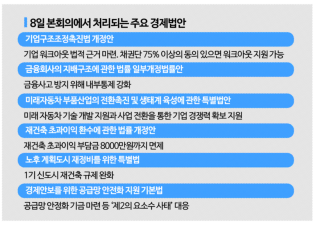
Relaxation bills related to reconstruction are also close to passing the National Assembly. A representative bill is the “Amendment to the Act on the Recovery of Excessive Reconstruction Profits,” which exempts reconstruction excess profit charges up to 80 million KRW. The amendment raises the average profit amount per member exempt from reconstruction charges from the existing 30 million KRW to 80 million KRW and adjusts the charge brackets from 20 million KRW to 50 million KRW. It also introduces provisions to reduce charges by 70% for long-term owners of a single house for over 20 years and by 50% for those owning for over 10 years. The “Special Act on the Reorganization of Aging Planned Cities,” which includes raising floor area ratios for apartments including those in first-generation new towns and exempting safety inspections to ease reconstruction regulations, is also expected to be processed at the plenary session.
The “Basic Act on Supporting Supply Chain Security for Economic Security (Supply Chain Basic Act),” a livelihood economy bill aimed at effectively responding to a “second urea solution crisis,” is also expected to pass the National Assembly that day. Following the urea solution shortage crisis in 2021, voices called for a system to ensure smooth supply chain operation. The bill includes provisions to establish a supply chain stabilization fund and a “Supply Chain Stabilization Committee” to deliberate and coordinate related matters.
The “Special Act on Repayment of Student Loans after Employment,” which reduces the interest burden on young people repaying student loans after employment, is also considered a representative livelihood bill to be processed that day. The core is to expand the exemption from student loan interest repayment to university students with household income below 100% of the median income.
The “Amendment to the Labor Union Act (Yellow Envelope Act)” and the “Broadcasting Three Acts,” led by the Democratic Party, are unlikely to pass that day. The Democratic Party intends to put the two bills, which President Yoon vetoed, to a re-vote for passage. However, for bills vetoed by the president, re-passage requires a majority of the total members present and two-thirds approval of those present, but the People Power Party (111 seats) opposes them, so the bills are expected to be discarded. Yoon Jae-ok, floor leader of the People Power Party, said at the party’s morning strategy meeting, “As we have stated, the People Power Party will firmly reject the two bills and end the long-standing exhausting debate.”
The 657 trillion KRW budget bill for next year is also unlikely to pass that day. Differences remain unresolved between the ruling and opposition parties regarding R&D (research and development) budgets, government special activity expenses, and local currency. The parties have agreed to hold a special session starting on the 11th and are negotiating with the goal of passing the budget bill at the plenary session on the 20th of this month.
© The Asia Business Daily(www.asiae.co.kr). All rights reserved.


















