Current Account Surplus of $6.8 Billion... Largest in 2 Years
Exports Increase for the First Time in 1 Year and 2 Months
Bank of Korea Forecasts $30 Billion Current Account Surplus
Uncertainties Remain Due to Winter Crude Oil Imports
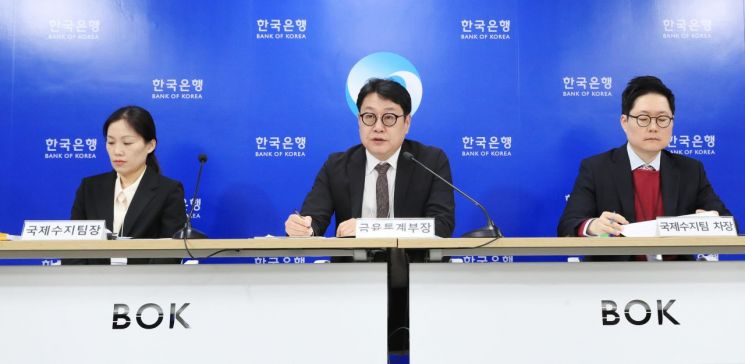 On the morning of the 8th, a briefing on the provisional balance of payments for October is being held at the Bank of Korea in Jung-gu, Seoul. From the left in the photo are Moon Hye-jung, Head of the Balance of Payments Team; Lee Dong-won, Director of the Financial Statistics Department; and Park Sung-gon, Deputy Head of the Balance of Payments Team. (Photo by Bank of Korea)
In October, the current account recorded a surplus of $6.8 billion, continuing a surplus trend for six consecutive months. The surplus also expanded to its largest scale in two years. This was due to the recovery of the semiconductor market, which led to exports turning to an increase compared to the same period last year for the first time in 14 months.
Accordingly, the economy moved away from a 'recession-type surplus,' where imports decrease more than exports, resulting in a surplus. The Bank of Korea (BOK) forecasted that the annual surplus of $30 billion is likely to be fully achieved, given the expected continued improvement in exports.
Current Account Surplus for Six Consecutive Months... Largest in Two Years
According to the preliminary balance of payments statistics released by the Bank of Korea on the 8th, the current account surplus in October this year was $6.8 billion. The current account has shown a surplus for six consecutive months, following May (+$1.93 billion), June (+$5.87 billion), July (+$3.74 billion), August (+$4.98 billion), and September (+$5.42 billion).
The surplus in the current account has expanded for three consecutive months since July, reaching its largest scale in two years since October 2021 ($7.9 billion). However, the cumulative current account surplus from January to October was $23.37 billion, about $4.01 billion less than the same period last year ($27.38 billion).
Looking at the October current account, the goods balance recorded a surplus of $5.35 billion, marking seven consecutive months of surplus. The surplus amount slightly decreased compared to the previous month ($7.42 billion).
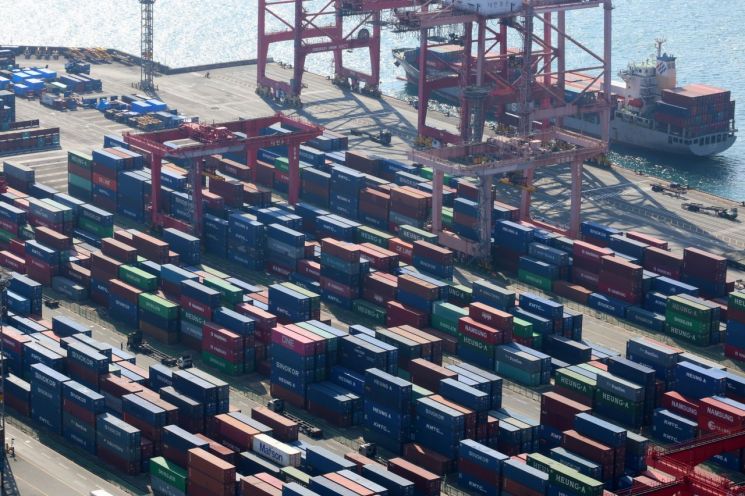
Exports Increase for the First Time in 14 Months... Semiconductor Recovery Accelerates
The most notable feature is that exports reached $57 billion, increasing by 7.6% compared to the same month last year for the first time in 14 months since August last year. The recovery of the semiconductor market and steady increases in exports of passenger cars and petroleum products had a significant impact. In October customs clearance exports, passenger cars increased by 21%, and petroleum products by 17.7% compared to the same month last year. By region, exports to China and the European Union (EU) decreased by 9.6% and 10.7%, respectively, while exports to the United States increased by 17.3%, Southeast Asia by 12.7%, and Japan by 10.3%.
On the other hand, imports amounted to $51.65 billion, down 4.3% compared to the same month last year. Due to the decline in energy import prices, raw materials decreased by 13.4% compared to the same month last year, while capital goods (-6.3%) and consumer goods (-4.1%) also declined. Previously, exports decreased compared to the same period last year, but imports decreased even more, showing a 'recession-type surplus.' However, in October, exports increased while imports decreased.
Lee Dong-won, head of the Financial Statistics Department at the Bank of Korea, said, "I previously mentioned that if exports turn positive compared to the same period last year, the debate over 'recession-type surplus' would become meaningless." He added, "The deficit has been overcome mainly by semiconductors, and since annual exports are expected to increase by around 9% next year, such debates are unlikely to arise for the time being."
The services balance recorded a deficit of $1.25 billion in October, centered on travel and processing services. The deficit narrowed compared to the previous month (-$3.19 billion). The reduction in the travel deficit to $640 million from the previous month's (-$970 million) was due to an increase in travelers visiting Korea from Southeast Asia and Japan. Additionally, the intellectual property rights balance recorded a deficit of $340 million, with the deficit narrowing.
The primary income balance showed a surplus of $2.77 billion, mainly from dividends on direct and securities investments. Among the primary income balance, the dividend income balance increased from $1.11 billion to $1.87 billion in one month due to increased dividend income from overseas subsidiaries of domestic companies. The secondary income balance recorded a deficit of $70 million.
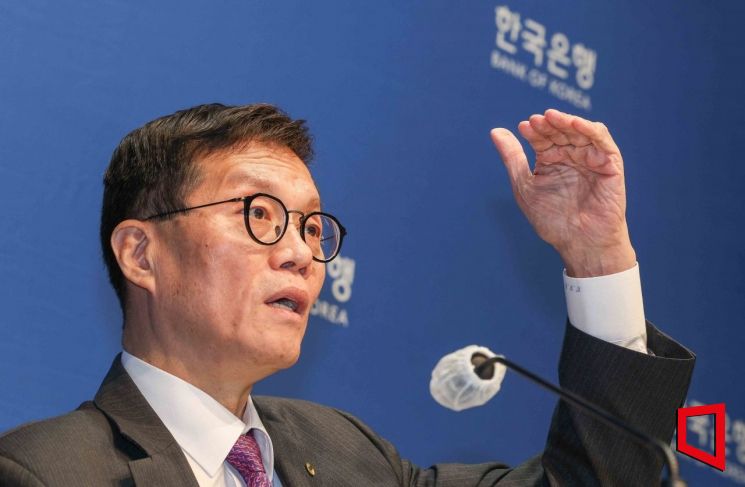 Lee Chang-yong, Governor of the Bank of Korea, is holding a press conference after the Monetary Policy Committee meeting on monetary policy direction held at the Bank of Korea in Jung-gu, Seoul, on the 30th of last month. (Photo by Joint Press Corps)
Annual $30 Billion Surplus Expected... BOK Declares 'End of Recession-Type Surplus'
As exports show signs of recovery, the Bank of Korea expects the annual current account surplus to reach $30 billion. Previously, on the 30th of last month, the BOK revised its forecast for the current account surplus upward from the August estimate of $27 billion to $30 billion.
Lee said, "Since the cumulative surplus from January to October is $23.37 billion, arithmetically, if a surplus of $6.63 billion is recorded over the next two months, it will meet the annual forecast." He added, "Currently, due to the improvement in the goods balance, this is expected to be achieved."
The Bank of Korea also expects exports to continue increasing compared to the same period last year after November. According to the BOK, November customs clearance export performance showed semiconductor exports turning to a 10.8% increase, and exports to China recovering close to last year's level, expanding the growth rate from 5.1% in October to 7.8% in November. This is because automobile exports continue to perform well, and items such as semiconductors have also improved.
Concerns Over Winter Crude Oil Imports... Economic Sentiment Still Weak
However, uncertainties surrounding the current account remain significant. As winter approaches, crude oil and other energy import volumes are a major concern. Although international oil prices have fallen to $70-80 per barrel due to recent economic slowdown concerns, an increase in import volumes could negatively affect the goods balance. Additionally, an increase in overseas travel during the winter vacation period could widen the deficit in the travel and services balance, and the size of quarterly dividend payments in November is also a key variable for the primary income balance.
Professor Heo Jun-young of the Department of Economics at Sogang University said, "The semiconductor market definitely seems to be improving," but added, "The question is whether the semiconductor recovery can be felt as an economic upturn, and there may be some time lag." He explained, "Since semiconductors are rebounding alone, it is a bit early to say the economy is recovering. It may take more time for people to feel the economy has improved, and the impact may be limited."
Meanwhile, the financial account net assets (assets minus liabilities) increased by $8.37 billion in October. In direct investment, domestic investors' overseas investments increased by $1.69 billion, while foreign investors' domestic investments decreased by $310 million due to global companies acquiring domestic firms, resulting in a net decrease. In securities investment, domestic investors' overseas investments increased by $2.83 billion, while foreign investors' domestic investments decreased by $1.58 billion due to a contraction in global investment sentiment, resulting in a net increase of $4.4 billion.
© The Asia Business Daily(www.asiae.co.kr). All rights reserved.
![Clutching a Stolen Dior Bag, Saying "I Hate Being Poor but Real"... The Grotesque Con of a "Human Knockoff" [Slate]](https://cwcontent.asiae.co.kr/asiaresize/183/2026021902243444107_1771435474.jpg)


















