Japan's Total Fertility Rate 1.26 Last Year
Natural Decrease of About 800,000 in 2023
Significant Expansion of Support for Multi-Child Families
The Japanese government, which is making various efforts to overcome the low birthrate crisis, has announced plans to provide free university education for families with multiple children.
According to the Asahi Shimbun on the 7th, the Japanese government has decided that from 2025, households with three or more children will be exempt from tuition fees for all children attending four-year universities, junior colleges, and technical colleges, regardless of income. They are also coordinating to waive entrance fees in addition to tuition. Until now, Japan has only exempted university tuition fees for multi-child families with an annual income below 3.8 million yen (approximately 34 million KRW).
However, starting next year, the eligibility will be expanded to include households with an income ceiling of 6 million yen (approximately 53.5 million KRW), and from 2025, the income ceiling will be abolished entirely, providing free university education benefits to all multi-child families.
The Japanese government also plans to increase the "child-rearing allowance" paid to low-income households. Previously, the allowance was up to 44,140 yen (approximately 395,000 KRW) per month for the first child, and up to 10,420 yen (approximately 93,000 KRW) per month for the second child. For the third child and beyond, the maximum monthly payment was 6,250 yen (approximately 56,000 KRW), but from as early as January 2025, this will be raised to the same maximum of 10,420 yen as the second child.
Additionally, the income ceiling for households eligible to receive the child-rearing allowance will be raised from an annual income of 3.65 million yen (approximately 32.6 million KRW) to 3.85 million yen (approximately 34.3 million KRW).
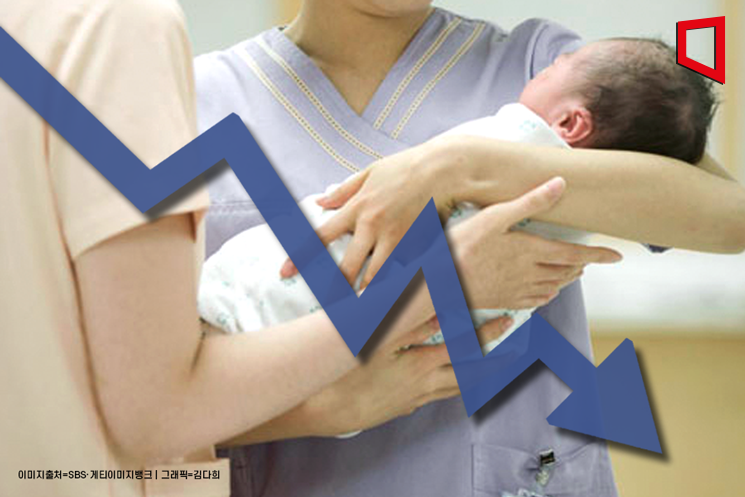
Meanwhile, the Japanese government announced that, based on last year's data, the number of Japanese births was 770,747, and the number of deaths was 1,568,961. This resulted in a population decrease of 798,214, which is equivalent to half the population of Fukuoka City, the largest city in Kyushu, and is similar in size to Hamamatsu City in Shizuoka Prefecture or Bucheon City in South Korea.
The total fertility rate (the expected number of children a woman will have in her lifetime) was 1.26, falling below the record low of 2005. This is higher than South Korea's total fertility rate of 0.78.
Regarding this phenomenon, the Yomiuri Shimbun reported in June, "The Japanese government expects the birthrate to gradually rise after next year, but the tendency to avoid having children due to concerns about childcare burdens is rapidly spreading," and added, "Support measures are needed to stabilize employment and increase income for young people."
© The Asia Business Daily(www.asiae.co.kr). All rights reserved.

















