South Korea and India will exempt the submission of paper certificates of origin to support export-import companies in both countries.
On the 7th, the Korea Customs Service announced that Commissioner Ko Gwang-hyo of the Korea Customs Service recently met with Sanjay Kumar Agarwal, Chairman of the Central Board of Indirect Taxes and Customs of India, for a high-level bilateral meeting.
The bilateral meeting was organized to promote paperless trade and support export-import companies in both South Korea and India.
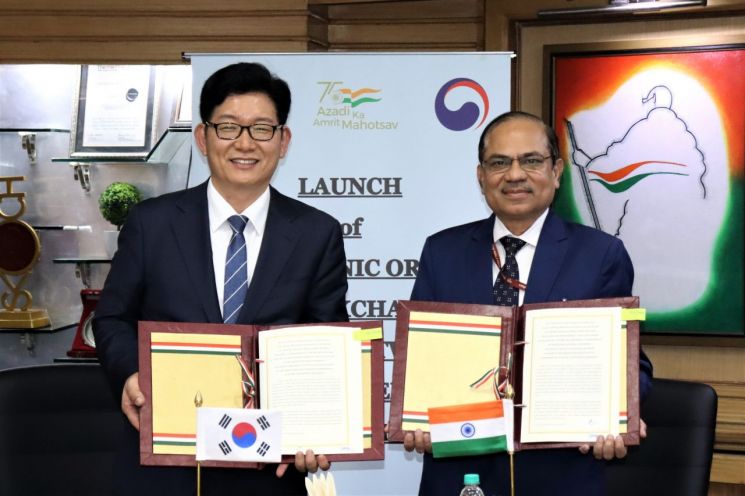 Koh Kwang-hyo, Commissioner of the Korea Customs Service (left), is taking a commemorative photo after a bilateral meeting with Agrawal, Chairman of the Central Board of Indirect Taxes and Customs of India, in New Delhi, India, on the 6th. Photo by Korea Customs Service
At the meeting, the customs authorities of both countries held an opening ceremony for the "Korea-India Certificate of Origin Electronic Data Exchange System (EODES)" and decided to officially operate it from the 22nd of this month. This system enables real-time online (electronic) exchange of FTA certificate of origin information between customs authorities.
With the electronic exchange system sharing origin information in real time between the two countries, domestic export companies will no longer need to submit paper certificates of origin to receive CEPA preferential tariffs in India.
Through this, companies can benefit from simplified CEPA utilization procedures, faster customs clearance (cargo waiting time reduced from 4-6 days to real-time), reduced logistics costs, and prevention of customs clearance difficulties caused by verifying the authenticity of paper certificates of origin.
Especially considering that India has been the country with the most customs clearance difficulties (accounting for 42% of all cases last year), the significance of launching the electronic exchange system is doubled.
According to the Korea Customs Service, most (92%) of the representative customs clearance difficulties occurring in India are related to CEPA utilization, such as non-recognition of certificates of origin, so omitting the submission of paper certificates of origin is expected to provide practical benefits to domestic export-import companies.
The customs authorities of both countries also agreed at the bilateral meeting to hold the "4th Korea-India Customs Commissioners Meeting" as soon as possible to discuss cooperation for facilitating trade between the two countries and blocking the import of high-risk goods at border checkpoints.
Commissioner Ko Gwang-hyo of the Korea Customs Service said, "Taking this high-level Korea-India bilateral meeting as an opportunity, we will create a favorable environment for trade between the two countries and strengthen cooperation with Indian customs authorities to resolve customs clearance difficulties."
He added, "Next year, we will hold meetings with customs commissioners of major trading countries to support domestic export companies and strengthen strategic customs diplomacy to block the import of harmful goods such as drugs, thereby increasing Korea's role as a global hub country."
© The Asia Business Daily(www.asiae.co.kr). All rights reserved.
![Clutching a Stolen Dior Bag, Saying "I Hate Being Poor but Real"... The Grotesque Con of a "Human Knockoff" [Slate]](https://cwcontent.asiae.co.kr/asiaresize/183/2026021902243444107_1771435474.jpg)
















