During his tenure as a Supreme Court Justice, Cho Hee-dae, the nominee for Chief Justice of the Supreme Court, has consistently taken the stance that "strict punishment rather than leniency" should be applied to the illegal acts of corporate heads in various corporate cases at the appellate level. This conviction has also been revealed during the personnel screening process, drawing attention from the business community.
In the business sector, there is a growing perception that if Cho is appointed as Chief Justice, his conviction could become the overall tone of our judiciary, and that more attention should be paid to managing the 'judicial risks' of corporate heads in the future.
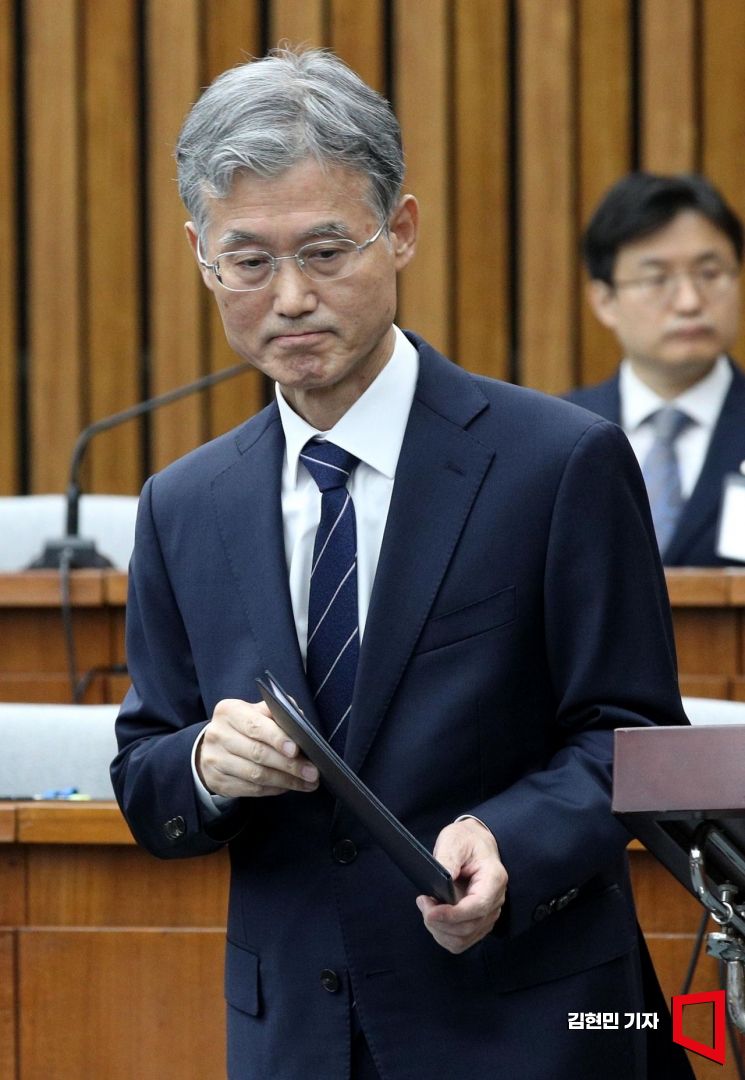 Cho Hee-dae, nominee for Chief Justice of the Supreme Court, is delivering the oath statement to Chairman Joo Ho-young at the confirmation hearing held at the National Assembly on the 5th. Photo by Hyunmin Kim kimhyun81@
According to the legal community on the 7th, the National Assembly is expected to hold a vote on the appointment consent bill for Cho as early as the final plenary session of the regular session on the 8th. With the Chief Justice position vacant for over 70 days and a thorough verification of Cho's qualifications during the confirmation hearing, it is widely anticipated in political and legal circles that the appointment consent bill will pass. Meanwhile, the business community is focusing on Cho's positions on corporate-related issues revealed during the confirmation hearing and is making efforts to interpret their implications.
In particular, Cho's response to criticisms that the judiciary has been issuing lenient punishments to corporate heads or granting special pardons without reasonable grounds has attracted attention. In a written response submitted to the Special Committee on Confirmation Hearings, Cho stated, "While it is not acceptable to impose aggravated punishment without reasonable grounds solely because one is a businessperson, I believe the public's criticism that the personal faults of managers and the evaluation of the company should be separated is valid." This can be interpreted as viewing corporations and their heads separately and asserting that appropriate punishment should be imposed for the faults of the heads. He added, "I understand that objective and strict sentencing guidelines have been established and are being implemented," and "It does not appear that the judiciary grants reductions in sentences to conglomerate heads solely to provide special favors considering their contributions to the national economy. Rather, there are many cases where actual imprisonment sentences have been handed down to conglomerate heads." Regarding special pardons, he refrained from commenting, citing that it is the president's exclusive authority and that it is inappropriate to express specific opinions.
The business community reportedly welcomes Cho's positive consideration of introducing the 'pre-examination system for search warrants' and the 'conditional arrest warrant system' upon his inauguration. These systems are exactly what the business sector has needed. The pre-examination system allows a judge to directly question persons involved in a case during the review of a search warrant. It has been considered to curb arbitrary searches by investigative agencies and to protect the rights of those subject to searches. The conditional arrest warrant system allows for the release of suspects under certain conditions, such as residence restrictions, even if an arrest warrant is issued. Until now, companies have suffered significant disruptions to their management activities when their headquarters were subjected to large-scale searches by prosecutors or when corporate heads were arrested on charges such as embezzlement or breach of trust. Without legal remedies to overcome these crises, they faced difficulties. The introduction of these two systems is expected by the business community to allow them to prepare in advance for variables such as searches and arrests of corporate heads and to guarantee at least minimal management activities.
Additionally, Cho stated regarding technology theft cases that "advanced technology is a critical matter directly linked to the nation's industrial competitiveness and national security, requiring strict responses." He emphasized, "Not only strengthening punishment but also enhancing detection capabilities to strictly punish leakage acts is very necessary," and pointed out the need for legislative and policy considerations such as strengthening judges' expertise in this regard. Regarding punitive damages and class action systems, which small and medium-sized enterprises find difficult to bear, he said, "It is worth continuously considering ways to appropriately regulate these within a limited scope where necessary."
Cho also attracted attention by candidly answering many questions about his past views expressed in corporate trials. Regarding his dissenting opinion in the 2019 appellate trial of the state corruption scandal, where he argued that the three horses supported by Samsung Electronics Vice Chairman Lee Jae-yong for Choi Seo-won's (formerly Choi Soon-sil) daughter Jung Yoo-ra could not be considered bribes, he explained, "Legally, I pointed out that the benefit of using the horses should be regarded as a third-party bribery charge rather than bribery, based on legal principles." He added, "I believe it was a reasonable and common-sense interpretation grounded in legal theory and the criminal law system." Regarding the 2007 case as a presiding judge at the Seoul High Court involving the low-price issuance of convertible bonds by Everland, where he sentenced former Everland presidents Heo Tae-hak and Park No-bin to three years in prison with five years probation?heavier than the first trial?he said, "I consider it a ruling that warned against the immoral gift practice using the expedient of low-price issuance of convertible bonds," and "It was a conclusion reached after much deliberation to set an appropriate sentence commensurate with responsibility, and I do not think the sentence was unduly light."
© The Asia Business Daily(www.asiae.co.kr). All rights reserved.
![Clutching a Stolen Dior Bag, Saying "I Hate Being Poor but Real"... The Grotesque Con of a "Human Knockoff" [Slate]](https://cwcontent.asiae.co.kr/asiaresize/183/2026021902243444107_1771435474.jpg)
















