Most Advanced Countries Plunge, Improvement in Korea, Japan, Taiwan, etc.
"Differences in COVID-19 Response Capabilities Created the Gap"
"Shorter Disruption Period and High Quality of Remote Classes"
In the 2022 Programme for International Student Assessment (PISA) survey, while the academic achievement of major OECD advanced countries fell unprecedentedly due to the impact of COVID-19, some countries including Korea showed an increase in achievement, drawing attention to the secret behind this.
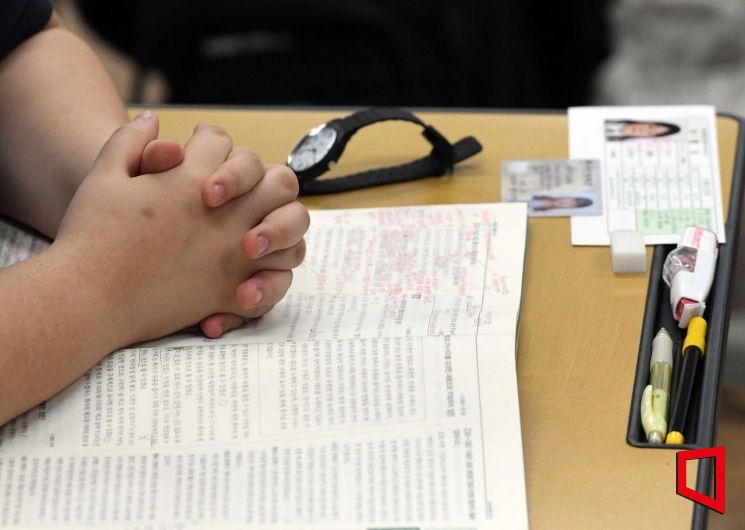 On the morning of the 16th, the day of the 2024 College Scholastic Ability Test, examinees are waiting for the exam to start at Yeouido Girls' High School in Yeongdeungpo-gu, Seoul. Photo by Joint Press Corps
On the 5th (local time), British weekly magazine The Economist and others reported that in the OECD's PISA 2022 survey, "the academic achievement of students in 37 member countries dropped sharply compared to the previous survey in 2018," but "a very small number of countries including Korea, Japan, Singapore, and Taiwan improved their scores, widening the gap with other countries."
According to the PISA 2022 survey results, the average scores of 15-year-old students in 37 OECD member countries fell by 16 points in mathematics, 11 points in reading, and 2 points in science compared to the previous survey in 2018.
Foreign media explained, "Generally, a drop of 20 points is considered equivalent to falling behind by one grade level compared to before," meaning "mathematics achievement fell by about three-quarters of a grade, and reading by half a grade compared to before."
Major Countries' Scores Plummet... "Catastrophic Consequences... Could Lead to Income Decline" Warning
 On the 16th, the day of the 2024 College Scholastic Ability Test, a test-taker is running into the examination site set up at Ewha Girls' Foreign Language High School in Jung-gu, Seoul. Photo by Jo Yongjun jun21@
The Economist described "such a level of (score) decline as catastrophic," expressing concern that lower academic achievement could lead to reduced income for students, and the UK's Financial Times also evaluated it as an "unprecedented global decline."
However, despite the downward trend in academic achievement, Korea's scores rose by 1 point each in mathematics and reading, and by 9 points in science. Taiwan, Japan, and Singapore also saw increases in mathematics and other subjects. Mathematics, in particular, was a subject where scores dropped significantly in many countries, with France, Finland, Germany, Poland, and Norway experiencing declines of more than 20 points, showing a stark contrast.
The Economist noted, "Education authorities worldwide will envy these few countries," attributing the difference to varying responses to the COVID-19 pandemic. It analyzed that countries with generally good scores such as Taiwan and Korea had relatively short periods of class disruption due to school closures during the pandemic.
It also viewed differences in the quality of remote learning as a factor creating gaps in academic achievement. The Economist explained, "In Korea, strict social distancing was maintained for a long time," but "in the first year of the pandemic in 2020, the government supported students extensively by hiring 30,000 temporary teachers."
Analysis Suggests Downward Trend in Academic Achievement Independent of Pandemic... SNS and Digital Device Addiction as Variables
 On the morning of the 6th, the last mock exam before the 2024 College Scholastic Ability Test (November 16) was held, and students were warming up before the test at Yeouido High School in Seoul. Photo by Joint Press Corps
However, there is also analysis that COVID-19 is not the sole cause of the decline in academic achievement. It is pointed out that academic achievement had been declining or stagnating even before the COVID-19 pandemic. Social media (SNS) usage is also cited as a problem in this regard.
In fact, one in four OECD students responded last year that their concentration was distracted during most of their math classes due to other students using digital devices, and after analyzing these respondents excluding the influence of socioeconomic background, the Financial Times reported that their math achievement lagged by an average of three-quarters of a grade.
Meanwhile, the international academic achievement assessment (PISA) is an evaluation conducted every three years by the Organisation for Economic Co-operation and Development (OECD) to internationally compare the achievement and trends in mathematics, reading, and science literacy of 15-year-old students. Originally scheduled for 2021, it was postponed by one year due to the impact of COVID-19. The latest assessment announced on the 5th (local time) involved about 690,000 participants from 81 countries worldwide (37 member countries and 44 non-member countries), with Korea participating with 6,931 students from 186 schools.
© The Asia Business Daily(www.asiae.co.kr). All rights reserved.



















