Accelerating Hydrogen Industry Expansion Centered on Fuel Cell Cluster, Proactive Response to Distributed Energy Act
Mayor Lee Gang-deok: "Focusing on New Growth Industries Next Year, Securing Global Super-gap Competitiveness"
Pohang City, which has achieved tangible results in fostering new industries such as the designation of a secondary battery specialized complex and the preliminary feasibility study approval for the hydrogen fuel cell cluster this year, will further advance new growth industries next year to secure global competitiveness.
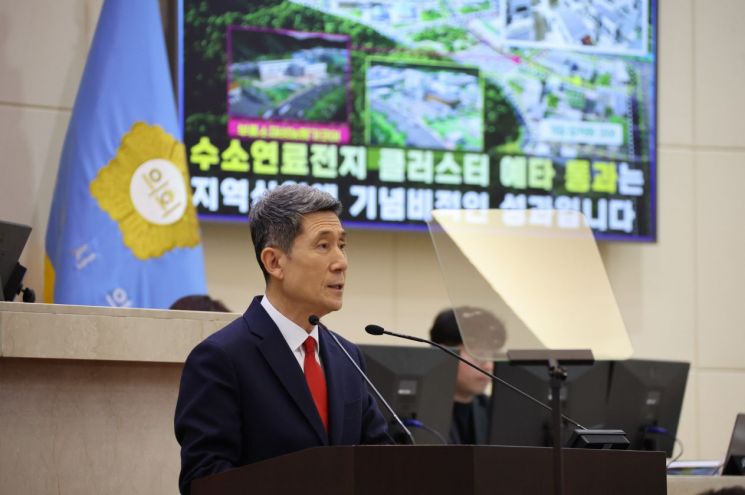 Mayor Lee Kang-deok of Pohang delivering the city administration speech at the 311th regular session of the Pohang City Council on the 30th of last month.
On the 30th of last month, Mayor Lee Kang-deok of Pohang City revealed the direction of city administration in his policy speech at the 311th regular session of the city council, stating that Pohang will focus more intensively on promoting new growth industries next year and strive to secure a global super-gap.
The city plans to use the secondary battery specialized complex designated this year as a catalyst to establish various infrastructures early and flawlessly complete South Korea’s largest mass production system for secondary batteries.
In addition, Pohang will concentrate its capabilities on designating the ‘Battery Global Innovation Zone,’ a follow-up project to the Battery Regulatory Free Zone, to create international standards for used batteries and secure cathode material technology through industry-academia-research-government cooperation, thereby gaining a global competitive edge.
Along with this, the city will devote itself to research, processes, and on-site workforce training tailored to corporate demand, completing South Korea’s largest mass production system for secondary batteries equipped with production, technology, and talent, and grow it into a ‘Secondary Battery Mega Cluster.’
The hydrogen industry will also be concentrated around the fuel cell cluster, expanding various hydrogen infrastructures such as hydrogen vehicles and charging stations, and rapidly completing the image of a hydrogen city through the designation of a specialized complex.
Starting next year, the Fuel Cell Cluster Promotion Team will be fully operational to accelerate securing world-class technology, and the ‘2030 Future Mobility Master Plan’ will be established to prepare for expanding the secondary battery and hydrogen fuel cell industries into complete vehicle industries such as electric vehicles and hydrogen vehicles.
The city will proactively respond to the Distributed Energy Act, scheduled to be enforced from June next year. Along with creating a hydrogen ecosystem, Pohang will actively attract a ‘Distributed Energy Specialized Complex’ to continue efforts toward an eco-friendly energy self-sufficient city that produces and consumes energy near demand sites.
In particular, Pohang City plans to devote itself to establishing the POSTECH research-oriented medical school, the city’s greatest long-cherished project for strengthening national bioindustry competitiveness and radically improving the regional medical system. The city will unite citizens’ capabilities to ensure the establishment of the POSTECH research-oriented medical school and simultaneously accelerate bioindustry development.
Using the Pohang Convergence Technology Industrial Zone as a base, the city will support bio companies to move in starting next year and create a bio cluster to strengthen bio sovereignty and citizens’ health rights.
Furthermore, based on the global data center agreement worth 1.5 trillion won signed this year, Pohang will attract numerous big data-based IT companies and focus on nurturing digital industries preferred by young people through the establishment of a Gyeongbuk-type digital innovation hub.
Additionally, to actively support the commercialization of advanced technology by young talents, the city will establish a ‘Global Industry-Academia Cooperation Center’ and continuously expand the venture startup ecosystem.
Mayor Lee Kang-deok said, “At a time when the crisis of local extinction is intensifying, local cities must have global competitiveness to survive,” adding, “Based on the strength that led South Korea’s industrialization through the steel industry over the past 50 years, we will secure future new industry super-gap competitiveness and stand tall as a hub city leading South Korea’s 4th Industrial Revolution era.”
© The Asia Business Daily(www.asiae.co.kr). All rights reserved.
![Clutching a Stolen Dior Bag, Saying "I Hate Being Poor but Real"... The Grotesque Con of a "Human Knockoff" [Slate]](https://cwcontent.asiae.co.kr/asiaresize/183/2026021902243444107_1771435474.jpg)
















