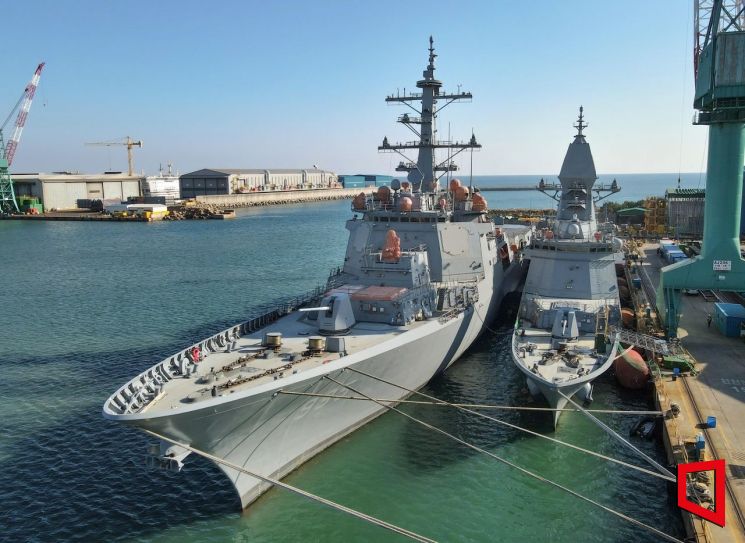
 The Aegis ship "Jeongjo the Great" (left) and the frigate "Chungnam" (right), equipped with the world's first 'graphene-based damping material for naval vessels' developed by HD Hyundai Heavy Industries, HD Korea Shipbuilding & Offshore Engineering, Korea Advanced Institute of Science and Technology (KAIST), and BN Chemical. Photo by HD Hyundai Heavy Industries
HD Hyundai Heavy Industries has applied a damping material made from the so-called "dream material," Graphene, to naval vessels for the first time in the world.
HD Hyundai Heavy Industries, together with HD Korea Shipbuilding & Offshore Engineering, Korea Advanced Institute of Science and Technology (KAIST), and ship coating specialist BN Chemical, announced on the 6th that they have applied the world's first developed "graphene-based damping material for naval vessels" to the state-of-the-art Aegis destroyer "Jeongjo Daewang," the new frigate "Chungnam," and the 3000-ton submarine "Sin Chaeho," confirming excellent vibration and noise reduction effects.
The damping material for naval vessels is similar in form to paint and is applied to the engine lower deck or the hull structure above the propeller to block vibrations transmitted from mechanical equipment, thereby reducing radiated noise.
It is also installed on the surrounding structures of the Sonar Dome to enhance stealth capabilities and enemy ship detection performance.
The damping material for naval vessels developed by HD Hyundai Heavy Industries and others, certified by the Korean Register (KR), is a form where graphene is combined with polyurethane. Graphene is a polymer carbon allotrope in which carbon atoms are connected in a hexagonal honeycomb pattern forming a two-dimensional planar structure, often called the dream material or next-generation material.
In particular, graphene is characterized by excellent conductivity, outstanding strength, and elasticity, and when applied to damping materials, it effectively converts vibration energy into heat energy and dissipates it externally.
The damping material developed using this graphene not only has excellent vibration damping performance but also superior adhesion and fire resistance, and is environmentally friendly as it contains no harmful substances. It has also been certified by relevant institutions that its damping performance does not degrade even after exposure to seawater for more than six months.
Furthermore, this damping material uses graphene produced by a low-cost, mass-production manufacturing method, making it more price competitive than existing products.
A representative of HD Hyundai Heavy Industries stated, "Through continuous research and development, we will further enhance the performance of our naval vessels and contribute to strengthening the Republic of Korea Navy's capabilities."
© The Asia Business Daily(www.asiae.co.kr). All rights reserved.

![User Who Sold Erroneously Deposited Bitcoins to Repay Debt and Fund Entertainment... What Did the Supreme Court Decide in 2021? [Legal Issue Check]](https://cwcontent.asiae.co.kr/asiaresize/183/2026020910431234020_1770601391.png)














