The Seoul Metropolitan Council Passed the Ordinance Aligning with the Intent of the JeonGyoJo Decision
Seoul Metropolitan Office of Education Should Also End the Litigation and Join in Saving Citizens' Taxes
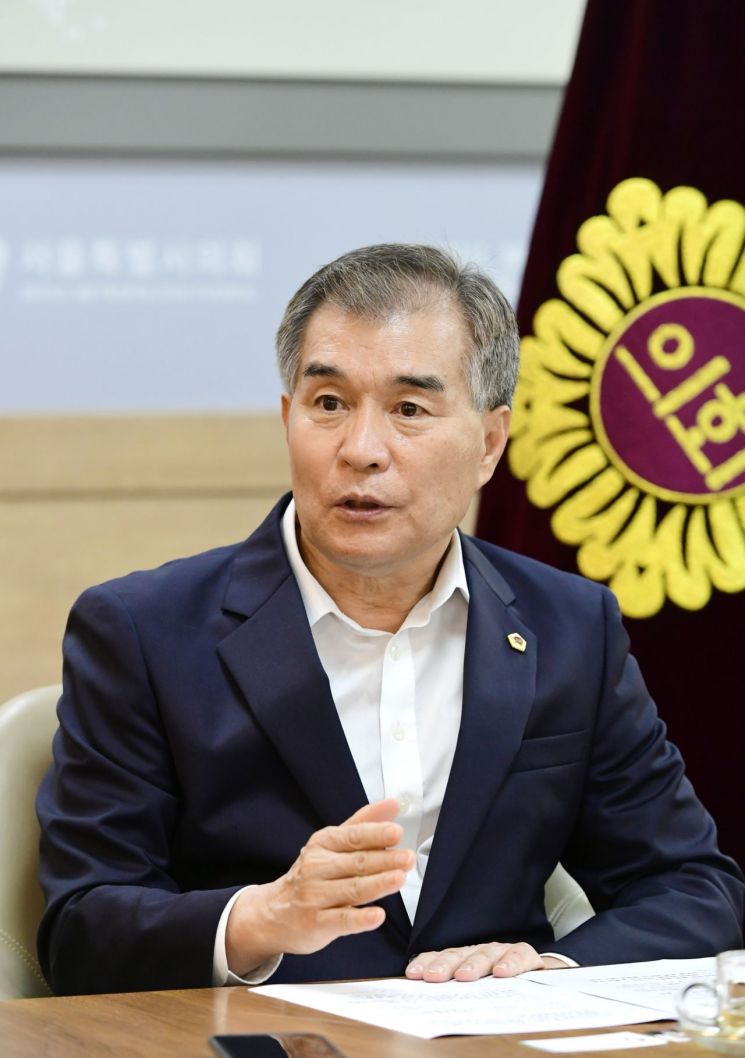
Kim Hyun-ki, Chairperson of the Seoul Metropolitan Council, announced on the 6th that he welcomes the decision of the Seoul branch of the Korean Teachers and Education Workers Union (KTU) to relocate their union office from a building in downtown Seoul to the former Huayang Elementary School building in Huayang-dong, Gwangjin-gu, Seoul, which has been closed.
According to data received from the Seoul Metropolitan Office of Education, the KTU Seoul branch moved their union office from a building in Gyobuk-dong, Jongno-gu, where the lease contract had expired and for which they had paid a deposit of 1.5 billion KRW, to the closed Huayang Elementary School.
As a result, the Seoul Metropolitan Office of Education has reclaimed the 1.5 billion KRW deposit it had been providing to the union.
This decision by the KTU appears to have been influenced by the “Ordinance on Support for Labor Unions by the Seoul Metropolitan Office of Education,” which was proposed by the Seoul Metropolitan Council in May and approved at the plenary session in early July.
The ordinance limits the size of union offices supported by the Superintendent of Education to a maximum of 100 square meters and prioritizes the use of idle public property for union offices.
Chairperson Kim Hyun-ki stated, “It is the responsibility of the Seoul Metropolitan Council to save citizens’ taxes and use public assets effectively,” adding, “Despite the availability of surplus space within the education office due to consecutive school closures, supporting the leasing of external private buildings at a cost of hundreds of millions to billions of KRW is highly inappropriate from the citizens’ perspective, which prompted the council to take action.”
He further explained, “Although the education office requested a reconsideration of the ordinance passed by the council and it was re-approved in September, the Superintendent ultimately refused to promulgate it, leading the Chairperson to promulgate it by his authority.”
Currently, the ordinance is pending in the Supreme Court as the Superintendent has filed a nullification lawsuit. The education office argues that the union’s collective bargaining rights can only be restricted by law, and that limiting them through an ordinance is illegal.
However, union-related laws stipulate that employers provide only minimal support for union offices, and the council’s ordinance does not fundamentally restrict union activities but merely limits the discretionary scope of the Superintendent, who is the employer and party to collective bargaining, in the name of the citizens, thus it is judged not to be illegal.
In line with the Seoul Metropolitan Council’s intention to actively utilize the remaining shared spaces of closed schools and save citizens’ taxes, other unions affiliated with the education office, besides the KTU, are also planning to downsize their offices.
The Seoul Headquarters of the Korean Federation of Teachers’ Associations plans to move from an office with a 600 million KRW deposit to one with a 30 million KRW deposit when their lease expires in April next year, and the Seoul branch of the Korea Teachers’ Union also plans to relocate from an office with a 200 million KRW deposit to one with a 30 million KRW deposit.
The deposits of 600 million KRW and 200 million KRW previously used by these unions will be incorporated into the Seoul Metropolitan Office of Education’s accounts and used for the benefit of our children. Under the Seoul Metropolitan Office of Education, a total of 11 unions have been established, including the teachers’ unions and the National School Irregular Workers’ Union affiliated with the Korean Confederation of Trade Unions. The latter operates an office in Yongsan-gu with 320 million KRW in tax support.
Chairperson Kim Hyun-ki emphasized, “It is the duty of council members and public institution workers to use citizens’ taxes and assets rationally,” and urged, “Besides the KTU, other unions should cooperate by negotiating with the education office to relocate to idle spaces within the education office to save taxes.”
Additionally, Chairperson Kim called on the Seoul Metropolitan Office of Education to stop rejecting the “Union Support Ordinance” and continuing litigation in the Supreme Court, and to cooperate in creating a future-oriented labor-management relationship that meets citizens’ expectations.
© The Asia Business Daily(www.asiae.co.kr). All rights reserved.
![Clutching a Stolen Dior Bag, Saying "I Hate Being Poor but Real"... The Grotesque Con of a "Human Knockoff" [Slate]](https://cwcontent.asiae.co.kr/asiaresize/183/2026021902243444107_1771435474.jpg)
















