Domestic Trend Cycles Every 3-4 Years... Possible Trend This Year
Recently, there has been a spread of Mycoplasma pneumonia primarily among children in China, raising concerns that the outbreak could also spread domestically.
Mycoplasma is a bacterium that mainly infects the lungs or reproductive organs of humans or animals. It primarily occurs in infants and young children, starting as a mild cold with symptoms such as cough, runny nose, fever, and sore throat, but it can potentially progress to severe cases. The duration typically lasts about three weeks.
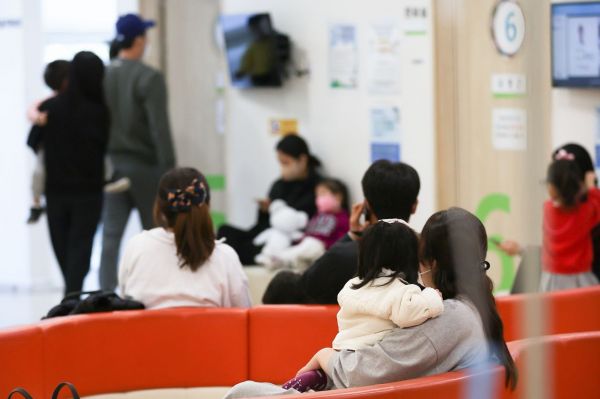 Woori Children’s Hospital, Seongbuk-gu, Seoul. The photo is not related to the specific content of the article. Photo by Yonhap News.
In China, signs of a surge appeared from this summer, and as the full winter season began, cases of cross-infection with respiratory diseases increased rapidly, leading to a swift spread. According to recent reports from local media such as the People's Daily, as respiratory illnesses spread, many classes across China have temporarily closed, and a significant number of students are absent, disrupting normal school activities.
As the outbreak intensified, Chinese authorities initiated emergency responses. According to the Chinese Zhengdan News on the 1st, in provinces such as Sichuan and Guangdong, the "Health Code," which was abolished in December last year, has been reinstated. The Health Code is an electronic pass symbolizing the three years of "Zero COVID," integrating personal COVID-19 prevention information such as the timing and results of polymerase chain reaction (PCR) tests, vaccination status and dates, and movement locations into a smartphone application.
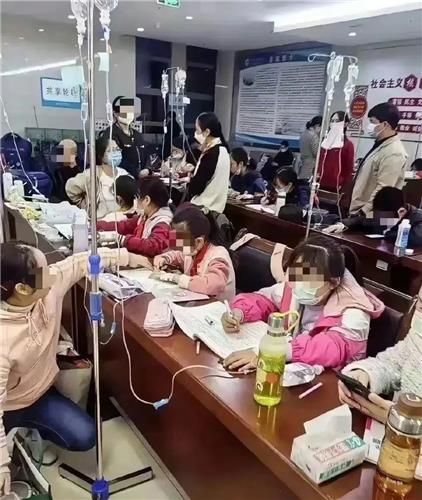 Students studying in the hospital corridor while receiving IV drips. Photo by Yonhap News Agency, Beijing Daily
Mycoplasma pneumonia outbreaks occur domestically every 3 to 4 years. Since the last outbreak was in 2019, there is a high possibility of an outbreak this year.
In this situation, voices calling for proactive measures are emerging. On the 4th, the Korean Pediatric Hospital Association issued a statement saying, "Pediatric infectious diseases tend to spread rapidly if early response is inadequate," and criticized, "Medical staff are walking on thin ice every day, but the Korea Disease Control and Prevention Agency considers it not a new pathogen and believes domestic medical standards can handle treatment, thus only recommending raising individual prevention levels."
Professor Lee Jae-gap of the Department of Infectious Diseases at Hallym University Gangnam Sacred Heart Hospital advised hospital consultation, noting that it is difficult to distinguish Mycoplasma pneumonia from the flu in the early stages. On the 6th, on CBS Radio's 'Kim Hyun-jung's News Show,' Professor Lee said, "There is body pain, fever, then cough, so early symptoms cannot be distinguished at all," and emphasized, "If respiratory symptoms and high fever occur, one should quickly visit a hospital to check whether it is the flu. If it is not the flu and symptoms are severe, an X-ray should be taken to check for accompanying pneumonia."
Adhering to personal prevention measures such as wearing masks is also important. Professor Lee stated, "People with respiratory symptoms or children should refrain from attending school, and if they must go outside, they should definitely wear masks," adding, "For the elderly, high-risk groups, and those caring for high-risk individuals, wearing masks is helpful when multiple respiratory viruses and bacteria are circulating, as is the case now."
© The Asia Business Daily(www.asiae.co.kr). All rights reserved.


















